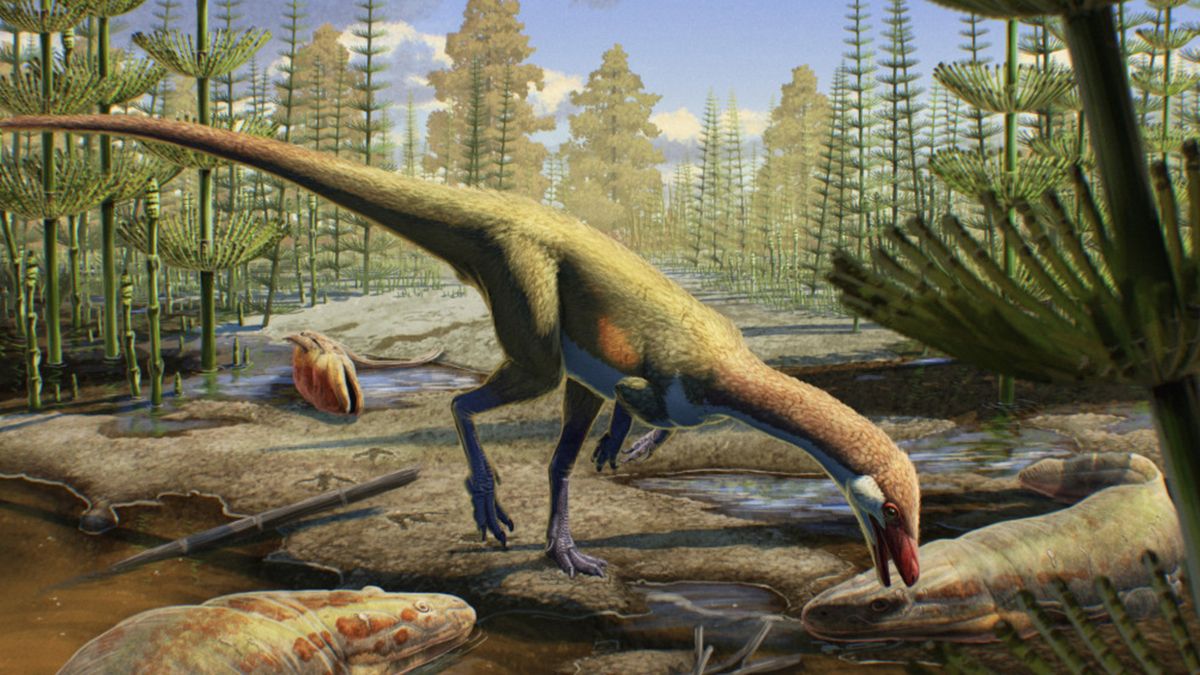
The remains of A. bahndooiveche hint that it is a distant relative of the enormous long-necked sauropod dinosaurs. (Image credit: Grup Guix)
The shape of the leg bones suggests that A. bahndooiveche was an extremely distant ancestor of sauropods — a group of enormous long-necked dinosaurs, such as brachiosaurus and diplodocus, which likely emerged around 50 million years later.
“We think of dinosaurs as these giant behemoths, but they didn’t start out that way,” Lovelace said.
Earlier than expected
The most striking implication of the new fossils is that they rewrite what paleontologists thought they knew about how quickly dinosaurs conquered the planet.
Dinosaurs first emerged in Gondawana, the southern half of the ancient supercontinent Pangea, which was made up of what is now Antarctica, South America, Africa, Australia and parts of Asia. But until now, the fossil record suggested that it took up to 10 million years for dinosaurs to spread to the northern half of Pangea, known as Laurasia, which has since been split up into North America, Greenland, Europe and the rest of Asia, researchers wrote.
However, the newly uncovered Laurasian dinosaur is only around 3 million years younger than the oldest commonly agreed upon Gondawanan dinosaur — an unnamed species of Herrerasaurid unearthed in Brazil that dates back to 233 million years ago. (Other older Gondawanan dinosaur fossils have been proposed previously but have not been widely accepted by the paleontological community.)
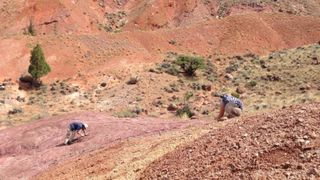
Researchers unearthed the newfound species at the Popo Agie Formation in Wyoming. (Image credit: David M. Lovelace)
The study team also identified potential dinosaur footprints in the area surrounding A. bahndooiveche, which may be even older than the new fossils. However, these tracks still require further research, they wrote.
It is unclear how dinosaurs emerged in Laurasia so early, but they may have been helped by a period of unusually wet climatic conditions, known as the Carnian pluvial episode, which lasted between 234 and 232 million years ago. This may have made it easier for dinosaurs to cross the deserts around Earth’s equator. However, the researchers say this is just one theory and they will need to uncover more early Laurasian dinosaurs to properly unravel this mystery.
“We’re kind of filling in some of this story, and we’re showing that the ideas that we’ve held for so long — ideas that were supported by the fragmented evidence that we had — weren’t quite right,” Lovelace said. “We now have this piece of evidence that shows dinosaurs were here in the Northern Hemisphere much earlier than we thought.”
Source link : http://www.bing.com/news/apiclick.aspx?ref=FexRss&aid=&tid=67816011f0f642e3be23f9645f89122d&url=https%3A%2F%2Fwww.livescience.com%2Fanimals%2Fdinosaurs%2F230-million-year-old-dinosaur-is-oldest-ever-discovered-in-north-america-and-changes-what-we-know-about-how-they-conquered-earth&c=11641469128728406292&mkt=en-us
Author :
Publish date : 2025-01-10 04:12:00
Copyright for syndicated content belongs to the linked Source.