But tannins aren’t the only driver behind deforestation.
Much of the cleared land, not just in Argentina but the whole Chaco forest, which also spans into Paraguay, Bolivia and Brazil, has been driven by soybean production and cattle ranching. Nearly a million acres of native forest were lost between 2008 and 2022 in the Chaco province, according to the Agroforestry Network Chaco Argentina.
The complaint is the latest development in the region’s long battle to protect the Gran Chaco, the animals that depend on it and the people living within.
Fighting Against Deforestation
In 2007, Argentina marked an important milestone for forests by passing the Native Forest Law. This breakthrough helped protect the country’s forests by classifying them according to their level of conservation needs. The law also established limits on deforestation.
“The Native Forest Law recognized that we were in an emergency state in Argentina back then,” said Hernán Giardini, the forests campaign coordinator of Greenpeace Argentina, with “around 750,000 to 900,000 acres of forest cleared per year.”
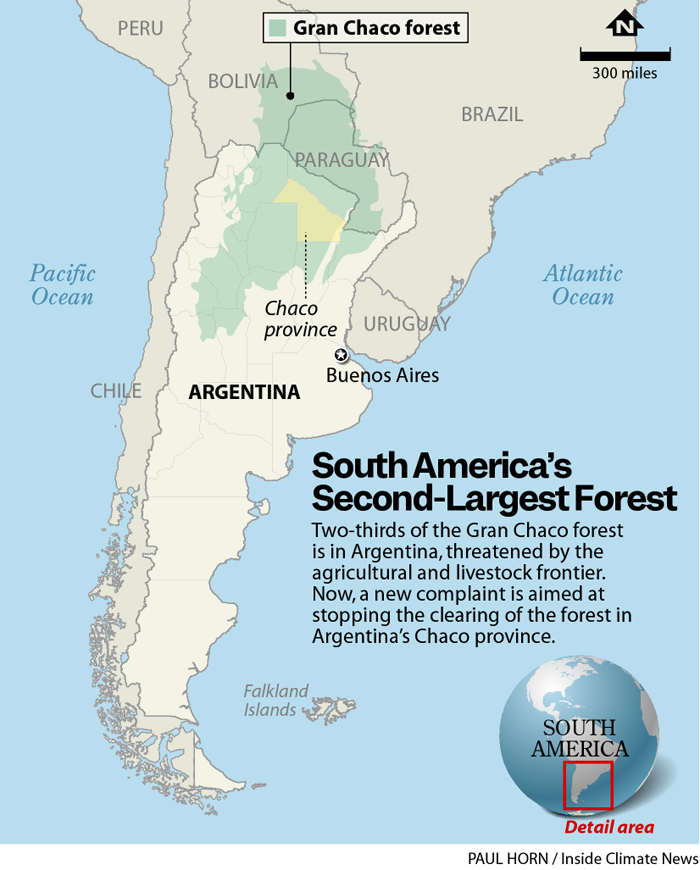
One of the important aspects of that law was that it required every province in Argentina to map which parts of the forest could be cleared and which ones couldn’t. The map had three categories: red for Category I, forest areas meant to be conserved forever; yellow for Category II, areas that may be degraded but that can be restored; and green for Category III, areas with low conservation value that could be partially or completely transformed. The map was part of a plan to designate land use in the native forest, known as “territorial ordering.”
“The map is always supposed to be improved, not worsened,” said Giardini, “and improved in the sense that deforestation is more restricted.”
Since then, the province of Chaco has gone through ups and downs in revising and updating the map. But in the late April update, legislators “incorporated new red areas in places that don’t have deforestation pressure, trying to exchange those for new green areas to clear,” said Giardini.
This story is funded by readers like you.
Our nonprofit newsroom provides award-winning climate coverage free of charge and advertising. We rely on donations from readers like you to keep going. Please donate now to support our work.
Donate Now
“But you can’t trade red for green as if the forest areas were all the same,” he said.
For Matias Mastrangelo, who studies the effects of deforestation in the Chaco forest, the April law has many implications. “We know that these new areas that are being cleared are important areas for biodiversity, they are biological corridors, they are in the buffer zone of National Parks,” said Mastrangelo, a researcher at the National Scientific and Technical Research Council in Argentina.
These areas are also home to many Indigenous communities.
If the forest is lost, it will be difficult to recover, Mastrangelo said.
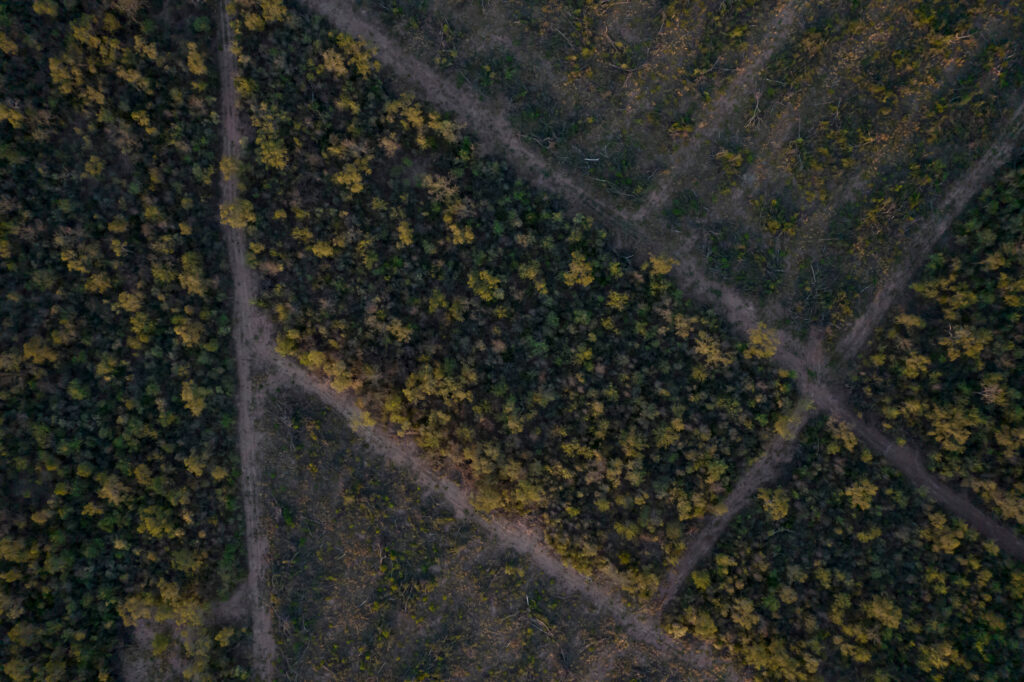 The Gran Chaco is the second largest forest in South America after the Amazon. Credit: Periodistas por el Planeta/Abogados Ambientalistas
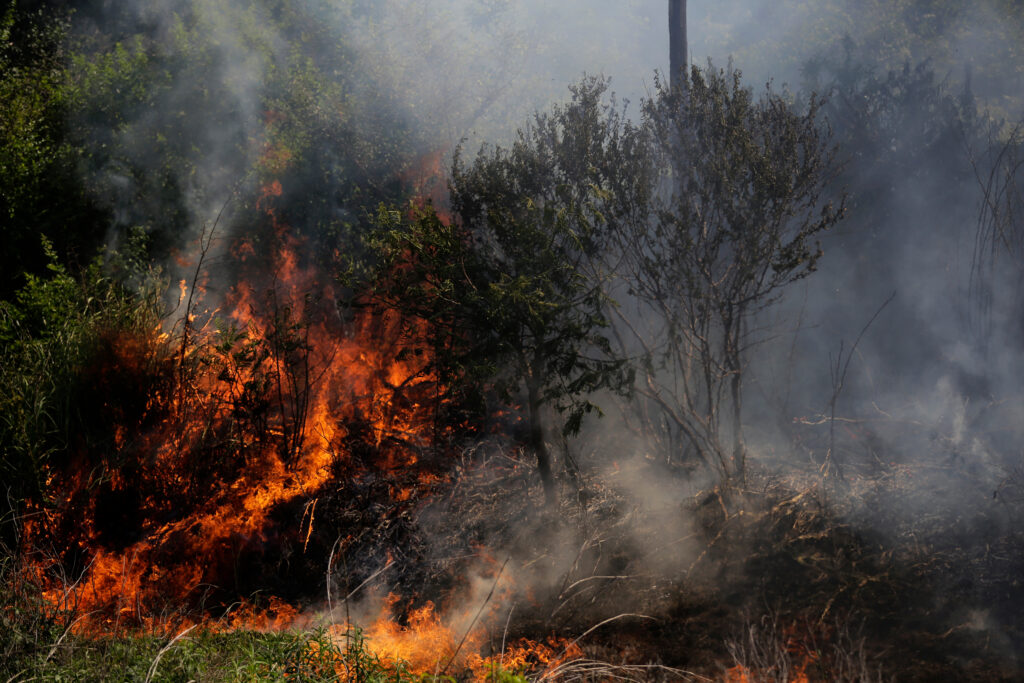 Clearing forest areas can sometimes involve burning the area after it’s been cleared with bulldozers. Credit: Periodistas por el Planeta/Abogados Ambientalistas
In the first half of 2024, Greenpeace detected the loss of nearly 150,000 acres in northern Argentina through satellite images. “That’s the equivalent of three times the area of the city of Buenos Aires,” the organization said in a statement, and a 15 percent increase over that of the same period in the previous year, with the largest deforestation area happening in the Chaco province.
It’s hard to bear witness to the forest being destroyed, said Giardini, the Greenpeace coordinator, but it’s even harder when there’s a human aspect involved.
“Because the destruction of the forest also has a human story,” he said.
Protecting Native Forests
When Karina Alonzo was a girl, she remembers her family members standing up against the deforestation of the Chaco forest. Alonzo, a local teacher and member of the Indigenous Qom community, grew up in a village called Pampa del Indio, where her grandfather and great-grandfather were Indigenous leaders. Though she says she didn’t understand the situation regarding deforestation then, she understands it now and is part of a larger resistance against it.
“The Chaco forest is our life and our identity,” Alonzo said, “if we didn’t have these green spaces we wouldn’t be able to do our ceremonies or have natural medicine.”
She said the village has already experienced some of the more immediate effects of deforestation, such as water quality problems. “The river that passes through our lands has another taste to it,” Alonzo said. “The clouds of dirt in the sky are signs of deforestation.”
“The Chaco forest is our life and our identity, if we didn’t have these green spaces we wouldn’t be able to do our ceremonies or have natural medicine.”
Besides the complaint, other letters calling for a Chaco free of deforestation have been written to the provincial government, Alonzo said.
The Argentine Association of Environmental Lawyers’ statement about its complaint closes with a warning: one of the most important ecosystems in South America is on track to disappear. The lawyers call for an urgent measure to suspend the April law and to immediately stop all destruction of the native forest that puts the ecosystem at risk.
“I don’t know much about laws,” Alonzo said, “but I know the land like it’s the back of my hand. I know which soil to use and how to use it, which tree is sick and which one isn’t. I’m not a person who sees the forest with greedy eyes.”
About This Story
Perhaps you noticed: This story, like all the news we publish, is free to read. That’s because Inside Climate News is a 501c3 nonprofit organization. We do not charge a subscription fee, lock our news behind a paywall, or clutter our website with ads. We make our news on climate and the environment freely available to you and anyone who wants it.
That’s not all. We also share our news for free with scores of other media organizations around the country. Many of them can’t afford to do environmental journalism of their own. We’ve built bureaus from coast to coast to report local stories, collaborate with local newsrooms and co-publish articles so that this vital work is shared as widely as possible.
Two of us launched ICN in 2007. Six years later we earned a Pulitzer Prize for National Reporting, and now we run the oldest and largest dedicated climate newsroom in the nation. We tell the story in all its complexity. We hold polluters accountable. We expose environmental injustice. We debunk misinformation. We scrutinize solutions and inspire action.
Donations from readers like you fund every aspect of what we do. If you don’t already, will you support our ongoing work, our reporting on the biggest crisis facing our planet, and help us reach even more readers in more places?
Please take a moment to make a tax-deductible donation. Every one of them makes a difference.
Thank you,

Alexa Robles-Gil
Fellow
Alexa Robles-Gil is a New York City-based bilingual journalist covering wildlife and environmental policy. Currently, Alexa is a master’s student in New York University’s Science, Health and Environmental Reporting Program. She has experience as a field biologist and is passionate about the complexity of conservation and climate change.
Source link : http://www.bing.com/news/apiclick.aspx?ref=FexRss&aid=&tid=66b1ffb9b2ef497daa8bd25baacd43a1&url=https%3A%2F%2Finsideclimatenews.org%2Fnews%2F06082024%2Fargentina-gran-chaco-native-forest-deforestation-complaint%2F&c=17311838590232064889&mkt=en-us
Author :
Publish date : 2024-08-05 12:59:00
Copyright for syndicated content belongs to the linked Source.