The questions in his class outside Chicago ranged from the absurd to the practical to the academic. Why are so many new shoes no longer including shoelaces? Can AI create a multiday itinerary for a visit to Charleston, South Carolina? What are the geopolitical implications of artificial intelligence?
Gershbein, who teaches classes on a range of technological topics, said interest in AI has ballooned in the last nine months. The 52-year-old teaches an AI course once or twice a week, he said, and aims to create a ‘safe space where (seniors) can come in and we can discuss all the issues they may be hearing bits and pieces of but we can put it all together and they can ask questions.’
During a 90-minute-long session on a June Thursday, Gershbein discussed deepfakes – videos that use generative AI to make it appear someone said something they did not. When he played a few deepfakes, the seniors sat agog. They could not believe how real the fakes seemed. There are widespread concerns that such videos could be used to trick voters, especially seniors.
The threats to seniors go beyond politics, however, and range from basic misinformation on social media sites to scams that use voice-cloning technology to trick them. An AARP report published last year that Americans over 60 lose $28.3 billion annually to financial extortion schemes, some assisted by AI.
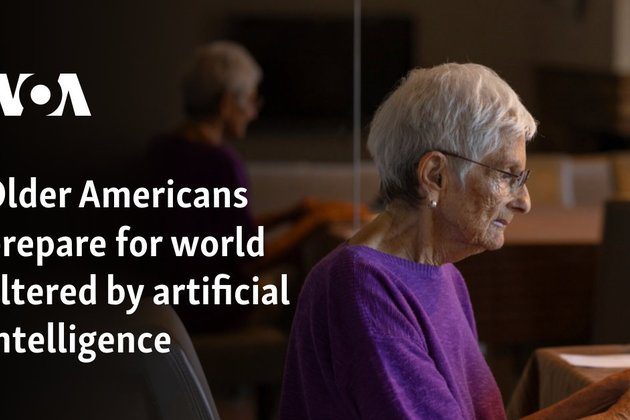
 FILE – Barbara Winston uses a computer and a smartphone at her home in Northbrook, Ill., on June 30, 2024, several days after taking an introduction to artificial intelligence class at a local senior center.
Experts from the National Council on Aging, an organization established in 1950 to advocate for seniors, said classes on AI at senior centers have increased in recent years and are at the forefront of digital literacy efforts.
‘There’s a myth out there that older adults don’t use technology. We know that that’s not true,’ said Dianne Stone, associate director at the National Council on Aging who ran a senior center in Connecticut for over two decades. Such courses, she said, are meant to foster a ‘healthy skepticism’ in what the technology can do, arming older Americans with the knowledge ‘that not everything you hear is true, it’s good to get the information, but you have to kind of sort it out for yourself.’
Striking that balance, said Siwei Lyu, a University at Buffalo professor, can be difficult, and classes tend to either promote AI’s benefits or focus on its dangers.
‘We need this kind of education for seniors, but the approach we take has to be very balanced and well-designed,’ said Lyu, who has lectured to seniors and other groups.
Seniors who have taken such AI classes said they came away with a clear understanding of AI’s benefits and pitfalls.
‘It’s only as good as the people who program it, and the users need to understand that. You really have to question it,’ said Linda Chipko, a 70-year-old who attended an AI class in June in suburban Atlanta.
Chipko said she took the class because she wanted to ‘understand’ AI, but on her way out said, ‘It’s not for me.’
Others have even embraced it. Ruth Schneiderman, 77, used AI to help illustrate a children’s book she was writing, and that experience sparked her interest in taking the Northfield class to learn more about the technology.
‘My mother lived until she was 90,’ Schneiderman said, ‘and I learned from her if you want to survive in this world, you have to adjust to the change otherwise you are left behind.’
Source link : http://www.bing.com/news/apiclick.aspx?ref=FexRss&aid=&tid=66bba892bd65461fae6f528bc7892e08&url=https%3A%2F%2Fwww.bignewsnetwork.com%2Fnews%2F274492243%2Folder-americans-prepare-for-world-altered-by-artificial-intelligence&c=1971252946656461940&mkt=en-us
Author :
Publish date : 2024-08-13 07:38:00
Copyright for syndicated content belongs to the linked Source.