Dean Grubbs, a research professor with Florida State University’s Coastal and Marine Laboratory, examines a smalltooth sawfish in the Gulf of Mexico, under a permit to work with the endangered species.
All of these are positive signs of population recovery, Gelsleichter said.
“The protections we’d provided seemed to be reversing (the decline),” he said. “We’re starting to see the animals on a more regular basis like we used to.”
Troublesome illness emerges in sawfish
Then a deadly disease showed up last fall, a disease that causes some abnormal behaviors in marine species, including spinning around in the water. The first dead sawfish was reported in January. Since then, Grubbs said, at least 54 sawfish have been confirmed dead from the toxic disease, mostly in the middle and lower Florida Keys. Experts believe the number could be higher.
In April in the Florida Keys, a team rescued a sawfish for the first time, an ailing 11-foot fish, and took it to a care facility operated by Mote Marine Laboratory and Aquarium, with high hopes for its recovery, but after more than 20 days of rehabilitative care, the sawfish died.
State officials are working with other groups to investigate the cause of the disease and deaths, reported in more than 80 additional fish species, as well as several crab species.
This illness is not to be confused with “whirling disease,” an invasive illness that affects freshwater fish through a parasite that damages the nervous system, said Kelly Richmond with Florida’s wildlife commission. “Our investigation has not uncovered any evidence of a parasite or other communicable pathogen that could account for the recent behavioral anomalies and mortalities.” That’s the case for the sawfish, as well as bony fishes, she said.
The investigation continues into the potential role of harmful algal blooms and associated toxins, Richmond said. Researchers have taken biopsies, blood samples and water samples, but so far have reached no definitive answers.
Florida legislators set aside money to study the spinning disease, and Grubbs hopes some of the money will go to support research into the disease in sawfish.
“This big mortality event may be a significant setback for us in terms of recovery,” he said. “It will be some time before we figure out exactly how big of a setback it was.”
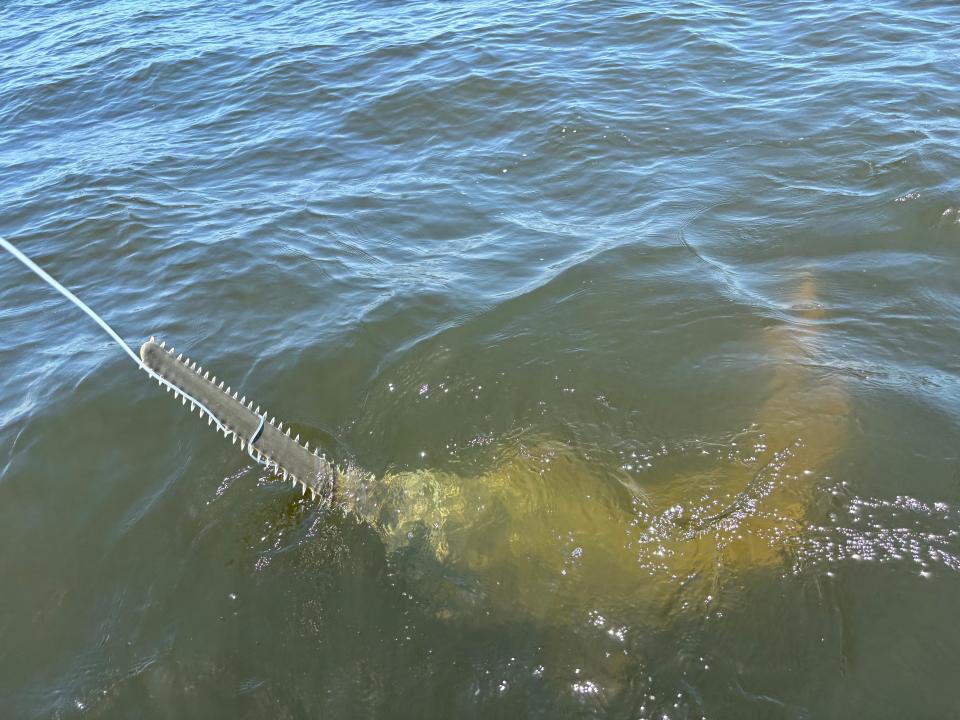
Students at the University of North Florida, under the direction of James Gelsleichter who is authorized by a permit to handle the endangered species, caught a smalltooth sawfish in the St. Marys River on July 16, 2024.
Public implored to report sawfish sightings
It’s critically important for fishermen and boaters and anyone who’s in the water to report all sightings or catches of sawfish, which could be seen anywhere in the Southeast, the scientists say. The report should include estimated size, location, date, time and water depth.
How to report sightings:
Fishers who hook one must handle it appropriately, keep it in the water at all times and quickly let it go.
In 2019, a Jacksonville commercial fisherman pled guilty to using a power saw to cut the rostrum off a live 12-foot sawfish off the Northeast Florida coast. He was sentenced to two years’ probation, a $2,000 fine and 80 hours of community service.
Field survey class yields rare opportunity
Gelsleichter teaches a field survey class where the students conduct surveys by boat looking for sharks and rays. He and his students study shark reproduction and pollutants in fish that impair reproductive biology.
Once they pulled the sawfish they caught up next to the boat, it was time to get to work, as quickly as possible. Because he’s included on a permit that allows him to work on sawfish, they took a couple of small biopsies for genetic research, measured the young male and shot some quick video. They also attached a NOAA tag and did a rostral tooth count.
This was only the second time in Gelsleichter’s decadeslong career that he’d been able to handle a sawfish. “I can’t even describe it,” he said. “For these undergraduates to get a chance to see something like this is the part of it I love the most.”
Dinah Voyles Pulver covers climate change, wildlife and the environment for USA TODAY. Reach her at [email protected] or @dinahvp.
This article originally appeared on USA TODAY: Rare sawfish trying to make comeback off Florida, Georgia
Source link : http://www.bing.com/news/apiclick.aspx?ref=FexRss&aid=&tid=66c91514b3644e018e1fc5a9af7c5838&url=https%3A%2F%2Fcurrently.att.yahoo.com%2Fnews%2Fprehistoric-relative-sharks-struggle-comeback-090551111.html&c=2321884840486777814&mkt=en-us
Author :
Publish date : 2024-08-22 22:05:00
Copyright for syndicated content belongs to the linked Source.