Venezuelan President Nicolas Maduro holds a small copy of the constitution as he gives a news conference at Miraflores presidential palace in Caracas, Venezuela, Wednesday, July 31, 2024, three days after his disputed reelection. (AP Photo/Matias Delacroix)
Maduro’s government says he won reelection. Did lifting sanctions affect the outcome?
Despite the disputed election results, Latin America experts partly credited the Biden administration’s sanction policy for Venezuela holding an election with an opposition candidate.
Gamarra presented two possible scenarios that could have unfolded without the Barbados Agreement and the U.S. negotiations: Maduro’s government wouldn’t have held elections, or would have held elections without a genuine competitor.
“Without external incentives the Maduro government might not have allowed González to run at all,” said Rebecca Hanson, an assistant professor at the Center for Latin American Studies at the University of Florida.
Hanson and other Latin America experts also noted that a usually fragmented opposition coalesced during these elections. Without this, “it would be much more difficult to know if election results had been manipulated,” Hanson said.
The Barbados Agreement also “committed the (Venezuelan) government to enter a terrain where they were forced to reveal how uncompetitive they were,” said Javier Corrales, a political science professor at Amherst College.
The Biden administration provided the “best option” Venezuela’s opposition has had in 25 years to oust Maduro from political power in a “democratic way,” Gamarra said.
Alejandro Velasco, a New York University Latin American history associate professor, said, “What has been happening over the last year is that the government has seen an opposition which has surprised it by being very united, very cohesive, many of the things that the opposition has not been able to achieve in the last 10 years.”
Venezuela’s opposition has had a history of boycotting elections and having internal fragmentation.
The U.S. has imposed sanctions on Venezuela for decades, Maduro remains in office
The U.S. has had fraught diplomatic relations with Venezuela for decades, and started imposing sanctions in 2006, according to the Congressional Research Service. Trump increased and expanded the sanctions, targeting not just specific people, but also industries, University of Illinois political science professor Damarys Canache wrote in January.
Over the past decade, Venezuelans have faced hyperinflation; food and medicine shortages; and human rights abuses. As a result, since 2014 nearly 8 million people have fled the country, according to the United Nations.
Under Trump’s sanctions, Maduro had no incentive to conduct free and fair elections, Velasco said.
Experts said it’s common for countries to negotiate or pressure other countries via sanctions. The U.S. has done it, with different levels of success with Cuba, Iraq, Nicaragua and the Balkans.
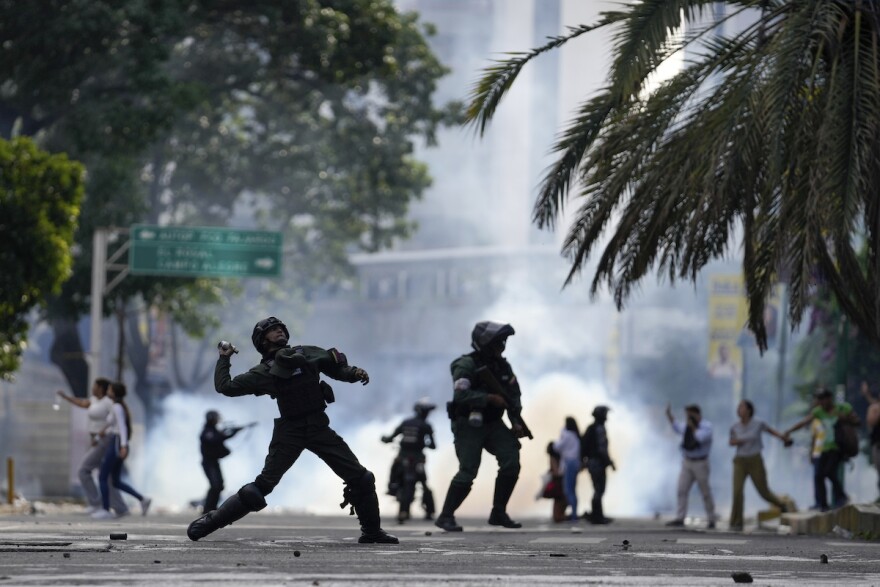
Police hurdle a gas canister at protesters demonstrating against the official election results declaring President Nicolas Maduro’s reelection, the day after the vote in Caracas Venezuela, Monday, July 29, 2024. (AP Photo/Matias Delacroix)
What’s next for Venezuela?
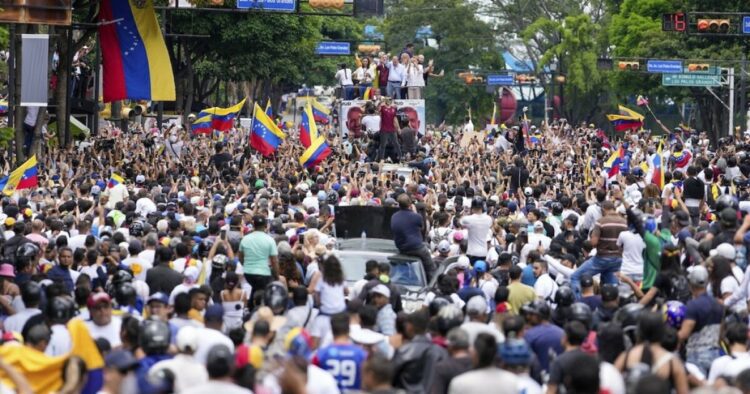
In the days after the elections, Venezuelans have taken to the streets to protest against the Maduro government. At least 11 people have died and more than 700 have been detained, according to Foro Penal, a Venezuelan legal assistance nonprofit.
In an opinion piece published by The Wall Street Journal, Machado said she is in hiding and fearing for her life.
Blinken in his statement said that threats to arrest opposition leaders, including Machado, “are an undemocratic attempt to repress political participation and retain power.” He called on Venezuelan parties to begin talks for a peaceful transition.
“We fully support the process of re-establishing democratic norms in Venezuela and stand ready to consider ways to bolster it jointly with our international partners,” Blinken said.
Our SourcesPhone interview with Alejandro VelascoAssociate professor of Latin American history at New York University, July 29, 2024Phone interview with Eduardo Gamarra, A Florida International University political science professor, July 30, 2024Email interview with Javier Corrales, July 29, 2024Email interview with Rebecca Hanson, assistant professor at Center for Latin American Studies at the University of Florida, July 29, 2024Email interview with David Smilde, sociology department chair at Tulane University, July 29, 2024The Associated Press, Venezuelan opposition says it has proof its candidate defeated President Maduro in disputed election, July 30, 2024NBC News, U.S. officials draft proposal to ease Venezuela oil sanctions, Aug, 23, 2023La Nación, El rol de EE.UU. en el proceso electoral de Venezuela y cómo se prepara ante los posibles escenarios tras la votación, July 27, 2024XRick Scott post, July 29, 2024PBS News, U.S. resumes deportation flights to Venezuela, Oct. 18, 2024NPR, President Trump Approves New Sanctions On Venezuela, May 22, 2018Congressional Research Service, Venezuela: Overview of U.S. Sanctions Policy, Updated April 24, 2024The White House, Background Press Call by Senior Administration Officials on Venezuela, Dec. 20, 2023 The White House, Background Press Call by Senior Administration Officials on Venezuela, April 17, 2024U.S. Department of State, Senior Administration Officials On the Venezuela Election, July 29, 2024PBS, Venezuelan opposition candidate blocked by court calls it ‘judicial criminality,’ won’t abandon race, Jan. 29, 2024Reuters, Venezuela to allow safe passage to Argentina for Machado aides, government source says, April 5, 2024The Associated Press, Ex-diplomat, political newcomer, grandpa. That’s Edmundo González, Venezuela’s Maduro rival, July 28, 2024The Associated Press, US extends sanctions waiver allowing Iraq to buy electricity from Iran, Nov. 14, 2023ABC, Blinken says US has ‘serious concerns’ about announced result of Venezuelan election, July 29, 2024Akin, OFAC Reimposes Venezuela Oil and Gas Sector Sanctions but Leaves Door Open for Possible Specific Licensing, April 23, 2024Atlantic Council, Experts react: The US just reimposed sanctions on Venezuela. What does this mean for energy markets and Venezuela’s election?, April 18, 2024Truth Social, Trump’s post, July 31, 2024NY Times, How the U.S. Has Played a Role in Venezuela’s Presidential Election, July 21, 2024CNN, US to reimpose sanctions on Venezuela’s oil and gas sector, April 17, 2024Migration Policy Institute, Venezuelan Immigrants in the United States, Feb. 15, 2023Tampa Bay Times, Venezuelans live mostly in Florida and they top Hispanic population growth, Sept. 27, 2021Al Jazeera, Venezuela election unrest Updates: Demonstrations as Maduro declared winner, July 30, 2024CBS News, U.S. announces new sanctions against Nicaragua over migration, human rights abuses, ties to Russia, May 15, 2024State Department, Assessing the Results of Venezuela’s Presidential Election, Aug. 1, 2024Miami Herald, Marco Rubio: Biden-Harris administration failures hurt Venezuela —and America | Opinion, Aug. 1, 2024
Source link : http://www.bing.com/news/apiclick.aspx?ref=FexRss&aid=&tid=66b164c242b749cfaf6a3d5e816f0047&url=https%3A%2F%2Fwww.wlrn.org%2Famericas%2F2024-08-02%2Fpolitifact-fl-joe-biden-lifted-sanctions-on-venezuela-is-he-to-blame-for-the-countrys-disputed-elections&c=12550792811310387072&mkt=en-us
Author :
Publish date : 2024-08-02 13:21:00
Copyright for syndicated content belongs to the linked Source.