What was your favorite experience on the Qhapaq Ñan?
Leonardo: For the most part, locals speak Aymara in the mountains of Bolivia and Quechua in Peru, and Spanish is their second language—just as is mine. Being able to share a bit about my life with the people I met and to learn about their culture in return was an invaluable experience. One particular moment comes to mind: It was around day ten, when we left Sorata and began the long climb on the Ruta de las Tres Cordilleras. We arrived at a town called Pocobaya around 4 p.m.—around when we normally began looking for a camp. We asked a local if we could camp on their soccer field. A few hours later, after we had set up our tent, all the kids began to show up to investigate us. They were curious about everything—our bikes, our tent, how we made food on our tiny stoves, and why I “didn’t talk properly.” But one common interest united us all: soccer.
Adam: One of my favorite experiences on the Qhapaq Ñan was about two weeks into the journey. We happened upon a few ranchers with their alpaca near the small village of Inca Capaturi. I noticed from afar that they were appearing to be shearing the fur of the animals. Eventually, we realized that they were actually processing the animals, right there in an open field. Curious, I wanted to engage, but since we were in such a remote area, we approached cautiously. It ended up being a family endeavor, and everyone welcomed us into the experience. Nelson, one of the ranchers, shared that in this part of the world, the natives save the blood of the animals and, later on, pour the blood at the entrance of the mines to bless passage and bring good luck to the miners.
How did you select your kits for such a long bikepacking expedition?
Leonardo: We carefully chose each piece of our gear with two important qualifications in mind: the durability to withstand the abuse of a monthlong traverse in desolated territory and the versatility to adapt to the ever-changing weather we expected to face at 16,000 feet. We carried very light cycling kits. For clothes, we relied on essential pieces:
Rab Force Hoody: Soft, breathable, and quick-drying, this hoodie was perfect for everyday wear.
Cinder Crank Shorts: Made from a breathable softshell fabric, these shorts delivered all-day comfort with thigh venting zips for further ventilation and saddle reinforcements for durability.
Cinder Downpour Light Waterproof Pants: These packable waterproof biking pants offered unmatched comfort in the saddle and reliable protection whenever the weather would turn.
Infinity Microlight Down Jacket: Insulated with 700 fill power 100 percent recycled down, this reliably warm jacket was the perfect layer for nights at camp.
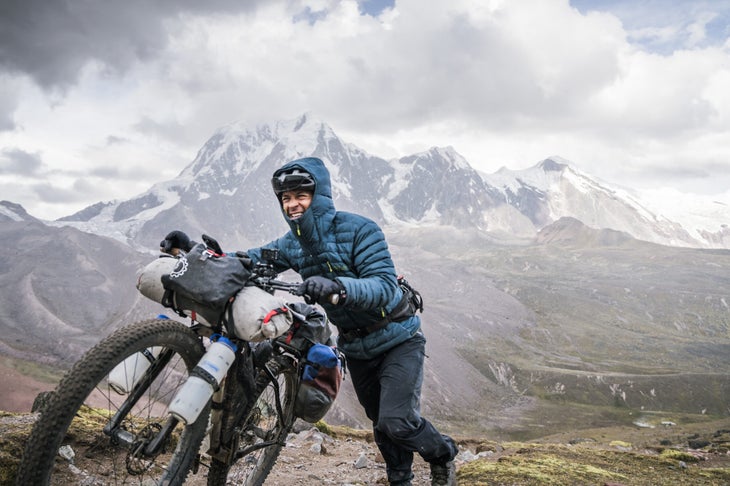 The Rab Infinity Microlight Down Jacket uses lightweight and breathable GORE-TEX INFINIUM™ WINDSTOPPER® and offers the perfect protection for alpine adventure. (Photo: Leonardo Brasil)
We also carried the Mythic 400 Down Sleeping Bag (21°F) for comfortable warmth in the varying high-alpine conditions. Here’s a video of all the gear we carried on our expedition.
Along your journey, what was the greatest challenge you faced, and how did you overcome it?
Adam: Our greatest challenge was the injury I endured at nearly 17,000 feet. About 30 miles from the finish of our planned route and just after summiting a rocky mountain pass, I crashed. We bundled up at the top as it began to hail. We were excited for a large descent after eight hours of pushing our bikes uphill. Leonardo was ahead of me as I photographed from behind. I excitedly started riding after him but quickly lost control and clipped a large boulder to my right. In an attempt to correct, I pulled the bike left and immediately flipped over my handlebars, landing in a field of scree—my left wrist absorbing the impact. I heard a crack, and a surge of pain radiated through my whole body. Leonardo rushed to me. And as we began to investigate, we realized that I had fractured my wrist. Over the next 48 hours, we pushed our bikes to the nearest path-turned-road until we arrived at a town that offered a bus to Cusco.
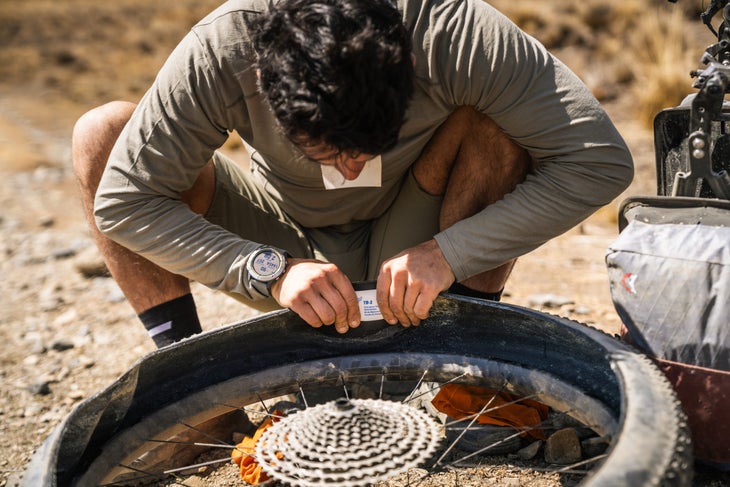 Things are not going to go as planned (they rarely do). (Photo: Leonardo Brasil)
What advice would you give to someone who’s interested in planning a similar adventure?
Leonardo: Be open-minded. Things are not going to go as planned—they rarely do—and the best approach anyone could have in these situations is to adapt and move on. What would you do if you slash your tire beyond repair in the middle of nowhere on the fifth day of a monthlong expedition? What would you do if you unexpectedly ride for six days without finding a single tienda to resupply and you are running dangerously low on food? What would you do if your partner crashes and breaks his arm at nearly 16,000 feet and the next town is a day away? You can’t plan for all possible scenarios, and you need to be okay with that. That’s the beautiful nature of adventure.
Adam: Set an intention, but similar to Leonardo’s advice, remain flexible. The fuel for these adventures is the desire to learn more about yourself and the world around you. With that in mind, the “destination” or “goal” is rather flexible. As long as you grow from the experience, it’s a win in my book.
More than 40 years since our founding, Rab continues to find inspiration in the untamed spirit of the mountains where we climb, the friendships we forge on the peak, and our enduring mission: to grow our community of mountain people and equip them for adventure.
We are committed to putting people at the heart of what we do. From our partners and athletes to our staff and everyone who has used and loved our gear, we are a global community that goes beyond mountains and crags, and it’s up to us to make sure it’s inclusive, diverse, and growing.
Source link : https://www.outsideonline.com/outdoor-adventure/biking/bikepacking-the-oldest-historic-road-in-latin-america/
Author :
Publish date : 2024-06-13 02:00:00
Copyright for syndicated content belongs to the linked Source.