Calling out greetings in her Aymara language, a herdswoman limped as she approached our campsite, where we were sipping hot tea and stamping our feet against the morning chill.
At almost 15,500 feet above sea level, the camp was among the highest – and coldest – stops of our six-day trek through Bolivia’s Cordillera Real, and temperatures had dropped far below freezing overnight, turning our water bottles into solid ice.
The old woman, who introduced herself simply as Rosa, was tending a herd of llamas. The animals’ thick fleece protected them against the morning chill, but Rosa’s feet looked chapped and cold in a pair of plastic sandals.
Our group of three hikers was walking with Ricardo Laso, an indigenous Bolivian guide with more than 20 years of experience in the Bolivian Andes, and he translated our Spanish into Aymara as we passed around black tea and oat cookies.
One of dozens of ethnic groups in Bolivia, the Aymara people and language pre-date the arrival of both the Inca and Spanish empires, and still have strong cultural ties to the peaks and high plains of the Andes mountains.
Jen Rose Smith for CNN
Hiking the Cordillera Real
Here, in our final camp of the trip, we had sweeping views of snow fields and glaciers that dropped into the wide valley where we’d slept. Only the hardiest plants can weather the harsh conditions of the alpine zone. But Rosa’s herds found forage as they stepped between rivulets of water still crusted over by ice.
During our trip, which took place during the cold, dry months of the Southern Hemisphere spring, the powerful sun left untouched the ice that gleamed from shady hollows. The Cordillera Real, though, is far from frozen in time, and climate change has already begun to transform Bolivia’s mountains.
For travelers, the diminishing snowpack and melting glaciers lend some urgency to travel planning – or they may arrive to find that snow and ice have given way to an entirely new landscape.
For now, however, the snow and ice remain in the Cordillera Real, a compact mountain range that extends fewer than 80 miles, with peaks that reach more than 21,000 feet. It’s a landscape of dramatic beauty just a few hours from downtown La Paz, and one that holds endless possibilities for adventurous travelers.
But unlike in neighboring Peru, where the famed Inca Trail to Machu Picchu sees up to 500 hikers, porters and guides each day, the trails we walked in the Cordillera Real were almost entirely free of visitors.
That seclusion from mainstream tourism is part of what sets Bolivia’s peaks apart from other destinations in South America’s Andes, which stretch from tropical Colombia to Argentina’s Tierra del Fuego, said Jeff Sandifort, the owner of guiding company Climbing South America, where Laso works as a guide.
“At the moment, you can still really get off the beaten trail,” said Sandifort, whose guiding and mountaineering resume reveals a deep knowledge of the Bolivian Andes, but also includes a long list of summits across South America and beyond. “In Peru, you’ll see more infrastructure and more hikers, but here it’s really quite remote, with maybe one group a week in some areas.”
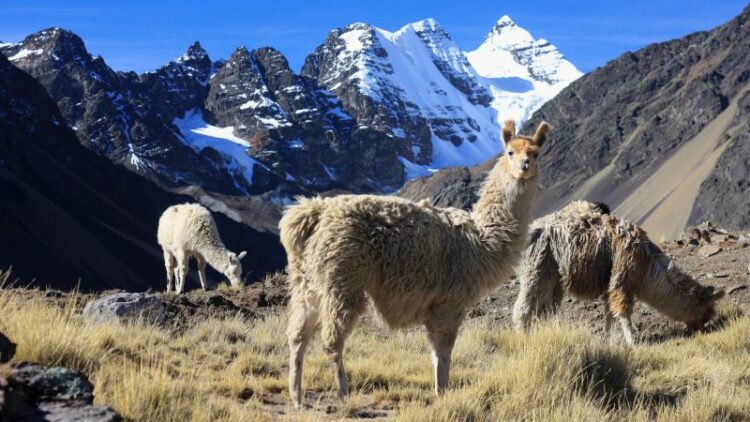
Among the high peaks and alpine lakes of the Cordillera Real, that meant we found far more llamas than people. And when we set out each day, the morning silence was broken only by the sound of our footsteps and the occasional bird call.
Jen Rose Smith for CNN
Llamas on the trail
In vast rock fields that tumble down from the passes, native viscachas–long-eared rodents that hop over rocky slopes with a loping gait–chirped to each other from shady dens while we watched the sky for a glimpse of the now-rare Andean condor.
During each day of walking, we met just a few people.
Like Rosa, they were mostly Aymara who live in the lower-elevation foothills and travel to the mountains to tend herds of llamas and alpacas, fish for trout, work in the mines and lay out their freshly harvested potatoes to freeze-dry in the sun and cold.
These are scenes that would have been familiar to their ancestors, who’ve long made a home in the highlands. But for tourists, the Bolivian Andes remain relatively unexplored.
The poorest country in South America, Bolivia’s tourist arrivals lag far behind those of nearby Brazil, Paraguay, Argentina, Chile and Peru. Harder to reach by air–even American Airlines, long the only US carrier to fly to Bolivia, ended service to La Paz in early July–Bolivia has also faced years of political turmoil that made travel within the country unpredictable.
Under the rule of Socialist president Evo Morales, however, the country’s found greater stability, and according to the World Bank, tourist arrivals have nearly doubled in the decade following his 2006 election. (In a controversial ruling, Bolivia’s Constitutional Court overruled the constitution and a 2016 referendum to allow Morales to seek a fourth term in 2019.)
“The road blocks are not as bad as they used to be,” noted Sandifort, referring to the political protests that can stop all traffic in cities and towns for days or weeks. “If the country is relatively more politically stable, with less road blocks and protests, that is going to bring more people.”
For Bolivians, that calm is a welcome change. As remote as the mountains appear, even the highest Andes saw tremors during the gas wars of the early 2000s, when the country was ignited by conflict over natural gas resources.
Laso recalled a time when his own hometown of Sorata was paralyzed by a gas-related road block, trapping dozens of tourists as the town slowly ran out of food.
Less than three and a half hours from La Paz by car, the only way to escape Sorata during the blockade was on foot, and Laso led a group of tourists on a week-long trek to the capital that followed some parts of our own, calmer hike.
“Everywhere you looked in the mountains there were people,” he recounted in Spanish. “Grandmothers, children, local people—everyone walking, everyone trying to get to La Paz.”
While the political situation is indeed more stable, occasional protests over natural resources, corruption and other issues still disrupt travel. During a 10-week stay in Bolivia, I was ensnared in a two-week, non-violent blockade of Sucre, the country’s constitutional capital, and I walked 25 miles along the highway to reach the next province.
As Laso hiked from Sorata to La Paz in 2003, he was passing peaks that Aymara tradition believes to be inhabited by apus, powerful spirits that watch over the mountain people and protect the land.
And from Illampu in the north to Illimani in the south, many of the Cordillera Real’s most imposing peaks retain their Aymara names, a geography that–along with the very existence of the Aymara people–is a powerful testament to cultural resilience under two powerful colonial empires.
The Inca arrived in these mountains as an invading force, and quelled Aymara rebellions only by sending waves of troop reinforcements, then attempting to replace the local population with Quechua-speaking Inca loyalists.
The Aymara survived that initial onslaught. But when the Inca empire fell at the hands of the Spanish, things got even worse.
Jen Rose Smith for CNN
The glaciers are melting
Spanish rule brought centuries of slavery and oppression, as well as anti-indigenous discrimination that still echoes through modern-day life in Bolivia. Like many of their Aymara-speaking peers, Laso’s parents weren’t able to attend any formal school because they didn’t speak Spanish.
Even now, when Bolivia is led by an indigenous, Aymara-speaking president, Laso’s children are reluctant to use the language outside of the home, fearful of being taunted at school.
“They don’t want to be called ‘Indian’ or ‘uneducated,’” he said.
Despite years of colonization and struggle, however, the mountains have remained a powerful part of Aymara life, customs and beliefs. Now, under an Aymara president, indigenous rituals that never disappeared are gaining new prominence in mainstream Bolivian life. On the recent Aymara New Year on June 18, 2018, celebrations took place at sacred sites around the country, including one led by Morales himself.
Some of those rituals address weather, traditionally believed to be controlled by a council of achachilas, ancestral beings that inhabit the Cordillera Real’s most imposing mountains.
And despite the resurgence of indigenous pride, some Aymara leaders blame modern life and the decline of traditional practices for disruptions to the yearly weather cycle that has long defined pastoral life here.
“It was different before,” one Aymara leader told the Swedish researcher Anders Burman. “There was a time for sowing, a time for harvesting. Not now…There is climate change, and it worries us.”
Though they offer a different set of reasons, scientists agree that a changing climate is rapidly melting Bolivia’s glaciers into trickling streams.
Glaciers in the Cordillera Real shrunk 41.9% between 1986 and 2014, according to researchers – dramatic evidence of that change.
Once the highest-altitude ski resort on earth, the 17,700-foot Chacaltaya doesn’t have enough snow to keep the lone ski lift spinning, and the mountain’s main glacier has disappeared even faster than scientists once predicted.
People don’t need specialized instruments or a lifetime of farming to see the transformations take place. In 23 years of climbing in the Bolivian Andes, he has watched the mountains melt from one climbing trip to the next.
“There’s more rock exposed all the time,” he said, “and the glaciers are not just retreating; they’re losing thickness as well.”
With conditions that change from year to year, Bolivia’s Andes are melting even as the country finds its way out of political turmoil and onto travelers’ itineraries.
For travelers who wish to see the mountains where Inca troops clashed with Aymara rebels or walk snowy peaks named for the spirits that inhabit them, the coming years are a vanishing opportunity to plan a trip. But for now, the Cordillera Real remains a shining challenge just beyond the skyline of La Paz, with technical peaks and walking trails that are an invitation to adventurous travelers.
And whether you opt for a 20-day expedition that traverses the entire range, or simply summit Pico Austria on a day trip to La Paz, you’ll set out along the trail to the sound of a changing world.
Listen carefully as you walk the Cordillera Real, and you might hear the cry of the Andean Condor, learn to exchange a greeting in the Aymara language and catch the drip, drip, drip of melting ice.
Guided day hikes and overnight trips are available from many outfitters based in La Paz. With pack animals and guides, the 5-night, 6-day route we followed is available starting at US $785 per person from Climbing South America; trips with a Spanish-speaking guide may be arranged for US $70 per day for a self-supported group carrying their own gear.
Source link : https://amp.cnn.com/cnn/travel/article/bolivia-cordillera-real
Author :
Publish date : 2018-07-18 03:00:00
Copyright for syndicated content belongs to the linked Source.