Pansani analyzes experimental and fossil bones from the Santa Elina rock shelter for the “Ice Age America” documentary in São Paulo, Brazil.
Robin Bicknell
Unlike anthropologists who primarily examine human history through pieces of material culture, like tools, Pansani explores our ancestors’ migration into South America via the traces they engraved on Pleistocene megafauna bones.
Throughout the ice age, the region that became modern-day Brazil was an arid landscape. The drier climate birthed savannas that supported a diverse assemblage of mammals, including giant sloths of varying sizes and their bipedal neighbors: ancient modern humans.
In the 20th century, archeologists proposed the Overkill Hypothesis, the idea that human overconsumption was the primary cause of large mammal extinctions in the Americas. This theory was supported by the discovery of spear points and piles of mammoth bones in Clovis, New Mexico. At its discovery in 1932, Clovis was the earliest known archaeological site in the Americas, dated around 13,000 to 12,000 years old. Scientists believed it provided proof that the emergence of humans led to the demise of the megafauna, especially in North America.
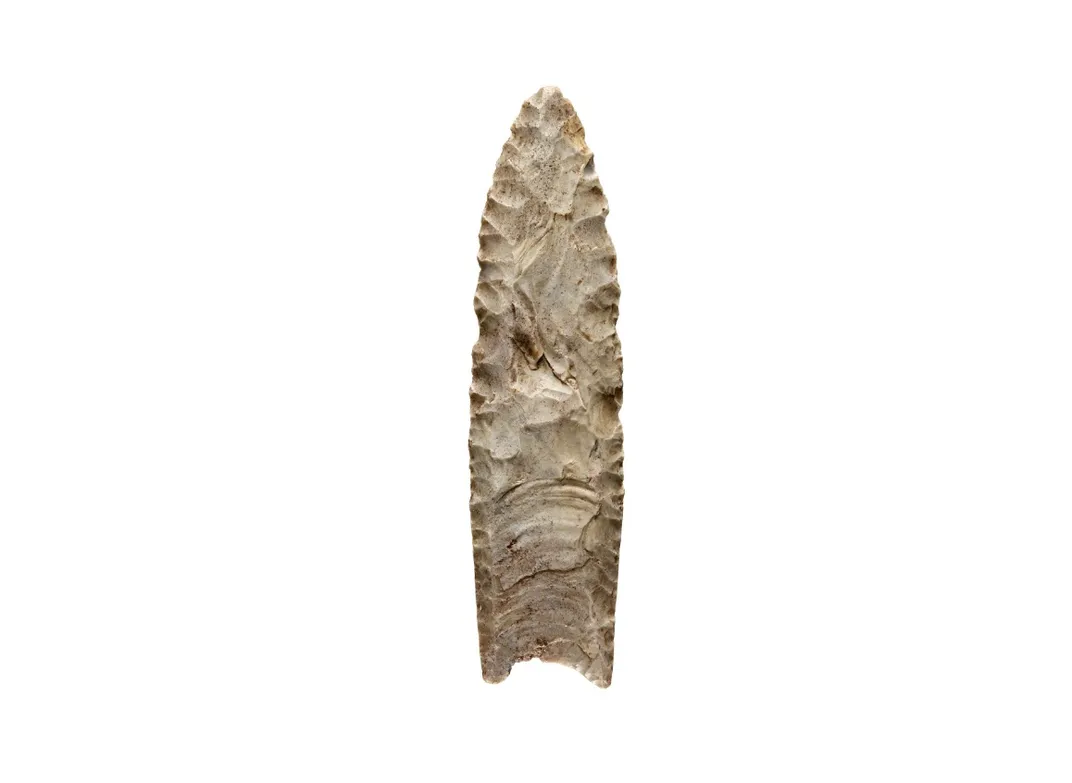
An 11,000-year-old spear point from eastern North America that is nearly as old as the Clovis points.
Department of Anthropology, National Museum of Natural History, Smithsonian Institution
“Now, we know that it’s way more complex than that,” Pansani said. “We were here way before that.”
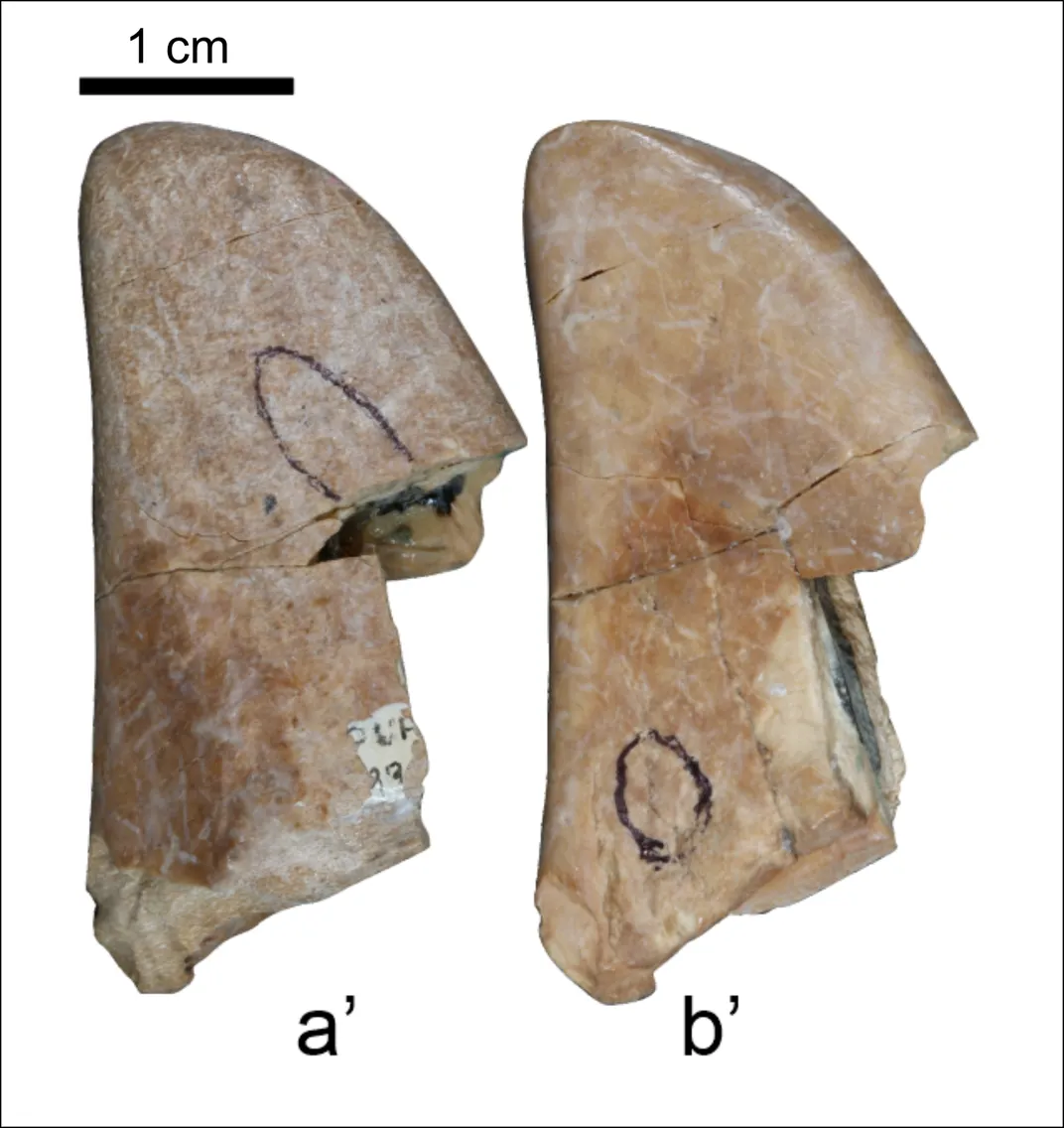
The modified ground sloth tooth was discovered in a tank deposit, a pothole like natural depression that can fill with water and sediment depending on the weather cycle. As sediments of all ages accumulate at the bottom of the tank, scientists could not determine whether a Paleolithic tool found nearby was from the same time period as the tooth.
Thaís R. Pansani
In September, Pansani published research on a modified giant ground sloth tooth discovered over 1,200 miles east of the zooarchaeological layers in Santa Elina. The tooth, shaved into a triangular point with parallel markings on the smoothed surface, was radiocarbon dated to just under 14,000 years ago. This discovery indicated humans were interacting with megafauna for more than ten thousand years before the giant animals disappeared from South America.
What does your research tell us about human interactions with giant ground sloths before their extinction?
We know that the extinction of megafauna, in South America at least, was around 10,000 years ago. This is at least 17,000 years after the arrival of the humans who modified the giant ground sloth bones in Santa Elina. So, there is evidence of humans existing with these mammals in a shared ecosystem and hunting or scavenging them in a sustainable manner.
However, we still don’t know what our relationships with the Pleistocene megafauna were like in general.
For a long time, we thought that the very first humans in the Americas were associated with the Clovis culture. We found weapons and associated bones, some with cut marks made using stone tools. So that supported the Overkill Hypothesis. We thought that humans got to the Americas from Asia, following and hunting the large animals until they were extinct. But this is an oversimplified takeaway.
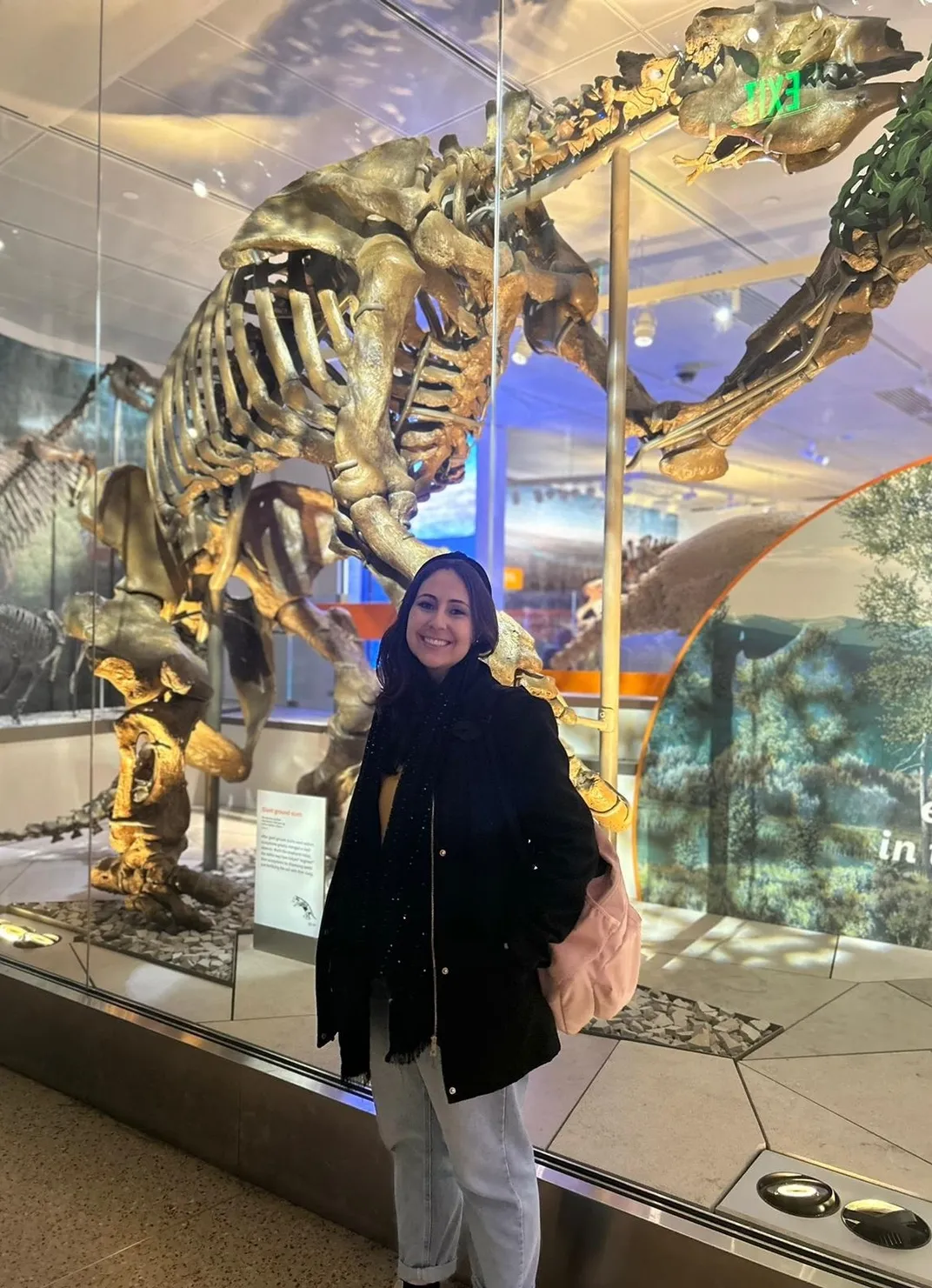
Pansani poses next to the fossil of the ground sloth Eremotherium laurillardi in the museum’s Deep Time Hall of Fossils. “Giant sloths were herbivores, so at least they were not eating humans. I think that humans were way more afraid of the sabertooth cats,” Pansani said.
Thaís R. Pansani
Do we know why humans were modifying giant ground sloth bones?
There is evidence of symbolic thinking in the ornaments made from giant ground sloth bones. These cultures were interacting with the giant sloths not just for subsistence. In Santa Elina, some of the oldest giant ground sloth bones were not only modified, but they were worn from extensive use. With the modified tooth, we know this part of the animal was handled outside the function of eating. It’s not a rib, it’s not a long bone that shows cut marks because people were hunting them. It’s just a tooth.
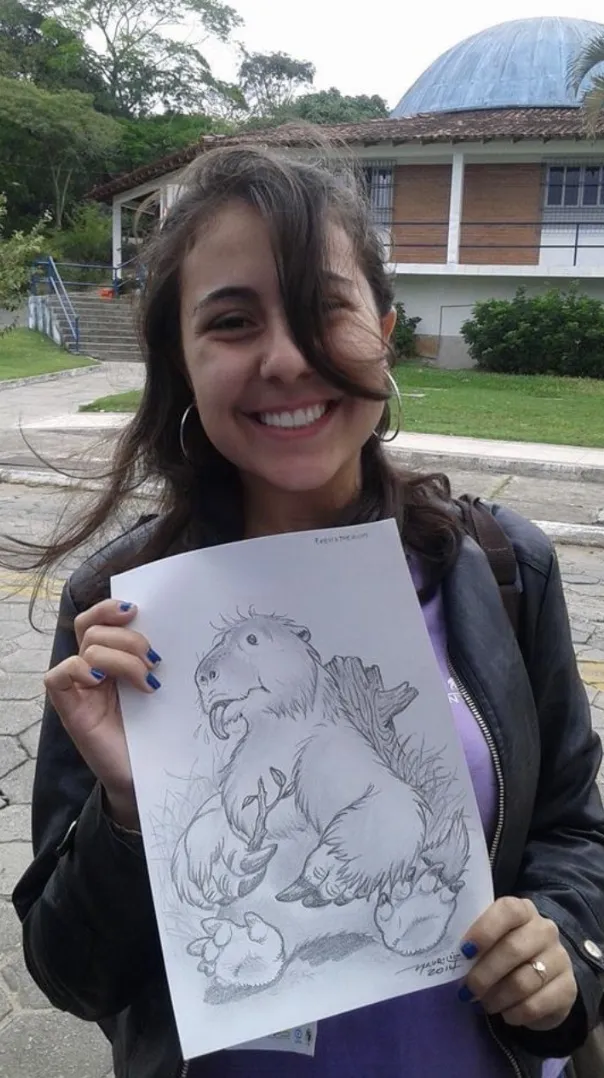
Pansani and the drawing she commissioned of a baby giant ground sloth at the Brazilian Congress of Vertebrate Paleontology in 2014.
Thaís R. Pansani
It’s beautiful to think about, but we can only speculate about the motives behind the alterations. But we’re learning more with these studies.
How does your research highlight some of the shortcomings of the Overkill Hypothesis?
The idea that human arrival immediately drove megafauna to extinction across the Americas does not align with recent discoveries.
I think that we need to be very careful with remembering that even these early dates for human occupation of the Americas are open to change. For a long time, everybody was talking about how megafauna went extinct 11,000 years ago, and humans got to the Americas 13,000 years ago. So the Overkill Hypothesis makes sense from this perspective.
But we keep seeing evidence of people showing up earlier, maybe 27,000 years ago. Similarly, new studies show the possible survival of some megafauna in Brazil until around 5,000 years ago. This demonstrates that humans existed on the continent and could manage the ecosystem and live together with these animals. Our interactions with these creatures were more complex than we thought even 20 years ago.

Pansani posing at a paleontological excavation in Brazil in 2020.
Thaís R. Pansani
Density may be the key. Maybe there was a peak in human density along the late Pleistocene and early Holocene in the Americas, and that is when we began “over hunting.”
I hope to contribute to further discoveries. We have so many megafauna specimens in museum collections that require further research, especially in South America and Brazil in particular. I’m one of the first people in the country who wants to go to other museums and review all the evidence for human interactions with these bones.
This interview has been edited for length and clarity.
Meet a SI-entist: The Smithsonian is so much more than its world-renowned exhibits and artifacts. It is a hub of scientific exploration for hundreds of researchers from around the world. Once a month, we’ll introduce you to a Smithsonian Institution scientist (or SI-entist) and the fascinating work they do behind the scenes at the National Museum of Natural History.
Related Stories
What a Drawerful of Dung Reveals About the Lives of Ground Sloths
What the Demise of Mammoths Can Teach Us About Future Extinctions
Bison Mummies Help Scientists Ruminate on Ancient Climate
Meet the Smithsonian Scientist Studying the Mysterious Mongolian Deer Stones
Ancient Humans
Extinction
Fossils
Human Origins Program
Meet a SI-entist
Megafauna
Research
Source link : http://www.bing.com/news/apiclick.aspx?ref=FexRss&aid=&tid=6721288fab444844a8e6d74698c98f05&url=https%3A%2F%2Fwww.smithsonianmag.com%2Fblogs%2Fnational-museum-of-natural-history%2F2024%2F10%2F29%2Ftelltale-traces-meet-the-scientist-decoding-human-history-in-south-america-through-giant-ground-sloth-fossils%2F&c=11466305374726126492&mkt=en-us
Author :
Publish date : 2024-10-29 05:20:00
Copyright for syndicated content belongs to the linked Source.