You are seeing a snapshot of an interactive graphic. This is most likely due to being offline or JavaScript being disabled in your browser.
Brazil’s drought began in mid-2023 and has been described as the “most intense and widespread” in its history by the National Centre of Natural Disaster Monitoring and Alerts (Cemaden). The government agency says almost 60 per cent of Latin America’s largest nation is affected to some degree.
Last year, one factor was El Niño, the naturally-occurring weather pattern that warms the Pacific Ocean, said Ana Paula Cunha, a researcher at Cemaden. “This year there’s an even bigger contribution from the overheated north Atlantic,” she added.
Rain may offer relief in the central south of the country from next week, said Cunha, but below-average precipitation is forecast for the next three months in other states already facing a “critical” situation.
Major waterways in the Amazon basin have touched historic lows, complicating basic supplies for distant communities dependent on riverine transport. Elsewhere, crops ranging from coffee to oranges have been harmed.
The dry spell has also led regulators to increase energy bills, because the backbone of Brazil’s power generation is from hydroelectric dams and reservoir levels have dropped.
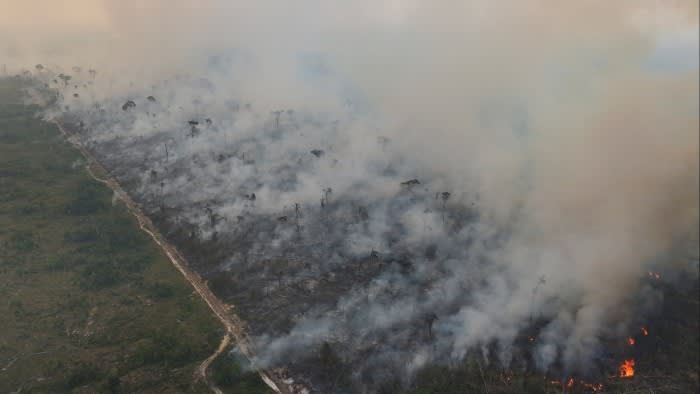
There is also an impact on human health. Wildfires have carried dangerous micro-particulate matter, blanketing both countryside and urban centres in muggy clouds.
On Thursday, the smoke plume reached about 33 per cent of national territory, with roughly 11 per cent of Brazil exposed to heavy smoke, according to Financial Times’ calculations based on data from the Copernicus Atmosphere Monitoring Service.
São Paulo, Brazil’s most-populous municipality, had the worst air quality of 120 major cities worldwide this week, according to the Swiss data platform IQAir. It found the country’s western Amazon region was the most-polluted area in the world last month because of wildfires.
“The scale of the emissions has grown to historic levels through August until now, around the typical peak season, with well above average emissions”, said Mark Parrington, senior scientist at Copernicus.
He said some regions, including Bolivia, Amazonas and Mato Grosso do Sul, were at or around their highest annual total fire emissions of the 22 years covered by the EU agency data set.
Fires across South America this year have emitted 72 per cent more carbon dioxide this year than the average for the same period in 2012-2023, according to the GWIS.
“This scenario will fuel climate change even more,” said Marcio Astrini, executive secretary at the non-profit Climate Observatory.
“We need more forceful action. This is the moment to increase punishments for environmental crimes in Brazil, especially those linked to fire and deforestation.”
Additional reporting by Beatriz Langella and Joe Daniels
Climate Capital
Where climate change meets business, markets and politics. Explore the FT’s coverage here.
Are you curious about the FT’s environmental sustainability commitments? Find out more about our science-based targets here
Source link : http://www.bing.com/news/apiclick.aspx?ref=FexRss&aid=&tid=66e5308d57e64e33aee343cf9ac0f2d7&url=https%3A%2F%2Fwww.ft.com%2Fcontent%2Fbdcdd185-73ba-411b-93f0-1a3b3b879834&c=9700387129699140319&mkt=en-us
Author :
Publish date : 2024-09-13 17:00:00
Copyright for syndicated content belongs to the linked Source.