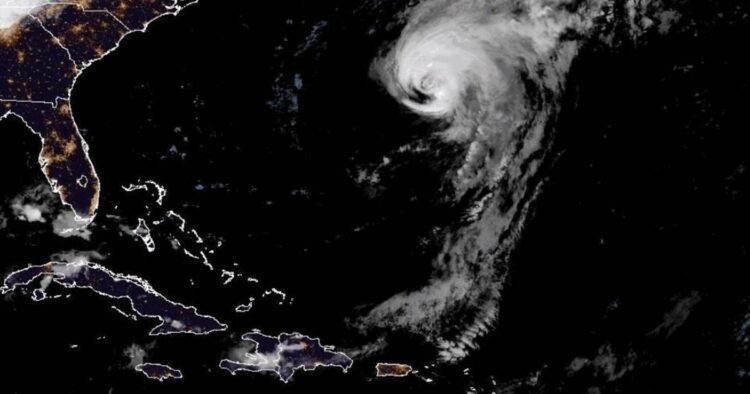
 A satellite image of Hurricane Ernesto taken at 11:20 p.m. EDT on Aug. 16, 2024.Â
NOAA/NESDIS/STAR GOES-East
Preparing for Ernesto
Just hours before landfall, generators, flashlights and generators were being snapped off shelves at one hardware store, while Bermuda’s largest grocery store was packed with people preparing for the worst.
“The best thing to do is obviously get your supplies beforehand,” shopper and Bermuda resident Lorenzo Cooke told CBS Ness.
Cooke said that in any hurricane, the best resource is often Bermudians themselves.
“Obviously, a neighbor is a helping hand at all times,” Cooke said.
Captain Jeremy Fowler secured the Pescador, an 80-foot sport fishing boat in a protected area of Bermuda’s harbor. He lost an engine but is riding out the storm with his friend Brian Alford.
“Feeling pretty confident, but still optimistic,” Fowler said. “Paying attention to what’s going on. It’s blowing the tops off the waves in the harbor here. I see some of the seawalls starting to get pretty deep.”
In preparation for the storm, the island territory suspended public transportation and closed the airport on Friday night.
“Hurricane Ernesto seriously threatens our community,” Weeks told the Associated Press. “This is not a storm to be taken lightly.”
Along with Bermuda, the hurricane center said swells generated by Ernesto were affecting portions of the Bahamas and the East Coast of the U.S. The swells were also forecast to reach portions of Atlantic Canada by late Saturday.Â
“Life-threatening surf and rip current conditions are likely in these areas during the next couple of days,” the hurricane center wrote.
Ernesto is forecast to be near or east of Newfoundland by Monday night.
A rush of people have been trying to leave Bermuda. Michael Vanderbilt of Arlington, Virginia, who cut his trip to Bermuda short, was among the travelers waiting in long lines at L.F. Wade International Airport on Thursday.
“I was here for a week of vacation, and I’m just taking the opportunity to leave a little early so I don’t get caught up in the aftermath of the storm,” Vanderbilt told CBS News. Â
The storm’s categorization is based on the Saffir-Simpson Wind Scale, which only accounts for wind speed and not the tropical cyclone’s size, which the National Hurricane Center said is “large.” It also doesn’t account for the amount of precipitation the storm system holds or its moving speed, both of which can be disastrous. Slow-moving tropical cyclones can increase the amount of rain, storm surge and flooding a region experiences. Â

Downed power lines are seen after Tropical Storm Ernesto moved through the area in Fajardo, Puerto Rico, on August 14, 2024.
JAYDEE LEE SERRANO/AFP via Getty Images
Ernesto’s path and origin
Ernesto already caused potentially life-threatening conditions in Puerto Rico and the U.S. Virgin Islands earlier this week. It passed north of the region as a tropical storm that still managed to knock out power to hundreds of thousands of residents. At one point, 23 hospitals were operating on generators. Schools and numerous roads were also closed.
Bermuda power utility BELCO said that as of Saturday afternoon, more than 26,000 customers were out of power.
A spokesperson for Puerto Rico’s electricity provider, LUMA Energy, told CBS News that at the outage’s peak, 750,000 customers were without power. As of 10 p.m. EDT Friday, that number had dropped to about 182,000. Some 1,600 crew members were working as quickly as possible to repair the power grid.
Residents in Puerto Rico were still coping with the damage Thursday. In Fajardo, a town on the northeast corner of the island, debris piles from damaged businesses were growing.
The U.S. Virgin Islands had about 46,000 out of power at one point on Wednesday — nearly all customers. As of Saturday morning, that number was down to about 7,000, according to PowerOutage.us.
Ernesto developed just days after Debby finished its move along the U.S. East Coast, where it left at least eight people dead, including children, as a Category 1 hurricane-turned-tropical storm. Â
Rivers across Puerto Rico were swollen after nearly 10 inches of rain.Â
Officials were forced to open floodgates at a dam along the La Plata River. Sirens warned residents in the nearby municipality of Toa Baja to evacuate their homes in case of flooding.
Puerto Rico’s power grid was wiped out in 2017 by Hurricane Maria, which slammed the island as a strong Category 4 storm.
“The government today is much better prepared,” said Juan Saca, president and CEO of LUMA Energy. “… We have a plan that you can go into our website and take a look at the plan.”
President Biden approved an emergency declaration for Puerto Rico, the White House said Tuesday night, authorizing FEMA to help with storm recovery.Â
Ernesto is the fifth named storm so far of the Atlantic hurricane season, which has already proven to be historic after Beryl reached record strength at the beginning of the season in above-average temperatures of the Gulf of Mexico.
NOAA has predicted an above-normal season, with 17-25 named storms, eight to 13 hurricanes, and four to seven major hurricanes.
The fifth-named storm typically doesn’t form until Aug. 22, according to NOAA.Â
Editor’s Note: Due to an editing error, an earlier version of this story reported 975,000 customers had lost power in Puerto Rico, but that was the number of customers who still had power, according to Puerto Rico’s electricity provider.
Manuel Bojorquez and
Dave Malkoff
contributed to this report.
More from CBS News
Li Cohen
Source link : http://www.bing.com/news/apiclick.aspx?ref=FexRss&aid=&tid=66c108b4ab9f4cb892e5839877a9bac9&url=https%3A%2F%2Fwww.cbsnews.com%2Fnews%2Fernesto-storm-forecast-puerto-rico-virgin-islands%2F&c=2871598634504419749&mkt=en-us
Author :
Publish date : 2024-08-13 23:36:00
Copyright for syndicated content belongs to the linked Source.