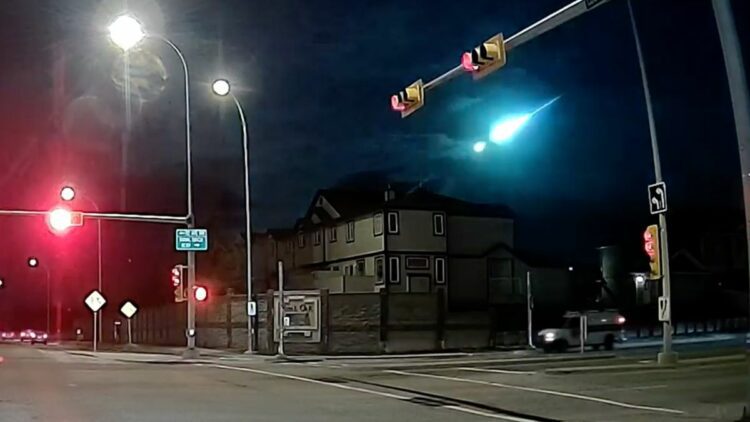
A video of a meteor on Nov. 13, 2024 captured by Matthew Craig and submitted to the American Meteor Society. (Image credit: AMS/Matthew Craig)
Based on the videos and eyewitness reports submitted to the American Meteor Society (AMS), this appears to have been a brilliant fireball.Â
“I’ve seen (and photographed) several fireballs before, but this was among the most spectacular I’ve seen,” wrote Dave R. of Alberta, Canada. “There was a greenish streak and then a very bright flash. The streak continued but shrunk in brightness. Then there was a secondary smaller and dimmer flash along the same meteor trail. This all occurred within 2 seconds or so.”
“All of a sudden I could see the road and my surroundings as if it was early/mid morning,” wrote Kaitlynn D. in Corvallis, Montana.Â
“This was the brightest and longest meteor I have seen this close up,” Emily G. of Clancy, Montana wrote in a report to AMS.
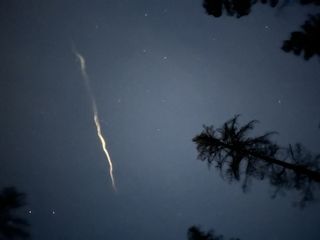
A picture of a streak left by a fireball on Nov. 13, 2024 taken by “U Y” of Whitefish, Montana and submitted to the American Meteor Society. (Image credit: American Meteor Society/UY)
The fireball was even seen from space.
Two of the GOES weather satellites operated by the National Oceanic and Atmospheric Administration’s captured the moment the meteor burned up in Earth’s atmosphere. One, the GOES-18 spacecraft, saw the meteor with an instrument designed to detect lightning strikes.
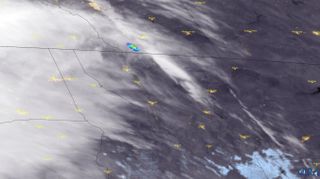
An image of a fireball captured by the GLM (Geostationary Lightning Mapper onboard NOAA’s GOES18 satellite on Nov. 13, 2024 over southwestern Alberta. (Image credit: NOAA/CIRA)
Another NOAA satellite, GOES-16, saw the flash using its own lightning sensor. The sensor is designed to detect bright flashes of light, meaning particularly bright meteors will sometimes appear in its data and imagery.
Here’s another look at the meteor signature from the Geostationary Lightning Mapper (GLM) on @NOAA’s #GOESEast (#GOES16).Read more about how #GLM tracks meteors: https://t.co/qm3r6bK7Cx https://t.co/8v0t7Rwz9q pic.twitter.com/eWKPclyzNjNovember 13, 2024
Meteors like this one become visible when small pieces of space dust (known meteoroids while in space) that come from asteroids or comets enter Earth’s atmosphere at very high speeds.Â
As they journey through the atmosphere, these small specks of space dust collide with particles of air, which generates friction and produces heat. That heat then vaporizes most meteors, creating the bright streaks of light we see zoom across the sky.
The next meteor showers we can expect will be the Leonid meteor shower, which will unfortunately peak on Nov. 16 under a bright moon which will make seeing them more difficult. After that, we can look forward to December’s Geminid meteor shower.
Source link : http://www.bing.com/news/apiclick.aspx?ref=FexRss&aid=&tid=67364d2f99134f9ab4c72e04a0774cad&url=https%3A%2F%2Fwww.space.com%2Fstargazing%2Fmeteors-showers%2Fbrilliant-fireball-explodes-over-north-america-as-satellites-watch-video&c=5985997118097514142&mkt=en-us
Author :
Publish date : 2024-11-14 05:04:00
Copyright for syndicated content belongs to the linked Source.