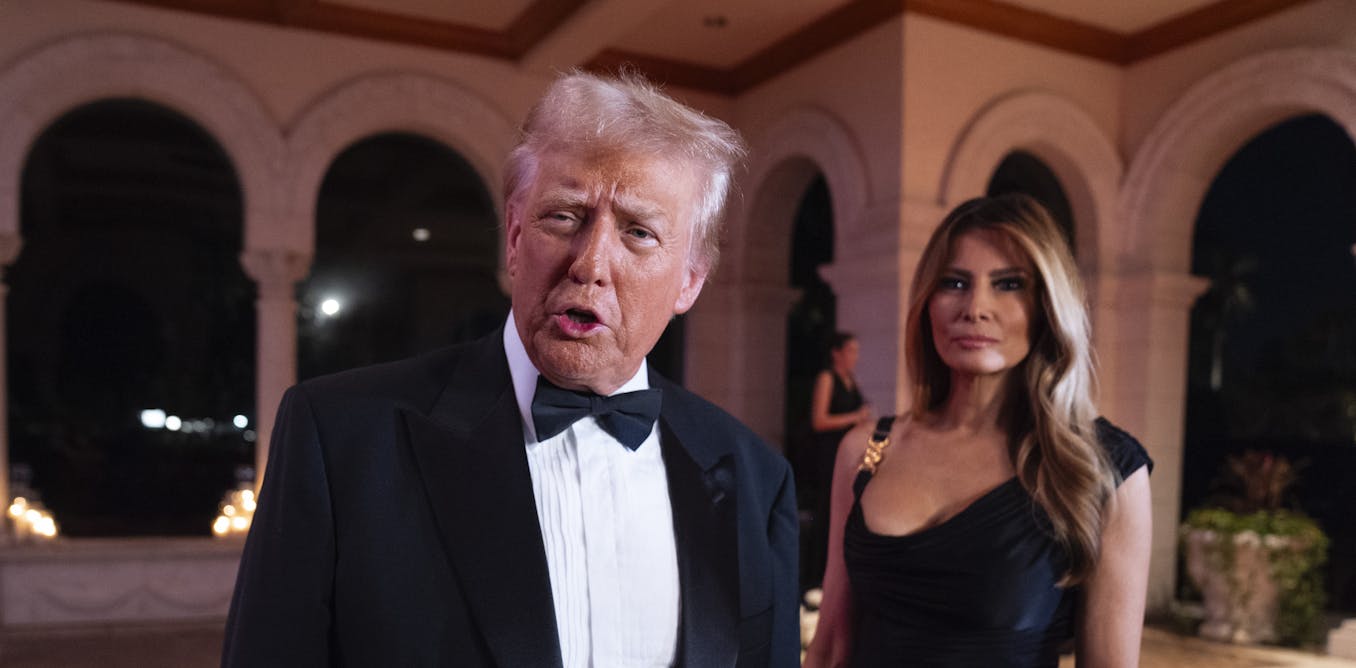
Prime Minister Justin Trudeau and president-elect Donald Trump at a recent dinner at Trump’s Mar-a-Lago estate in Florida.
(X/@JustinTrudeau)
It’s helpful in this situation to think of Trump as a schoolyard bully demanding someone else do his homework — in this case, defend America’s borders. Such bullying doesn’t end when you give in to the bully, but only when it becomes clear you won’t.
Border protection is a core function of any state, and a responsibility of any American president. Trump’s demand that others do it for him is both a sign of weakness and an attempt to create a scapegoat should his efforts fail.
As with any bully, if you promise to do the work for him, you’ll just encourage additional torment. So when Trudeau promised to do more in exchange for an end to the bullying, he got a kick in the pants for his efforts as Trump began to taunt him about being the governor of the 51st American state.
The world is watching how Canada responds to the bully. If Canada hopes to enjoy the respect of its peers, it must show a willingness to fight for itself, its prosperity and its values. It must defend its sovereignty from those who refuse to respect it, and act assertively to maintain Canadian prosperity. That could mean a trade war.
Power imbalance
For more than a century, Canada and the U.S. have found ways to co-operate and prosper side by side despite the fact that the U.S. is a much more powerful nation. They’ve built alliances and agreements founded on shared norms, values and customs as part of a deep and multifaceted relationship.
Read more:
Biden-Trudeau meeting caps two and a half centuries of Canada-U.S. relations
None of that history seems to matter to Trump, and now American power seemingly matters more than Canadian sovereignty. This power imbalance is all the more acute given Canada’s dependence on the American economy and American military might.
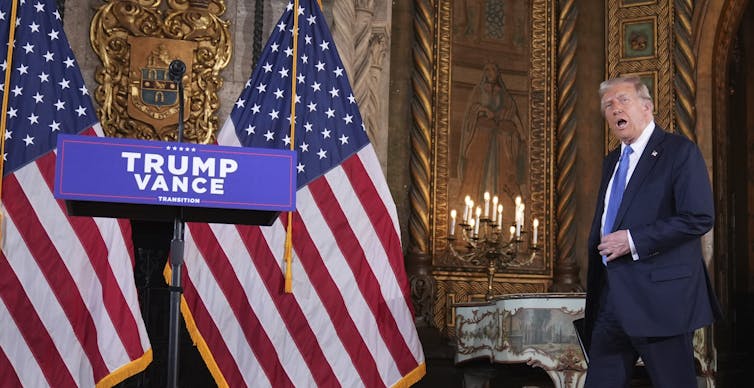
Trump arrives for a news conference at his Mar-a-Lago estate, in December 2024, in Palm Beach, Fla.
(AP Photo/Evan Vucci
But Canada is not powerless. Dependency works both ways, and the deep integration of the two countries’ economies makes the U.S. vulnerable as well.
Shutting off power exports, as Ontario Premier Doug Ford suggests, is one course of action that would have an immediate and significant detrimental effect on the American economy. Ditto for petroleum. Energy is power in more ways than
one.
Read more:
How Canada and the country’s premiers must respond to Trump’s trade and energy policies
The U.S. consumes millions of barrels of Canadian petroleum every day, and a tax on that fuel would be inflationary and ultimately unpopular with American voters.
Other countries stand to lose if the U.S. gets away with disrespecting Canadian sovereignty as well. If Trump refuses to respect Canadian sovereignty, no country is safe. Panama and Denmark can already attest to that.
Finding ways to creatively push back against such demands should be an imperative for any country that values its independence, and Canada needs to work with such allies.
Trump will soon be U.S. president again. But he is not and should not be treated as the president of Canada. Whoever leads Canada in the months to come has tools at their disposal to defend Canadian sovereignty, and they must be prepared to use them.
Source link : http://www.bing.com/news/apiclick.aspx?ref=FexRss&aid=&tid=67780b24a56946968bd332b863e6da85&url=https%3A%2F%2Ftheconversation.com%2Fcanadas-fight-with-trump-isnt-just-economic-its-existential-246619&c=3041790494508150596&mkt=en-us
Author :
Publish date : 2025-01-02 07:49:00
Copyright for syndicated content belongs to the linked Source.