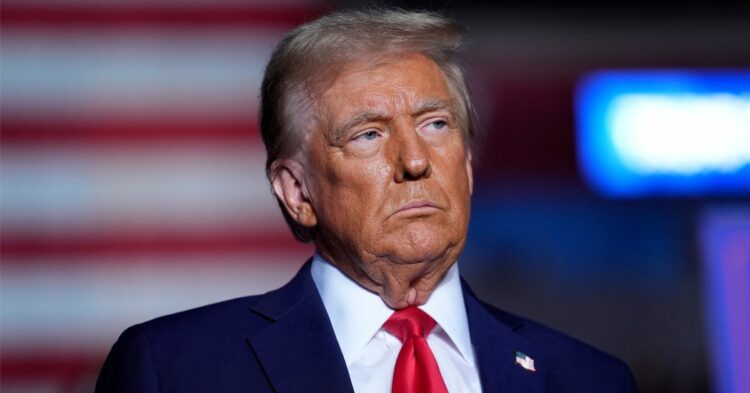
Eyepix Group via Getty Images
But for Trump, tariffs are now a tested tool that seems less politically controversial even if the mandate he received in November’s election largely involved restraining inflation.
The tariffs he imposed on China in his first term were continued by President Joe Biden, a Democrat who even expanded tariffs and restrictions on the world’s second largest economy. Biden administration officials looked at removing Trump’s tariffs in order to bring down inflationary pressures, only to find they were unlikely to help significantly.
Tariffs were “so new and unique that it freaked everybody out in 2017,” said Stumo, but they are now seen as part of the policy toolkit by the United States and other countries.
Trump’s first term tariffs had a modest impact on economy
Trump imposed tariffs on solar panels and washing machines at the start of 2018, moves that might have pushed up prices in those sectors even though they also overlapped with plans to open washing machine plants in Tennessee and South Carolina.
His administration also levied tariffs on steel and aluminum, including against allies. He then increased tariffs on China, leading to a trade conflict and a limited 2020 agreement that failed to produce the promised Chinese purchases of U.S. goods.
Still, the dispute changed relations with China as more U.S. companies looked for alternative suppliers in other countries. Economic research also found the United States may have sacrificed some of its “soft power” as the Chinese population began to watch fewer American movies.
The Federal Reserve kept inflation roughly on target, but factory construction spending never jumped in a way that suggested a lasting gain in manufacturing jobs. Separate economic research found the tariff war with China did nothing economically for the communities hurt by offshoring, but it did help Trump and Republicans in those communities politically.
When Trump first became president in 2017, the federal government collected $34.6 billion in customs, duties and fees. That sum more than doubled under Trump to $70.8 billion in 2019, according to Office of Management and Budget records.
While that sum might seem meaningful, it was relatively small compared with the overall economy. America’s gross domestic product is now $29.3 trillion, according to the Bureau of Economic Analysis. The total tariffs collected in the United States would equal less than 0.3% of GDP.
Trump wants much more far-reaching tariffs going forward
The new tariffs being floated by Trump now are dramatically larger and there could be far more significant impacts.
If Mexico, Canada, and China faced the additional tariffs proposed by Trump on all goods imported to the United States, that could be roughly equal to $266 billion in tax collections, a number that does not assume any disruptions in trade or retaliatory moves by other countries. The cost of those taxes would likely be borne by U.S. families, importers and domestic and foreign companies in the form of higher prices or lower profits.
Former Biden administration officials said they worried that companies could piggyback on Trump’s tariffs — if they’re imposed — as a rationale to raise their prices. This would mirror price increases by many companies in 2022 that were made possible because of Russia’s invasion of Ukraine, which pushed up food and energy prices and gave the companies cover to further raise their own prices.
“I’m very worried about the total indiscriminate tariffs on more than China — that it gives cover to firms to jack up prices,” said Jen Harris, a former Biden White House official who is now director of the Economy and Society Initiative at the William and Flora Hewlett Foundation.
But what Trump didn’t really spell out is what might cause him to back down on tariffs and declare a victory. What he is creating instead with his tariff threats is a sense of uncertainty as companies and countries await the details to figure out what all of this could mean.
“We know the key economic policy priorities of the incoming Trump administration, but we don’t know how or when they will be addressed,” said Greg Daco, chief U.S. economist at EY-Parthenon.
AP writer Mark Stevenson contributed to this report from Mexico City.
Source link : https://www.huffpost.com/entry/trumps-tariffs-first-term-did-little-to-alter-economy-but-this-time-may-be-different_n_674868f7e4b067cbed40d3e5
Author :
Publish date : 2024-11-28 00:37:00
Copyright for syndicated content belongs to the linked Source.