President Joe Biden listens as Vice President Kamala Harris speaks during a ceremony where Biden signed the Inflation Reduction Act into law in September 2022. An electrical apprentice students stands to Harris’s left.
(AP Photo/Andrew Harnik)
The power of swing states
Part of this is electoral calculation. American elections are now decided by a handful of working-class voters in competitive states — Pennsylvania, Michigan and Wisconsin, for example — that serve to benefit the most from this approach.
But it’s also the consequence of a changing international environment and how it’s shaped what it means to be a conservative or liberal. A decline in American international presence means that industrial capacity is now a matter of national security and self-determination, seen as a necessary means to undermine the influence of challengers like China.

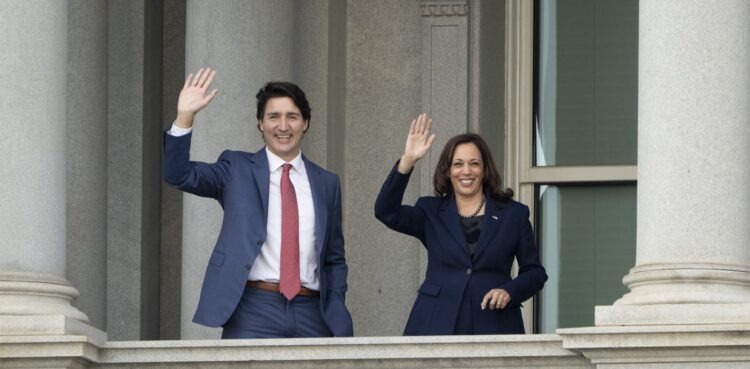
Prime Minister Justin Trudeau and Vice President Kamala Harris seem to have a good rapport, but will it matter to the Canada-U.S. relationship if Harris wins the presidency?
(Official White House photo by Lawrence Jackson)
Climate change suggests the need to shift to entirely new energy sources, supply chains and supportive infrastructure that world powers are now fighting over.
In this context, no powerful conservatives or liberals in the U.S. really support free trade or economic liberalization as ends in and of themselves. American conservatism is no longer about individual economic freedom; it’s shifted the focus of its attention towards priorities related to culture, community cohesion and national self-determination.
Liberals, while economically flexible, want to be able to finance a government that can pursue further social supports and progressive initiatives. Although the U.S. is divided, the source of conflict is largely over cultural and social questions, not economic ones.
This doesn’t mean that a future Harris or Trump administration would be synonymous. Both parties, for example, have significant disagreements over energy policy. While the Democrats are convinced that the green economy is the way to renewed industrial capacity, Republicans prioritize American self-sufficiency in cheap energy through the further development of natural sources, particularly natural gas.
Trump tariffs
At the same time, while Harris is likely to maintain the status quo already established by the two previous administrations, Trump has proposed further tariffs, including a 10 per cent across-the-board charge on almost all imports.
But even this is hard to evaluate with any certainty, as the Trump-Vance campaign has also been noticeably quiet on economic policy as well. The former president, for example, has suggested that tariffs can be threatened as a tool in trade negotiations, and important Republican figures continue to disagree on the exact way their economic goals should be achieved.
Overall, what matters is that — regardless of niceties or formal appearances — both administrations are prepared to continue a more forceful pursuit of American economic interest and self-capacity, even if it’s at the expense of Canada.
This is likely to come to a head in the upcoming review of the United States-Mexico-Canada Agreement (USMCA) that is slated for 2026, as it opens the greatest opportunity for the American president to pursue change.
Of course, Canada-U.S. economic integration is essential to the prosperity of both countries, and existing arrangements are certain to remain in terms of broad contours. But in cases where specific industries or commodities are in conflict, Canadians should expect a less conciliatory and amicable American approach — even under a potential President Harris.
Source link : http://www.bing.com/news/apiclick.aspx?ref=FexRss&aid=&tid=66d6878fd1d64762a5603212113a0e75&url=https%3A%2F%2Ftheconversation.com%2Fwhy-a-kamala-harris-presidency-wouldnt-necessarily-be-good-news-for-canada-237299&c=12129164113707062065&mkt=en-us
Author :
Publish date : 2024-09-02 01:33:00
Copyright for syndicated content belongs to the linked Source.