FIFA’s reasoning at the time was that high altitude was a potential health hazard for players and distorted fair competition — something Bolivia strongly denied. Evo Morales, the Bolivia president at the time, railed against what he described as “football apartheid”.
The ban was soon lifted and, eventually, La Paz could host international matches again, albeit the complaints from some countries — Brazil in particular — have never really gone away.
After a goalless draw at the Estadio Hernando Siles in La Paz in 2017, the Brazilian star Neymar posted an image on Instagram that went viral. “Inhuman to play in these conditions. Pitch, altitude, ball… everything is bad,” he wrote. The accompanying photo showed Neymar and his Brazil team-mates wearing oxygen masks on a sofa and armchairs, in full kit, at the end of the game. It was a bizarre scene.
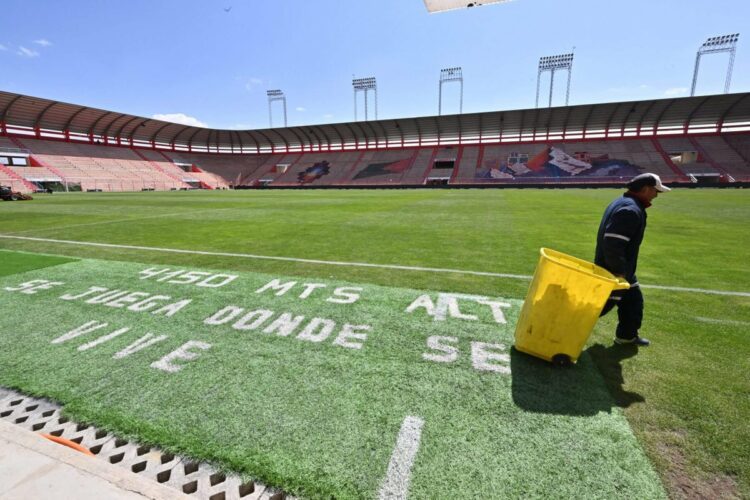
Now, seven years on, Bolivia have taken things a step further by choosing to play games in El Alto; in fact, about 1,840 steps further if we’re counting in feet. El Alto’s elevation is 560m higher than La Paz — a city where tourists often need days, and sometimes even weeks, to adapt to the thinner air that forces their lungs to work harder to deliver oxygen to the bloodstream.
All of which makes you wonder how the opposition players handle playing 90 minutes in El Alto — and the extent to which Bolivia stand to gain from what has been described by the federation as a trial.
“Soccer is made of details. It does not mean that with this (changing stadiums) we are going to win,” Oscar Villegas, the Bolivia coach, told the Associated Press before the Venezuela game. “We are trying to take care of details that can allow us to be more effective.

Oscar Villegas’ Bolivia side have 12 points from nine World Cup qualifying matches (Aizar Raldes/AFP via Getty Images)
“In El Alto, we are going to try to be as intense as possible and to let them know that they are on a new pitch where we have been unbeatable (a reference to Bolivian club teams playing at the stadium in international competitions such as the Copa Libertadores and Sudamericana).
“The psychological and emotional aspect also plays a role. It is something that is going to help us a lot.”
Mindful that the national team had been in a state of turmoil before the Venezuela win — they had lost five of their six World Cup qualification games, leaving them second from bottom in the group, and also suffered three straight defeats at the Copa America in June — it is hard not to be cynical about the motivation behind the Bolivian Football Federation’s decision to play matches in El Alto, where the stadium capacity is significantly lower than in La Paz. In short, it smacks of desperation.

An alternative view would be that Bolivia are just making the most of their natural habitat and that it’s no different to a nation that typically plays games in extreme heat or sub-zero temperatures.
“I don’t think it’s an important aspect for Bolivia to win — I see it a different way,” Marco Etcheverry, who is considered one of Bolivia’s greatest footballers, told The Athletic before the Venezuela win.
“Bolivia is going through a difficult moment in terms of players, directors — they have lots and lots of problems now. The organisation that defends the players — the union — isn’t in dialogue with the directors. It’s very bad.
“They’ve appointed a coach who is a great friend of mine and who I have a special affection for, to withstand people so that they don’t get too angry because they wanted a Bolivian coach. I think they did it (moving games to El Alto) more to pacify the fans. I think they think they will win in El Alto — hopefully, they do. But I don’t think it will be a great advantage for Bolivia.”
How much playing at high altitudes has helped Bolivia over the years has long been a matter of debate. There is a school of thought among some in Bolivia that all the talk about altitude gave the team a psychological edge over opponents more than anything else and that the possible physical effects, which can include nausea, headaches, fatigue and vomiting, are often overplayed.
What we can say for sure is that Bolivia have been a completely different proposition on home soil. Thirteen of their 15 points in the 2022 World Cup qualifiers were picked up in Bolivia and it was 14 in the previous campaign, which included another win over Argentina (2-0). Since moving to El Alto, they’ve won two from two, including against the team ranked ninth in the world, and have moved up to sixth in the group. Finish in that position and they will qualify for the 2026 World Cup.
Probably the best way to illustrate the difference playing at home makes to Bolivia is by looking at their away form. Their impressive 2-1 win away to Chile in September was only their second competitive victory outside of the country in the past 28 years.
For any teams travelling to Bolivia, adaptation is viewed as key. Mario Kempes, a World Cup winner with Argentina, tells a story about how the national team coach Omar Sivori decided to pick two totally different teams to face Bolivia at home and away in 1973, when the fixtures were only 14 days apart, in order to allow one set of players to acclimatize to high altitude. Kempes was in the so-called ghost team that won 1-0 in Bolivia.
“It is very hard to play at high altitude, you feel it. But it’s doable,” Kempes told The New York Times in 2009. “We went 15 days before to prepare. It was the right way. You do need extra time. But today, there is very little time.
“Yes, some countries have altitude on their side, but if you don’t have the players, it really is not an advantage.”
That chimes with Etcheverry’s views. “I think the altitude myth used to be a source of fear, but now with technology, you can do studies of everything — from what you have to eat to counteract the altitude, to the time at which you need to drink water, what quality of food you need, the rest, and specific training. Now teams go there (to Bolivia) and have fewer problems than previous times because managers are prepared.”
That is not to say there are no physical effects from playing at high altitudes. “The recovery is what’s slower,” explains Etcheverry. “It doesn’t stop you from running: you do everything the same. The only problem is when you make an effort, your recovery isn’t as quick. If there’s a move in which you make a big effort, you run 30m and put in a cross — you can do that. But running back and taking a breath is what’s difficult. That’s what costs you.”
Then there is the unusual behaviour of the ball to take into consideration. When Daniel Passarella was in charge of Argentina, they lost an away game against Ecuador in 1996 in Quito, a city more than 2,800m above sea level, prompting the coach to make a comment that has never been forgotten. “En la altura la pelota no dobla,” Passarella said afterwards.
So was Passarella right — is it true that the ball doesn’t bend at altitude or, at the very least, behaves differently?
Etcheverry smiles. “The speed, the time, the space the ball covers is different, that’s true,” he says.
“It goes faster,” Etcheverry adds, gesturing with his hand to show the sudden change in trajectory. “It’s like the ball goes in a straight line, let’s say, and it doesn’t have that downward curve at the end when it falls. It falls (immediately), which is complicated for goalkeepers.”
Claudio Taffarel, the former Brazil goalkeeper, could hardly blame altitude for Etcheverry’s shot from an acute angle pinballing between his legs and over the line in 1993, when Bolivia inflicted a famous 2-0 defeat against the team who would go on to win the World Cup 12 months later.
Bolivia qualified for the World Cup finals in the United States in 1994, but they have not managed to return to that stage since. Their journey to try to put that right continues with a helping hand from the unlikely environs of El Alto.
(Top photo: Aizar Raldes/AFP via Getty Images)
Source link : http://www.bing.com/news/apiclick.aspx?ref=FexRss&aid=&tid=6708e7f3867741c4a5b7031120ea5aec&url=https%3A%2F%2Fwww.nytimes.com%2Fathletic%2F5746338%2F2024%2F10%2F11%2Fbolivia-altitude-el-alto-colombia%2F&c=13853090945967667997&mkt=en-us
Author :
Publish date : 2024-10-10 21:35:00
Copyright for syndicated content belongs to the linked Source.