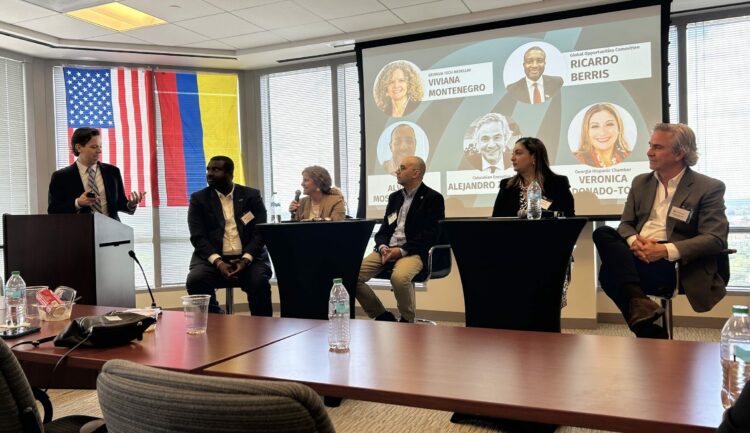
More Atlanta companies have been finding out firsthand how Colombia can help fulfill their objectives.
YKK, the Japanese zipper company which runs its Americas operations from Atlanta, set up a new factory in near Medellin in recent months. Atlanta’s Spectrum International has a Latin American fulfillment center there. RickyJoy, a candy and yogurt drink company run by a native of Colombia in metro Atlanta, has been looking to source from the country. Vensure, private employment organization that is a member of the Georgia Hispanic Chamber, has operations in Bogota.
Even the largest Georgia firms have seen benefit in the country.
United Parcel Service Inc. has not only had customs brokerage and logistics operations at the ports of Buenaventura on the Pacific and Cartagena, Barranquilla and Santa Marta on the Atlantic, but it has also taken advantage of Colombia’s skilled labor force, investing in knowhow that has helped continuously grow the local business and support international operations, Alvaro Moscoso Diaz, regional tax manager at UPS, said during a panel discussion at Miller & Martin.
In Medellin, a UPS shared services center has seen rapid uptake.
“We started with 200 employees. Now we are 1,000 employees. Basically, we are exporting services from Medellin to the United States, providing services like customer services, billing,” Mr. Diaz said said. “Why Medellin? The ability to get multilingual people in the workforce, not only in English and Spanish, but we are able to get people that speak more than those languages, as well as a special regime about exports.”
In Bogota, the company is investing in growing Latin American cold-chain operations after acquiring Bomi, an Italian multinational with a health care facility there.
In the opposite direction, acquisitions have also become a growing pathway for Colombian companies entering the United States, said Alejando Zuluaga, a former CFO in the U.S. for Argos, the Medellin-based cement company with headquarters in Alpharetta.
Buying a firm can give Colombian companies a quick foothold in the market while overcoming cultural barriers and learning about U.S. regulations.
“Companies in Latin America, particularly in Colombia, are thinking that acquisitions need to be huge companies. It depends on the industry and everything, but you can, you can start small, and I recommend that,” said Mr. Zuluaga, who now runs BTZL Partners.
Another panelist, Viviana Montenegro, outlined how the Enterprise Innovation Institute at Georgia Tech has been helping build capacity for Colombian entrepreneurs, both helping them explore the U.S. market through the Soft Landings program and establishing a new innovation center in Medellin.
Funded with $2.5 million from an alumnus, Georgia Tech Medellin aims to help the city establish an innovation ecosystem by introducing programs like that have been successful in Atlanta, like the CREATE-X entrepreneurship program.
“We are opening the center, installing the capacity, training local people, convening all these entrepreneurs and universities to work together. And then, after year five, we are leaving and getting them to run the center,” Ms. Montenegro said.
It’s not just Bogota and Medellin or the tourism hub of Cartagena that are seeing interest from Atlanta.
Cali, the largest city near Colombia’s Pacific coast that has sought to emulate Atlanta’s success in building its minority business community, welcomed 20 Black-owned businesses from Atlanta during a historic trade mission last year.
Ricardo Berris, who chairs the Atlanta Black Chambers Global Opportunities Committee, said the trip was part of a broader initiative to help Black businesses in Atlanta go global by building up their trade and investment partnerships with their counterparts in Africa, the Caribbean and beyond.
“We recognized that just down the street there 5 million people who look like us,” he said of the Afro-Colombian community. “We thought that outside of the Caribbean, that was the next best group we wanted to interact with.”
The followups have been tangible, not only from the Atlanta side. Mr. Berris recently traveled back to Cali and observed that the city had set up the Next Room program to help Black-owned businesses export, partially modeled on the chamber’s initiative. He also attended the packed Petronio Alvarez music festival.
On Oct. 3, the GO committee will welcome Daniel García-Peña Jaramillo, Colombian ambassador to the United States, to Atlanta as part of a delegation coming for the committee’s Global Opportunities Week, the next step toward an annual conference it hopes to host in 2025. Contact Mr. Berris about attending
Atlanta has been the target of other Colombian delegations in recent years. ProBarranquilla, the organization promoting the city on Colombia’s Atlantic coast, hosted an investment seminar in 2023 in Atlanta during which it highlighted opportunities as a near-shoring hub with key free-trade zones near Caribbean-facing ports. Watch that seminar here
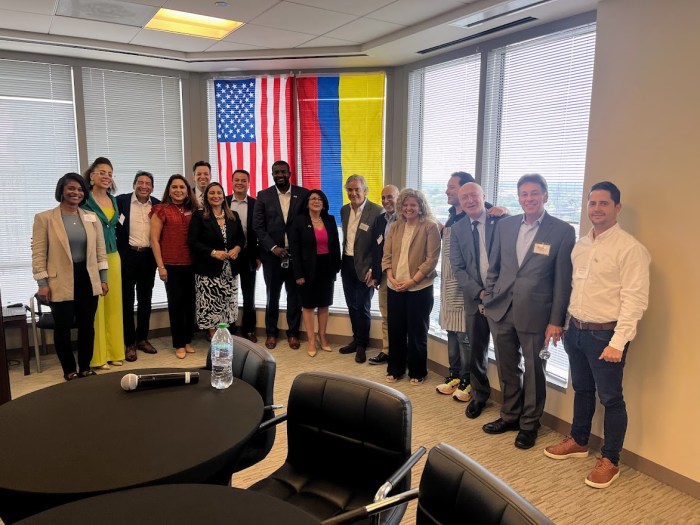 Many Atlantans who accompanied the Atlanta Black Chambers to Cali, Colombia, last year reunited at the event and met with the panelists.
Related
Source link : http://www.bing.com/news/apiclick.aspx?ref=FexRss&aid=&tid=66ef04c127324636979850c123a9c6c0&url=https%3A%2F%2Fwww.globalatlanta.com%2Fcolombia-a-panoramic-view-of-atlantas-growing-ties%2F&c=4247049440014843489&mkt=en-us
Author :
Publish date : 2024-09-21 05:41:00
Copyright for syndicated content belongs to the linked Source.