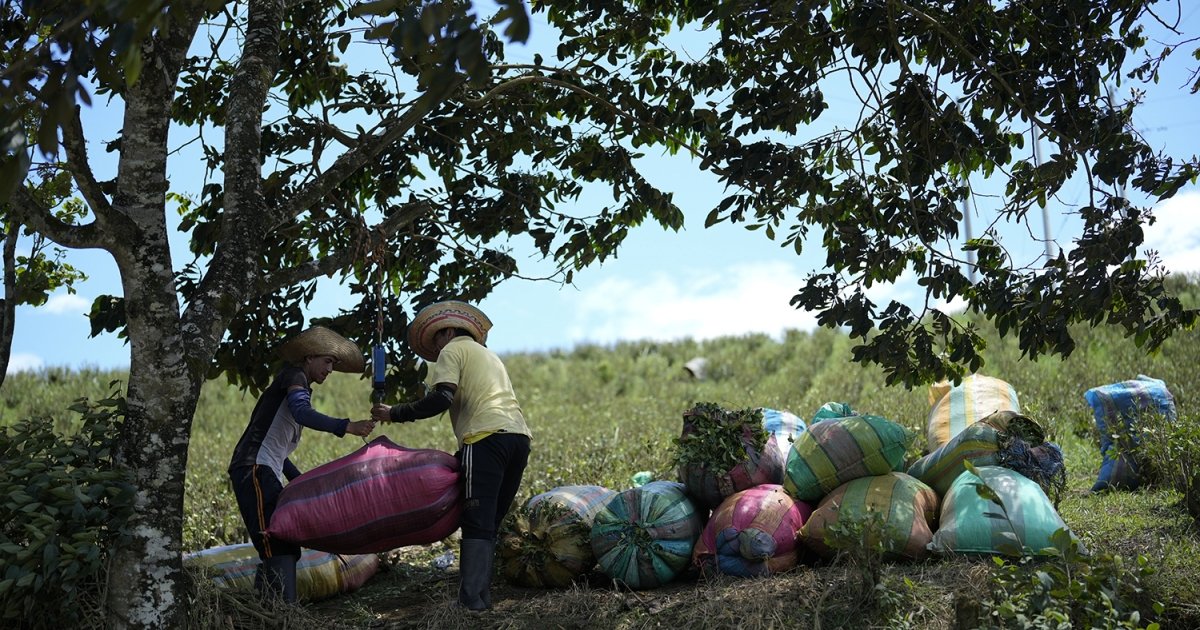
In 2023, Colombians cultivated coca leaves on over 250,000 hectares of land—10% more land than the preceding year and the most in more than 20 years.
What happens in, and from, Colombia has long affected life in the United States. American culture has been enriched by the many contributions of Colombians like Shakira, Carlos Vives, and Sofia Vergara, and productions like Disney’s Encanto. And where would we be without Colombian coffee? But it’s also true that the illicit side of Colombia—its status as the world’s largest producer of cocaine—has significantly impacted the US.
Colombia and the US have partnered on many projects and policies over the years, but none have been more consequential than Plan Colombia. A bipartisan effort spanning numerous administrations and involving many sectors of the Colombian economy and society, Plan Colombia was formally launched in the year 2000 in response to the hemispheric impacts of Colombia’s drug cartels and terrorist insurgencies. It received support from both political parties in Washington, DC—each one expanding and strengthening the initiative. While it took $12 billion dollars and decades of effort, Plan Colombia, alongside the US-Colombia Free Trade Agreement, helped bring lasting peace and stability to Colombia, and reduced the flow of cocaine to US shores.
But while Plan Colombia defeated the dominance of cartels in Colombia, it didn’t end the cocaine trade. Nor did it eliminate rural poverty or marginalization. In his campaign for the presidency in 2022, Gustavo Petro proclaimed that his country’s war on drugs had badly failed. He promised to replace what he referred to as the “militarization” of drug policy with a radically different approach.
At first that new approach was to include the legalization of cocaine and treating its production as a public health matter warranting regulation and taxation, instead of prosecution and punishment. In response to opposition both inside Colombia and with partners like the US, President Petro eventually jettisoned his plans in favor of an approach built on disrupting large scale drug operators by, among other things, trying to intercept cocaine in transit, while economically supporting small family coca farmers. He ruled out broad eradication efforts and instead said that small farmers would be allowed to continue coca leaf cultivation. He promised to boost government investment in areas where most coca farms were located, and to heavily incentivize farmers to shift to other crops and economic activities.
A recent United Nations Office on Drugs and Crime (UNODC) report suggests President Petro’s policies may be approaching a moment of truth for both Colombia and US-Colombia relations. The report finds that the area of land under coca leaf cultivation increased 10% during 2023, from 230,000 hectares in 2022 to 253,300 hectares. It also notes that moves by coca farmers to adopt more effective cultivation techniques in recent years have doubled cocaine yield per hectare compared to a decade ago. The UNODC’s analysis concludes that this combination of increased coca farmland and increased production efficiency amounts to a 53% increase in the country’s cocaine production capacity. This expansion of potential cocaine production is the largest recorded increase since the UN began monitoring production in 2001.
President Petro hoped his policies would lead rural areas away from participating in the country’s cocaine sector, but it appears that the opposite may be happening. Sixteen of Colombia’s 19 departments (equivalent to states) saw increases in coca cultivation during 2023. The highest increases occurred in the regions bordering Ecuador and Venezuela, areas often neglected by the state and influenced (if not controlled) by criminal gangs.
Colombia is a spectacular country, and its people are hardworking and creative. The more that Americans learn about Colombia—and the accomplishments of the US-Colombia relationship—the more they realize how important the country is to the hemisphere’s culture and way of life. But if anywhere near the 53% increase in potential cocaine production is realized, so much can come undone. Plan Colombia was a massive undertaking and an extraordinary achievement. If it is seen to be unraveling, it will represent an extraordinary tragedy.
This blog was researched and drafted with assistance by Dhruvi Thakker.
Source link : http://www.bing.com/news/apiclick.aspx?ref=FexRss&aid=&tid=674f7878aec84260acbc6ea20da45f4f&url=https%3A%2F%2Fwww.wilsoncenter.org%2Fblog-post%2Fcolombias-cocaine-moment-truth&c=11835776617833042601&mkt=en-us
Author :
Publish date : 2024-12-03 07:22:00
Copyright for syndicated content belongs to the linked Source.