WBEZ reporter Chip Mitchell takes a break in downtown Bogotá in April with a young Colombian journalist who was shadowing him for the day to learn about audio reporting.
Anthony Vazquez/Sun-Times
I had to draw from what I had learned during my 18 years at WBEZ — a shop that nurtured “This American Life” and remains influenced by that storytelling approach.
I also had in mind the late Sun-Times movie reviewer Roger Ebert’s principle for judging a film’s merit: “Your intellect may be confused, but your emotions never lie to you.”
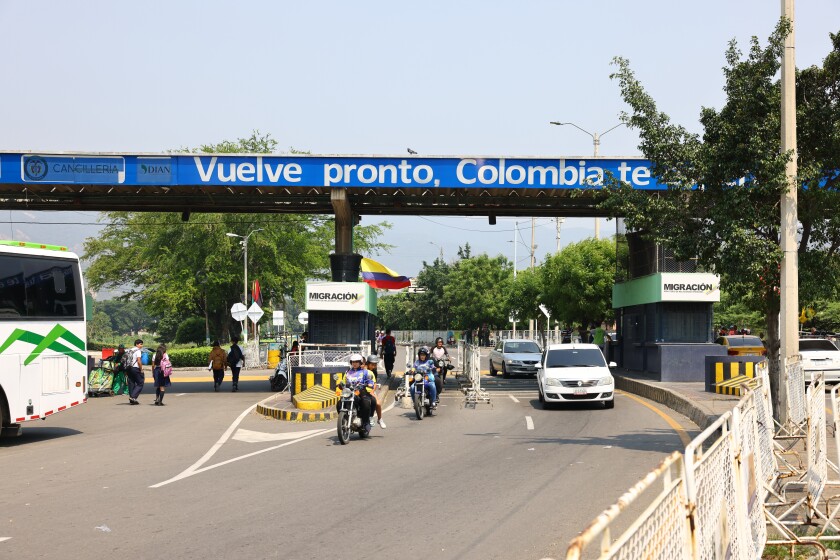
I worked through local journalists and humanitarian aid groups to reach migrants in low-income parts of Bogotá and Cúcuta, a Colombian city along the Venezuelan border. I was able to schedule most of those interviews for the trip’s second week, when I was joined by Sun-Times photographer Anthony Vazquez. We met most of these migrants in their homes, all humble.

Desiré Borges, 17, holds her daughter in April outside their home in Los Patios, a town near Colombia’s Venezuelan border. She said xenophobic bullying led her to drop out of high school.
Anthony Vazquez/Sun-Times
The job was to zero in on moments of their journeys that evoked meaning and emotion, such as:
A mother’s wrenching decision to uproot her family from its once-comfortable home as hyperinflation wiped out her ability to feed and clothe themAnother mother’s crisis when she lost grip of her baby on a rocky path across the Colombia-Venezuela border; he seemed to be dying until a stranger appeared and provided lifesaving careA 17-year-old’s escape from her Colombian high school, where she faced searing anti-Venezuelan comments from classmates and even teachersA family’s successful steps to rebuild the middle-class life they had to leave behind

Zoheny Lugo and her kids this April in their kitchen in Palmitas, a low-income neighborhood of Bogotá, the Colombian capital. They struggled after moving from their comfortable life in Venezuela. After she and her husband got work permits and jobs, they were saving up to move to a bigger apartment in a safer neighborhood.
Anthony Vazquez/Sun-Times
We anchored our digital, newspaper and audio stories in those moments. We documented what drove migrants from Venezuela, how they crossed into Colombia, the xenophobia they have faced and their integration into Colombia, which has turned out to be a tenuous muddle.
We compared Colombia to Chicago and looked at U.S. policy toward Venezuelan migrants. And we tried to add nuance. We took apart, for example, a left-wing talking point that Venezuela’s economic meltdown resulted from a U.S. economic blockade.
Another tricky subject was Colombian President Gustavo Petro’s failure to embrace migrant integration, a policy the left-wing leader had inherited from right-wing predecessors. Petro’s priority was building relations with Nicolás Maduro, Venezuela’s authoritarian president, who was embarrassed by the exodus from his country.
It took several weeks of coaxing to get an interview with anyone from Petro’s administration about his migration approach. We finally sat down with an official just a few hours before boarding our plane back to the United States.
It was an achievement. But the bigger win would be back in Chicago — if our reporting touched any hearts.
Chip Mitchell reports for WBEZ Chicago on policing, public safety and public health. Follow him at Bluesky or X. Contact him at [email protected].
Source link : http://www.bing.com/news/apiclick.aspx?ref=FexRss&aid=&tid=676e9cba568643c3910e395f6c200c71&url=https%3A%2F%2Fchicago.suntimes.com%2Fchicago%2Fyear-in-review-2024%2F2024%2F12%2F27%2Fmigrants-immigration-colombia-venezuela-solutions&c=5211026125109616717&mkt=en-us
Author :
Publish date : 2024-12-26 22:30:00
Copyright for syndicated content belongs to the linked Source.