* * *
But it’s on the right, divided and out power, where open disagreement is breaking out.
First and foremost, conservatives, egged on by a former president who alleges all manner of cloak-and-dagger intrigue against them and his old administration, are increasingly receptive to messages of war against the security state. Tucker Carlson, sized up by Time magazine in an interview on Thursday as “the most powerful conservative in America,” has in recent months said the National Security Agency is spying on him, personally, among manifold other complaints, adding to the track record of challenging the foreign policy status quo he racked up in the Trump years (including giving voice to this writer).
While much of the rest of Fox dedicated much of their programming to the island this week—including fellow primetime stars Sean Hannity (who hosted Sen. Marco Rubio) and Laura Ingraham (who welcomed former Secretary of State Mike Pompeo)—Carlson has, thus far, conspicuously ignored it, other than to briefly call out politicians more invested in that country than the goings on at the U.S. southern border.
And in recent months, Carlson has escalated his alliance with independent journalist Glenn Greenwald, a sort of transpartisan anti-establishmentarian, who has blasted the Biden administration and liberal media stars, shocking old comrades on the left. But Greenwald has blasted many folks more right-leaning in recent days: those backing a side in Cuba.
“The last five years of discourse on the right have been about the CIA’s evils and the Deep State. Why would you want to unleash people like that and empower them to interfere in other countries?” Greenwald told the Spectator.
But to quote that film about communist intrigue, Hail, Caesar!: Would that it were so simple.
The high command of the Republican Party is increasingly concentrated in Florida. The state’s residents include not only Rubio, and Carlson, and Donald Trump, but almost countless other big names and plausible future presidential contenders: Sen. Rick Scott, Suarez, and perhaps the biggest Republican name after Trump, Gov. Ron DeSantis. And that list didn’t include the conservative-friendly, Tampa Bay Buccaneers superstar Tom Brady.
And the linchpin of the Republican vote in Florida is that constituency where Mayor Suarez’s sentiments are not exactly an outlier: the Cuban diaspora.
This doesn’t even get into perhaps the most promising development for the Grand Old Party in an otherwise dismal 2020: surging Hispanic support, not just isolated to Cuban-Americans. Negative opinions of the governments in Latin America often motivate Hispanic conservatives, including to the point of supporting tough-minded immigration measures.
But what is politically untested: demanding border enforcement at home, while proclaiming total disinterest to the fates of those still abroad. If they can’t move to America, what is to become of those trapped under dictatorship or desperation, or both? And what is to become of a political party that potentially messages myopically? Republicans overperformed with minorities in 2020, and are wary of forfeiting the moral authority those gains brought, but are unsure of how to proceed.
An added factor: That paragon of left-leaning dysfunction, California, particularly San Francisco, has recently suffered an exodus, to where else? Miami. While not exactly officially a Republican storyline, the success of Miami as a start-up incubator and refugee camp for those tired of Golden State Gauleiters is pretty clear. Many of these venture capital types have openly mused in recent days about making Cuba the 51st state, not clearly facetiously.
A writer who straddles both those worlds, Antonio Garcia Marquez, wrote this week: “If protests continue to grow in Cuba, I’d wager the government again opens the exile escape valve to calm things down. … In that scenario, the Biden administration will have a crisis on his hands.”
This would be bad news for those involved, and for Biden, but potentially good political news for Republicans. Their bugbear, Vice President Kamala Harris, just so happens to have the immigration portfolio, and the early results have left something to be desired from Biden’s assumed successor.
Harris backed ending the Cuba embargo during the presidential campaign, but sometimes, as any fast-rising politician knows, things change.
“We are focused on addressing both the acute factors and the root causes of migration,” Harris told the Conference of the Americas in May. “First, the acute factors—the catastrophes that are causing people to leave right now…. And then there are the longstanding issues—the root causes—and I’m thinking of corruption, violence, and poverty. The lack of economic opportunity… the lack of good governance.”
And Harris knows well the dangers of being seen as too cozy to Cuba’s regime. In 2020, her principal rival for the vice presidential nomination, Los Angeles Rep. Karen Bass, was likely disqualified because of past praise of the late Fidel Castro.
In many ways, the discourse surrounding Cuba mirrors Israel and Palestine, last seen flaring up in May. In these theaters, conservatives can feel good for once, on the side of angels against terroristic, failed left-wing governments. Though nuance abounds, it’s lost in the sound and fury of patriotism, and Democratic shuffling by politicians eager to not be seen as too close to Hamas, or the communist has-beens in Havana.
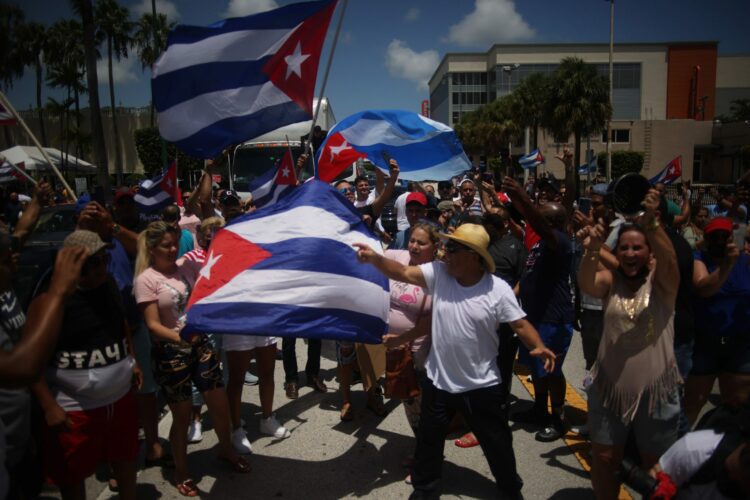
Perhaps contra Greenwald, for many, witnessing the scenes in Miami this week was the first time in a long while that people remember a gathering in the streets where the clear spirit of the crowd was that America is good.
* * *
The politics are not clean here for the Republican Party and its conservative base.
As evidenced by its takeover by Donald Trump, the GOP is clearly ready to move on from Middle East wars, with the possible, worrying exception of a future, outright conflict with Iran. But policy on Latin America has for years been less clear.
Rex Tillerson, Trump’s short-lived secretary of State, once urged a renewal of the Monroe Doctrine to counter China.
Calling it “clearly….a success,” the ex-oilman said the fifth president’s declaration of regional power was “as relevant today as it was the day it was written…. Latin America does not need new imperial powers that seek only to benefit their own people…. China’s state-led model of development is reminiscent of the past…. It doesn’t have to be this hemisphere’s future.”
More hawkish entrants into Donald Trump’s inner sanctum—Rubio, Pompeo and John Bolton—agreed, and then some.
Bolton, of course, led the charge on a potential but eventually scuttled invasion of Venezuela. And a former senior official told me Rubio was the “pointman,” as Trump preferred to informally divy up regions, on Latin America early in the administration. Whatever strides Rubio has made with Trump’s nationalist, populist base—and he has—the senator is still dogged by concerns over a seemingly neoconservative, nation-building past.
But Rubio wisely anchored his criticism of the Cuban regime this week in China.
“And by the way, that system, in Cuba, that shuts down the internet? Guess who gave it to them? China,” Rubio told Fox’s Sean Hannity this week.
And while Bolton is now a Trumpist apostate, Pompeo desires to succeed Trump pronto, however he can. And this week, it’s Cuba.
“This is about communism, this is about socialism,” Pompeo told Fox’s Ingraham this week. “They know that the lives of their family won’t be better the next generation,” Pompeo said, hesitating slightly, perhaps worrying about the possible comparison to intergenerational struggles in the United States. “They know that their country was designated by me as a state sponsor of terror,” the former secretary said.
Perhaps a red line will emerge. Opposition to Biden repeating the early mistake of the last Catholic president to hold office—an invasion of Cuba—is easy enough to picture. But all other bets appear to be off.
Source link : http://www.bing.com/news/apiclick.aspx?ref=FexRss&aid=&tid=66dc8a440fb6474fb8fae1b0e6eb2aba&url=https%3A%2F%2Fwww.theamericanconservative.com%2Fhow-cuba-divides-the-right%2F&c=6102436666932526039&mkt=en-us
Author :
Publish date : 2021-07-15 13:00:00
Copyright for syndicated content belongs to the linked Source.