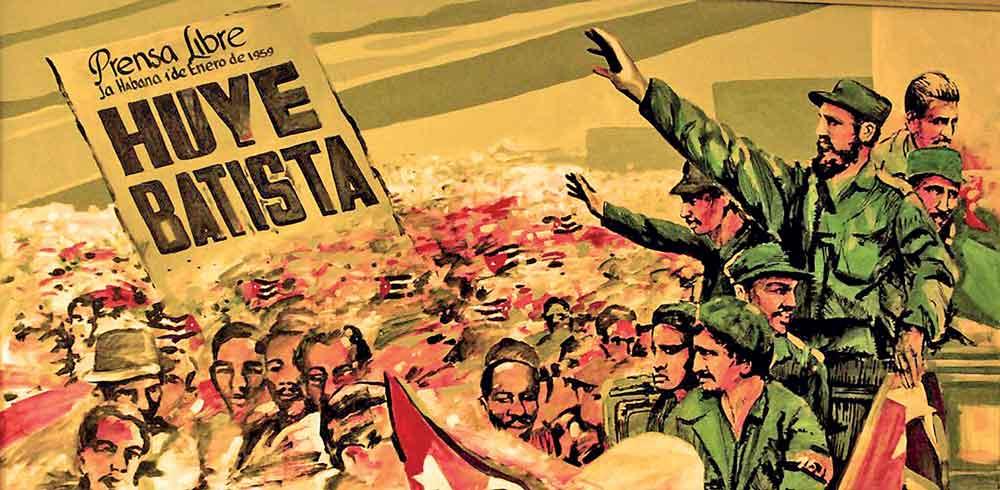
The Cuban Revolution was an armed uprising in Cuba that overthrew the government of Fulgencio Batista on January 1, 1959
 The Cuban Revolution was an armed uprising in Cuba that overthrew the government of Fulgencio Batista on January 1, 1959. The revolution’s leader, Fidel Castro, went on to rule Cuba from 1959 to 2008. This article highlights the significance of this revolution and the revolutionary transformation of Latin America.Â
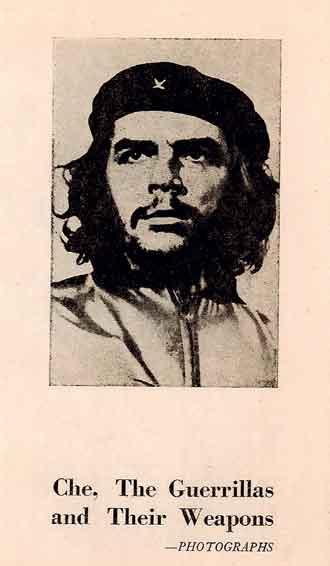
One day, Che said to the guerrilla fighters in Bolivia: “This type of fight gives us the opportunity of becoming revolutionaries, the highest level of the human species, and it also permits us to graduate as men; those that cannot reach either of these two stages should say so and give up the fight.�
Those that fought with them until the end have become worthy of such honours. They symbolise the type of revolutionaries and men whom history is now summoning for a truly hard and difficult task: the revolutionary transformation of Latin America.
 The enemy which faced our forefathers during the first fight for independence was a decadent colonial power. The revolutionaries of today have as their enemy the most powerful bulwark of the imperialist camp, equipped with the most modern techniques and industries. This enemy not, only newly organized equipped the Bolivian army, where the people had destroyed the previous military repressive forces and immediately helped with weapons and military assistants for the fight against the guerrillas, but they also offer military and technical aid to the same degree to all the repressive forces on this continent. And when these measures were not sufficient, they intervened directly with their troops, as they did in Santo Domingo.
The North American people themselves, who are becoming conscious of the fact that the monstrous political superstructure which prevails in their country is no longer the idyllic. The bourgeois republic established by its founders almost two hundred years ago, is undergoing to an ever greater degree the moral barbarousness of an irrational, obsessed, brutal and inhuman system which engulfs more victims from among the North American people in its aggressive wars, political crimes, racial aberration, niggardly regard for the human being, and the repugnant squandering of economic, scientific and human resources. All these events happen in the middle of a world which is seventy five per cent underdeveloped and hungry.
But only the revolutionary transformation of Latin America could permit the people of the United States to settle accounts with imperialism itself. At the same time and at the same rate the rising struggle of the North American people against imperialist policy could become a decisive ally of the revolutionary struggle in Latin America.
If this part of the hemisphere does not undergo a profound revolutionary transformation, the enormous difference and lack of balance at the beginning of the century between this powerful nation – which was rapidly industrialised at the same rate as it progressed by its own law of social and economic dynamics toward imperial heights – and the group of weak and thwarted nations in the other Balkanised part of the American continent will be but a pale reflection. A reflection of not the already great lack of economic, scientific and technical balance which now exists, but of the frightful lack of balance which the imperialist superstructure will impose at a greater speed on the peoples of Latin America in the next twenty years.
This way we shall become poorer, weaker and more dependent upon and enslaved by imperialism. This dark perspective equally affects the underdeveloped countries of Asia and Africa.
If the industrialised and well-instructed nations of Europe, with their Common Market and supranational scientific institutions become perturbed by the possibility of getting left behind and contemplate with fear the perspective of being converted into economic colonies of Yankee imperialism, what does the future have to offer to the peoples of Latin America?
If this real and unquestionable situation decisively affects the destiny of our peoples, some liberal or bourgeois reformist or pseudo-revolutionary charlatan, incapable of action, may have an answer that is not for a profound and urgent revolutionary transformation. It could gather together all the moral, material and human forces to launch them forth in this part of the world in order to recover from the economic and scientific-technical backwardness of centuries, greater when compared to the industrialised world of which we are tributaries, and will continue to be a greater degree, especially of the United States – and furthermore is able to give the formula, the magic way to accomplish this, different from the way conceived by Che. In turn it can wipe out oligarchies, despots, petty politicians, that is to say, nursemaids, and Yankee monopolies, the masters, and to be able to do it with all the urgency which the situation requires.Â
Che wrote his last line on October 7. The following day, at 13 hours, in a narrow ravine where he proposed waiting for the night in order to break the encirclement, a large number of enemy troops made contact with them. The reduced number of men of which the detachment was composed on this date, fought heroically until dusk from individual positions located in the bed of the ravine and on the top edges against the mass of soldiers that had surrounded and attacked them. Among those who fought in positions close to Che, there were no survivors. Besides him were the doctor, in a grave state of health, and a Peruvian guerrilla, also in bad condition, which seems to indicate that Che, until wounded, did his utmost to protect the withdrawal of these two comrades to a more secure place. The doctor was not killed during the same battle but several days later at a not very distant point from the Quebrada del Yuro. The abruptness of the rocky irregular terrain made visual contact among the guerrilla fighters very difficult and at times impossible. Those defending the position at the other entrance of the ravine several hundred metres from Che, among them Inti and Coco Peredo, held off the attack until dusk when they managed to get away from the enemy and left for the previously agreed point of contact.
It has been established that Che continued fighting, though wounded until the barrel of his M-2 rifle was destroyed by a shot, rendering it completely useless. The pistol he was carrying had no magazine. These incredible circumstances explain how he could have been captured alive. The wounds in his legs kept him from walking without help but they were not fatal.
Moved to the town of Higueras, he lived approximately 24 hours more. He refused to exchange words with his captors and a drunken officer who tried to vex him received a slap across the face.
Gathered in La Paz, Barrientos, Ovando and other high military chiefs coldly made the decision to assassinate him. The details of the way they proceeded to carry out the treacherous agreement at the school in the town of Higueras are well known. Majo Miguel Ayoroa and Colonel Andres Selnich, rangers trained by the Yankees, instructed officer Mario Teran to proceed with the killing. When the latter, completely drunk, went into the place, Che, who had heard the shots which had just killed a Bolivian and a Peruvian guerrilla fighter, seeing that the assassin vacillated said firmly, “Shoot, don’t be afraid!� The latter left and again it was necessary for his superiors, Ayoroa and Selnich, to repeat the order, which he then proceeded to fulfill, firing with his machine-gun from the waist down. Word had already gone around that Che had died several hours after combat and therefore his executors had orders not to shoot at his chest or head so as not to induce fatal wounds. Such a procedure is in brutal contrast to the respect that Che had, without a single exception, for the lives of numerous officials and soldiers of the Bolivian army whom he had taken prisoner.
The final hours of his existence in the power of his despised enemies must have been very bitter ones for him, but there was no man better prepared than Che to be put to such a test.
The way that the Diary came into our hands cannot be divulged at the moment; it is enough to say that it required no monetary remuneration. It contains all the notes he wrote from November 7, 1966, the day Che arrived at Nancahuazu, until October 7, 1967, the evening before the combat in the ravine in Yuro. There are only a few pages missing which are not in our hands but they correspond to dates on which nothing of any importance took place and therefore do not alter the content of the Diary in any way.
Although there was no doubt as to the authenticity of the document, all the photo static copies were submitted to a rigorous examination for the purpose not only of proving the authenticity but also to check on any possible alteration, no matter how small. Furthermore, the data was compared with the diary of one of the surviving guerrillas. Both documents coincide in all respects. The detailed testimony of the remaining guerrilla survivors who were witnesses to each and every one of the events also contributes to the proof of its authenticity. The conclusion was reached with absolute certainty that all the Photostats were true copies of Che’s Diary.
It was a fatiguing job to decipher the small and difficult handwriting, a task carried out with the laborious participation of his wife and comrade, Aleida March de Guevara.
The Diary was published almost simultaneously in France, by the French Editorial Francois Maspero; in Italy by the Editorial Feltrinelli; Trikont Verlag of the German Federal Republic ; the Ramparts Magazine in USA; Ediciones Ruedo Iberico in Spain ; Revista Punto Final in Chile and in other countries.
Â
Source link : http://www.bing.com/news/apiclick.aspx?ref=FexRss&aid=&tid=6775c091c8744415b538622de679c215&url=https%3A%2F%2Fwww.dailymirror.lk%2Fnews-features%2FHow-the-Cuban-Revolution-influenced-the-revolutionary-transformation-of-Latin-America%2F131-299263&c=12654559704179959114&mkt=en-us
Author :
Publish date : 2025-01-01 07:06:00
Copyright for syndicated content belongs to the linked Source.