(Amazon)
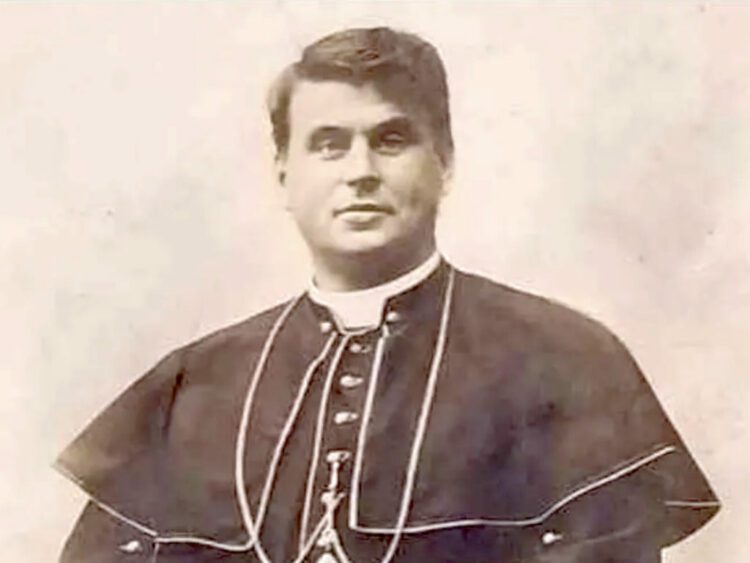
Perhaps the business issue is why the Vatican ambassador to Cuba who had consecrated the young Broderick as a bishop, Archbishop Placide Chapelle, turned from promoter to “persecutor� according to Hanna, who does not speculate on reasons. After only a short time as auxiliary bishop, Broderick faced opposition in Havana. Chapelle went to Rome to complain about him, and Broderick followed him there to defend himself, taking with him his mother and her caregiver, a former nun with whom he had worked in Cuba.
The new pope at the time, St. Pius X arranged a pension from the Church in Cuba and named Broderick, a gifted fundraiser, to oversee the Peter’s Pence Collection in the U.S. He also made plans to assign him as auxiliary bishop of Baltimore, with residence in Washington, D.C., without bothering to consult the local bishop. Cardinal Gibbons, archbishop of Baltimore, was adamantly opposed to both aspects of the plan. Pretty soon the young bishop ended up without a diocese and without a job.
He tried to find work, and even got President Teddy Roosevelt to support his idea for a system that would draw Italian immigrants away from crowded cities and into villages in Virginia where they could continue their agricultural work. The plan failed miserably, and Broderick took up residence in New York.
Broderick had some personal income but ended up spending a great deal of time in court while waiting for an assignment from Rome that never came. He wrote a letter to St. Pius X arguing that his situation would give scandal, which the pope took as a threat. And the rest was silence, for a long time.
He said Mass privately for his mother and her caregiver, was involved with the community in which he lived independently, but had no connection with Church life. He tried his hand at farming, was popular with his mostly wealthy neighbors, who knew him as “Doctor� Broderick, and wrote for a small weekly newspaper from 1937 to 1939. Hanna has edited a collection of the bishop’s columns titled “The Wit and Wisdom of Bishop Bonaventure Broderick.� The writings reveal a very cultured man, an America First-er, and a critic of Franklin Delano Roosevelt (whose family home was not far from Millbrook, where the bishop lived).
Because of the Great Depression, perhaps, the bishop found himself in financial difficulty. He invested in a gas station and auto parts store in the 1930s. He lived in quiet exile. Then in 1939, after 34 years in the ecclesiastical cold, came something of a miracle: the archbishop of New York knocked on his door.
Archbishop (later Cardinal) Francis Spellman got a lot of bad press from critics over the years. But his compassion with Broderick is a story of grace, assigning the 70-year-old prelate to a nursing home as a chaplain to a congregation of sisters, and making him an auxiliary bishop of New York. Broderick sold his home and business and went to live with the sisters, who loved him and who told stories about how the bishop would talk of Cuba with tears in his eyes. Three years after the return to ministry, Broderick died in the arms of Holy Mother Church. It is an extraordinary story, puzzling and with many missing pieces, but also heartwarming.
Like the mythological character Icarus, the ambitious and brilliant young cleric flew a bit too close to the sun. James Hanna and Serif Press have done a service to the Church in America publishing these two books on a man Hanna describes as a “curious footnote� in the recorded history of the Church in America. There must be more to all this than Hanna shows, but the human dynamic in the Church, the sweep of ecclesiastical history, and God’s everlastingly ironic Providence make Broderick’s story well worth reading and reflecting upon.
Source link : http://www.bing.com/news/apiclick.aspx?ref=FexRss&aid=&tid=66b3e613e29a4de99fab22e41c61e847&url=https%3A%2F%2Fangelusnews.com%2Farts-culture%2Fbishop-broderick-book%2F&c=5285440619504093715&mkt=en-us
Author :
Publish date : 2024-08-06 20:00:00
Copyright for syndicated content belongs to the linked Source.