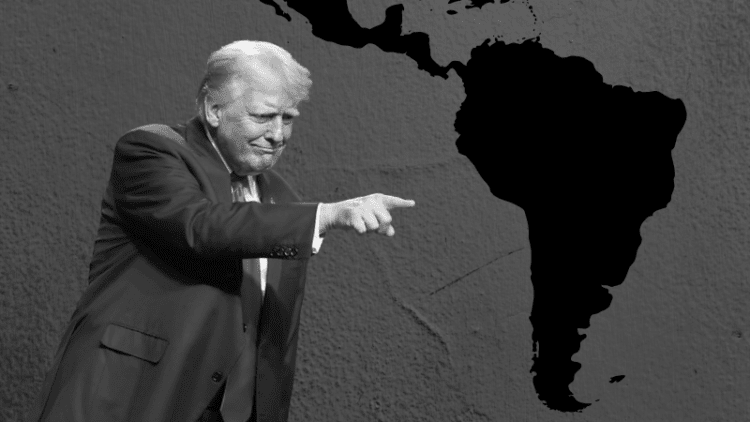
Montage by Global Voices, featuring U.S. President-elect Trump (image from Flickr, under CC BY-SA 2.0) and the map of Latin America
On January 20, 2025, U.S. President Donald Trump will assume office again and face familiar but evolving challenges in Latin America. Two of these challenges stand out.
First, the decline of U.S. influence in the world. This tendency is confirmed in Latin America, where China and Russia are strengthening their foothold. China‘s investments in infrastructure, technology, and energy have surged across the region, making it the second most important commercial partner for many Latin American countries. Meanwhile, Russia has expanded its military and diplomatic ties with several countries and continues to engage in disinformation campaigns, aiming to sway public opinion and political outcomes.
Second, since the onset of COVID-19, Latin American countries have experienced slow economic recovery, deepening political crises, a spike in violence linked to drug trafficking cartels, and worsening social inequalities. These challenges have led to a surge in migration. Migrants, numbering in the millions, have been making the journey to the U.S.-Mexico border in search of a better future. Data indicates that during President Biden’s administration, an estimated eight million individuals, mainly from Latin American countries, have been apprehended at the U.S. border.
These were central issues during Trump’s campaign. Like his previous term, his speeches focused on prioritising U.S. interests abroad, a strong anti-immigration stance, and a promise to launch the largest deportation campaign in U.S. history. While in the past he accused Mexico of sending “rapists” and “criminals” to the U.S., he has now directed similar accusations toward El Salvador, expressing concerns about gang members entering the United States. Trump’s relationship with Latin America has been marked by ups and downs; for this reason, governments in the region did not all react the same to his re-election.
Those with minimal concerns
For one group of Latin American governments, a victory by either Kamala Harris or Donald Trump would not have changed much. Countries like Argentina, Brazil, Chile, Costa Rica, the Dominican Republic, Panama, Paraguay, Peru, and Uruguay maintain good relations with the U.S., holding solid economic, diplomatic, and, in some cases, military cooperation. Apart from the Dominican Republic and Peru, the diasporas from these nations in the U.S. are relatively modest, and, therefore, they have fewer significant concerns that Trump’s policies would directly impact their populations abroad.
However, Trump’s re-election could bolster populist right-wing governments in Latin America. This might be the case in Brazil, the region’s largest economy, where former president Jair Bolsonaro is also seeking a comeback. Bolsonaro and Trump shared overlapping presidencies from 2019 to 2021 and were close ideological allies. An important question arises: how might Trump’s personal ties with Bolsonaro shape his interactions with Luiz Inácio Lula da Silva, Brazil’s current president? For his part, Lula has stated that relations with the Trump administration will remain respectful and not based on ideological biases.
Libertarian politician Javier Milei of Argentina may benefit the most. Milei has directed Argentina’s foreign policy toward closer alignment with Western and U.S. interests and shares a network of associates with Trump, including individuals like Elon Musk. Although Milei is known for bold statements, he remained silent during the U.S. campaign. After the election, however, a publicized call revealed Milei expressing admiration for Trump, saying, “You are my favorite President!”
Shortly after the re-election, Milei travelled to Mar-a-Lago to hold a meeting with Trump and Musk. During the meeting, Milei invited Trump to create an alliance of “free nations“ to preserve Western identity and promote commercial trade. Experts say that Milei seeks to stimulate private U.S. investment in Argentina’s deteriorated economy and use U.S. influence over the International Monetary Fund (IMF) to secure new credits for his country.
Those with the most to lose
The return of President Trump to the White House is marked by a Republican majority in both the Senate and Congress and allies from Florida in key positions. Florida is home to substantial exiled communities from Cuba, Nicaragua, and Venezuela, who significantly influence political dynamics and often bring international issues from their home countries into local politics.
Having fled a communist regime, around three million Cubans — representing nearly 30 percent of Cuba’s population — have settled predominantly in Florida and gained political influence. They distinguish themselves by being the only Hispanic community that has traditionally voted Republican. Many of them support increased sanctions on Cuba as a way to force the regime to transition to democracy. Over the years, several Republican politicians with Cuban origins have occupied important positions in local and national politics. This Cuban diaspora has been complemented by migrants from Nicaragua and Venezuela who are escaping similar situations.
For these dictatorships, this is the worst-case scenario. Caracas, Havana, and Managua could face increased pressure with Cuban-American Marco Rubio appointed as the next secretary of state. Similarly, Congressman Mike Waltz, nominated as national security advisor, has been one of the strongest critics of these regimes. Together with other Republican politicians from Florida — such as Senator Rick Scott, Congressmen Carlos Gimenez, Mario Diaz-Balart, Maria Elvira Salazar, Debbie Wasserman Schultz, and Texas Senator Ted Cruz — they are likely to gain more influence in shaping U.S. policies toward Latin American countries within the Republican Party.
Already, immediate consequences are becoming apparent. On Monday, November 14, 2024, members of Congress, Mike Waltz and Debbie Wasserman Schultz, introduced an act named BOLIVAR, aiming to sanction all individuals and entities with commercial ties to Nicolás Maduro’s regime in Venezuela. This law is reminiscent of the sanctions already in place against the Cuban government since the 1990s. Moreover, Cuba may remain on the list of countries that sponsor terrorism for longer, which limits its capacity to trade and receive financing from foreign partners.
Unpredictability prevails for many
Other countries like Bolivia, Colombia, Guatemala, Honduras, and Mexico face uncertain relations with the United States. Apart from Bolivia, these nations have some of the largest diasporas in the U.S., and their economies benefit greatly from remittances sent by migrants to families back home. If President Trump’s proposed deportation plan is implemented, it could have serious economic and social implications for these countries.
Another source of uncertainty in bilateral relationships is the left-leaning stance of their governments. A Trump administration that openly dismisses socialist ideologies might find it challenging to work alongside these governments, and the feeling may be mutual. Signs of strained relations are beginning to appear. During the G-20 meeting held in Brazil, Colombian President Gustavo Petro reportedly told the media that Trump and Argentine politician Javier Milei represent a “new kind of fascism.“ More tensions might arise during Trump’s second term.
El Salvador, a unique case
El Salvador is an interesting case. Salvadorans make up a large diaspora in the United States, particularly on the West Coast. During his campaign, Trump singled out this diaspora as a source of gang activity, prompting strong criticism of El Salvador and its president, Nayib Bukele.
What makes this dynamic particularly interesting is the similarity between the two leaders. Both Trump and Bukele share a populist style and unconventional political and social approaches. Despite Trump’s criticisms, Bukele opted for a measured response, avoiding escalating tensions. Bukele was also the first world leader to congratulate Trump on his re-election.
In conclusion, for Latin American leaders, the next four years are likely to bring changes to U.S.-Latin American relations as governments attempt to adapt to, or survive, Trump.
Source link : http://www.bing.com/news/apiclick.aspx?ref=FexRss&aid=&tid=67447e1c68f946a79272d1c60fe74182&url=https%3A%2F%2Fglobalvoices.org%2F2024%2F11%2F25%2Flatin-america-who-wins-and-who-loses-after-trumps-victory%2F&c=18039561220146377309&mkt=en-us
Author :
Publish date : 2024-11-25 00:15:00
Copyright for syndicated content belongs to the linked Source.