A Haitian family gathers outside their home in the Bahoruco province of the Dominican Republic in May 2024.
(AP Photo/Matias Delacroix)
Lactating mothers, schoolchildren
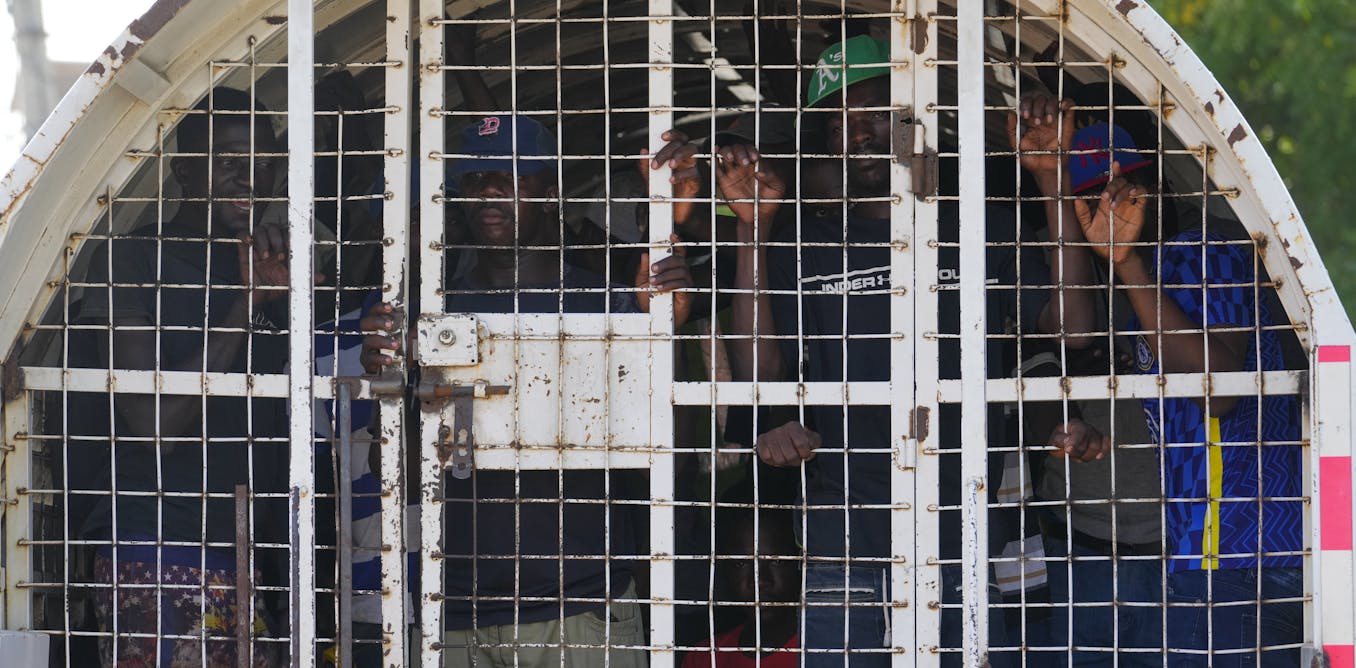
Despite the fact Dominican law prioritizes the rights of children to family reunification, my research interview subjects told me lactating women have been forcefully separated from their infants. They also told me of cases in which “Haitian-looking children” — in other words, Black — were loaded onto deportation trucks on their way home from school.
Racial profiling, in fact, is a key aspect of deportations in the DR. Black people are targeted and their identity documents disregarded.
For example, in my research visit to the northern Dominican border crossing in 2022, I met a young Dominican-Haitian teen apprehended by police in the middle of the night. The boy had no time to collect his documents as he was forced into a migration truck.
He was held under harsh conditions at the border, far from his hometown, while his mother looked for transport options to bring his documents to authorities to prove he was in fact Dominican.
The boy was lucky he had documents at all. Historically, access to documents among Haitians, Dominicans and specifically Dominicans of Haitian descent has been chronically lacking. The situation has worsened since 2013, when up to 200,000 Dominicans of Haitian descent were denationalized, making them subject of deportation back to a country where many of them had never been.
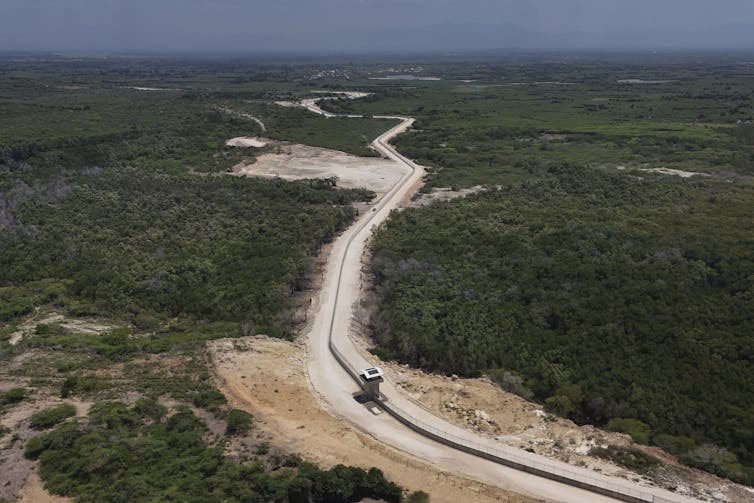
A watch tower stands along a miles-long wall built by the Dominican Republic running along the Haitian border in May 2024.
(AP Photo/Matias Delacroix)
Why do Haitians migrate to the DR?
Haitian labour migration has been a significant feature of the Dominican Republic’s development since the beginning of the 20th century.
During a period of occupation and heightened influence over both sides of Hispaniola, the United States promoted the cultivation of sugar in the DR while implementing a racially segregated migration system. The migration model sought to attract European immigrants and dissuade Black and Asian people from coming to the island.
Read more:
Haiti has suffered hugely over centuries but its revolution was stunningly innovative
The only viable option for the majority of Haitians to immigrate to the DR was through a labour migration scheme geared toward Haitian men working on sugar plantations under profoundly exploitative conditions.
Even though sugar is no longer the main economic sector of the Dominican economy, the country remains an important destination for Haitians, especially since it’s the only one they can reach by land.
The DR and Haiti are important trading partners with a high volume of goods moving across the border. There are also longstanding cross-border social and cultural practices that shape the culture of both sides of the island.
The DR is also a key destination for Haitians fleeing political violence and the effects of natural disasters. In particular, the 2010 earthquake displaced an estimated 2.3 million people, generating unprecedented numbers of internal and international displacement. Haiti has still not fully recovered from the disaster.
A deep governance crisis resulted from the intervention of an array of international entities that managed up to US$2.4 billion between 2010 and 2012 without significant participation of the Haitian government. More recent natural disasters affecting Haiti include a hurricane in 2016 that displaced another 175,000 people and another earthquake in 2021.
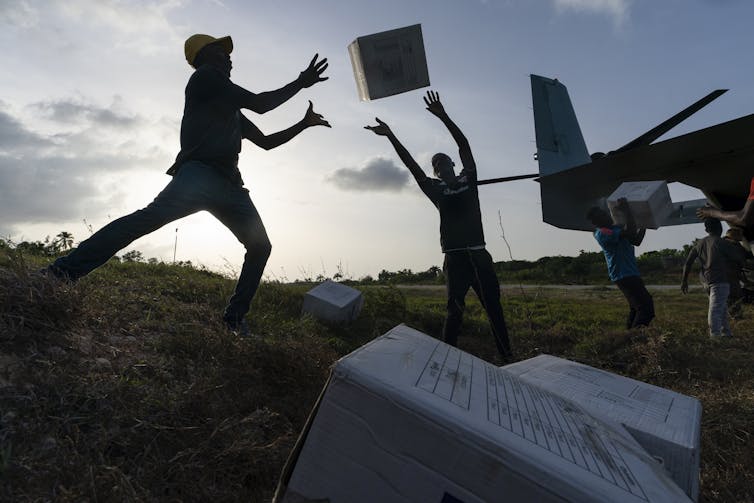
Haitian aid workers unload food at the airport, in Jeremie, Haiti in August 2021 following a 7.2-magnitude earthquake.
(AP Photo/Alex Brandon)
Modern-day Haiti
Today, Haiti finds itself in the middle of a formidable political crisis. Following the assassination of President Jovenel Moise in 2021, the country’s public institutions became severely weakened.
Most have fallen into the hands of informal armed groups, especially in the capital of Port-au-Prince and surrounding areas. These gangs terrorize the population. Mobility within the country is restricted due to the violence and sky-high fuel prices, which makes transportation inaccessible.
Access to clean water, sanitation, electricity and nutrition remains a challenge to the wide majority of the population. Everyday life is subject to gun and sexual violence, in widespread gang-controlled areas.
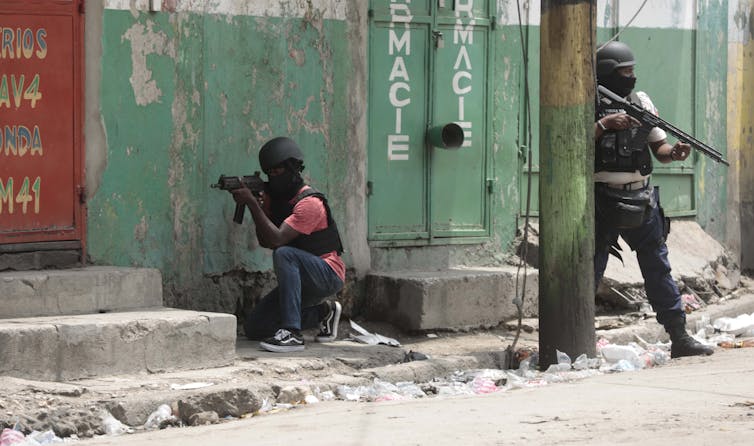
Police officers take cover during an anti-gang operation in Port-au-Prince, Haiti, in April 2023, a day after a mob in the Haitian capital pulled 13 suspected gang members from police custody at a traffic stop and beat and burned them to death with gasoline-soaked tires.
(AP Photo/Odelyn Joseph)
According to a recent news release put out by the Haitian Support Group for Repatriates and Refugees, 1,200 people died due to gang violence between July and September of 2024. The organization specifically referred to a massacre on Dec. 10 — the International Day of Human Rights — that left 180 civilians dead, many of them elderly, in Wharf Jérémie, a neighbourhood of Port-au-Prince.
This makes the ongoing wave of deportations in the DR particularly reprehensible since deportees are being forced to return to an environment of extreme violence.
The DR is not the only country forcing Haitians to return to these conditions. According to the U.S. Immigration and Customs Enforcement agency statistics, the deportation of Haitians without criminal records has doubled between 2021 and 2024, and increased tenfold in 2022.
Haitians face significant challenges in accessing international protection throughout the Americas, starting with their next-door neighbour.
Read more:
Haiti’s gangs turn to starving children to bolster their ranks
The scene in the U.S.
As Trump prepares to make good on his promise of mass deportations, it’s important to pay attention to what’s happening in the Caribbean.
Haitians took centre stage in the migration debate during the presidential election campaign when Trump disseminated false claims about migrant criminality in Springfield, Ohio, resulting in threats of violence against the Haitian community there.
We are witnessing the global community turn its back on Haitians as they navigate the country’s worst political crisis in decades. They are being forced to return to a country where their lives are at risk. Will the same fate await the migrants victimized by Trump’s mass deportations?
Source link : http://www.bing.com/news/apiclick.aspx?ref=FexRss&aid=&tid=677d53560cfc433586fb5e248effe460&url=https%3A%2F%2Ftheconversation.com%2Fthe-dominican-republics-expulsion-of-thousands-of-haitians-shows-the-brutality-of-mass-deportations-245545&c=11629313198991394389&mkt=en-us
Author :
Publish date : 2025-01-07 02:38:00
Copyright for syndicated content belongs to the linked Source.