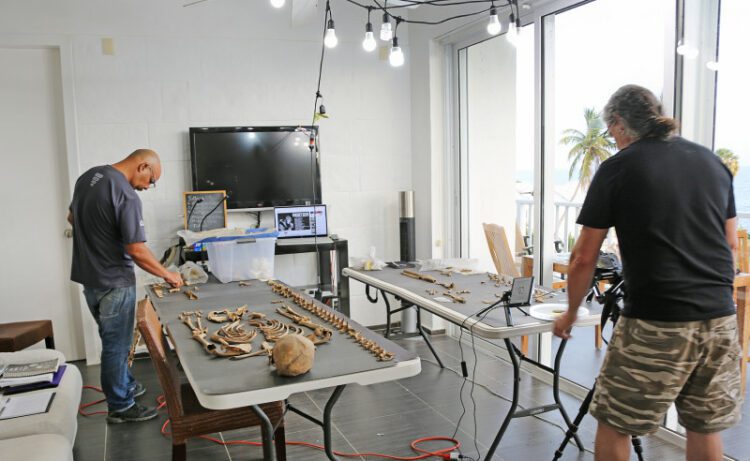
Photograph shows individuals buried in burial bundles from the Daniel Shelter and the Daniel Funerary Cave.COURTESY OF ARCHAEOLOGIST ADOLFO LÓPEZ
The positions in which the individuals were buried indicate that there were burial systems in place.
“The most representative is the one that suggests that the corpses were baled, given the position of the skeletons with the extended arms placed over the ribs and the skull wedged between the shoulder blades,” says Lopez.
Photograph shows detail of archaic individual from Abrigo de Daniel with the head wedged between the shoulder blades.COURTESY OF ARCHAEOLOGIST ADOLFO LÓPEZ
The study of the skeletons deduced that these early inhabitants of the island had bone fractures that healed in life.
“A special robustness was observed in the bones of the arms and torso of some adult people which is consistent with the practice of physical activities, such as, among others, those derived from the handling of paddles in canoes for fishing or sailing long distances.”Adolfo LopezSpecialistin archaeological methodologyHe specifies that the shelter was not permanently inhabited after its use as a cemetery, but “it did serve as a place of refuge or passage during the pre-Hispanic period.”
In that area, meals and funerary ceremonies related to burial rituals were held.
“A triangular piece that resembles the shape of the female pubis was located in the surface level of the shelter and other objects related to fertility,” he points out.
Photograph shows triangular idols.COURTESY OF ARCHAEOLOGIST ADOLFO LÓPEZ
WHERE DID THEY COME FROM?
Lopez claims, according to DNA tests, that the group came from southern Belize and Central America.
“Harvard University has been studying the DNA of these skeletons for more than a year, but they had been trying to find results for 20 years and there was no way, and thanks to the Samaná skeletons it has been possible to follow the DNA chain to southern Belize, in Central America, and the group that made the great leap sailing to the Greater Antilles and settled, among other places, in the Samaná peninsula, has also been located, that is, it has been a first-rate finding worldwide,” he says.
Photograph shows Cabo Samaná Natural Monument.COURTESY OF ARCHAEOLOGIST ADOLFO LÓPEZ
“It is a group that lived there around 6,000 years ago and curiously these first inhabitants of the Antilles have the same Central American ancestors as the Mayans, because the same groups that crossed the Caribbean Sea and populated the Greater Antilles, on the continent also gave rise to the Mayan culture, that is, it really turns out that we Antilleans have ancestral ties,” he adds.
Lopez says that, the ties with the ancestors the Mayans are very old because the same human group on the one hand goes up the Yucatan peninsula, settles there and generates the Mayan culture, but some of them take their canoes and jump into the Caribbean Sea and colonize the Antilles, giving rise to the first Antillean cultures.
“We have realized that, contrary to what was thought, these first colonizers of the island of Santo Domingo were not people who came in rafts, by chance, nor that they had a very low cultural level, but on the contrary, they were people who came in large canoes, who organized great expeditions 5,500 years ago, who had a very high cultural level, in addition with the studies we have found corn in their diet, which means that they had an agriculture…. something that was already suspected, but now for the first time we have been able to find remains of corn in the 5,500 year-old utensils,” he explains.
“What Samaná has given us is the knowledge that our most ancient ancestors in the Antilles were people who had a much higher cultural level than we thought, a very high level of social organization and that they did not arrive here by chance, they came here expressly.”Adolfo LópezSpecialistin archaeological methodology.But “why did they come here?” asks López and explains that he has lived four years in the Yucatán peninsula and has been working in all the cultures of that area and realized that the jungles there are inhospitable.
“You go to work in the Yucatan and you risk being bitten by one of the four species of poisonous rattlesnakes that are there and you see them passing close by. I had to go with my people with syringes to prick my guides in case they were also bitten by a scorpion and, in fact, I had to prick someone several times, and one of them was left with half a paralyzed body. Then it is unbearably hot, I mean, really, the Yucatan Peninsula, those jungles are inhospitable, I mean, living there is very difficult and it is very hard”, he says.
This, according to him, was the main reason why this group decided to migrate.
“They arrived on the island of Santo Domingo where there was no poisonous animal, where the ecosystem was intact and they could get food wherever they went, where they could hunt, a mild climate, water supply points, safe harbors for their canoes, in other words, it was paradise… so of course, when they arrived for the first time, the first thing they did was return to bring their families and to tell them, gentlemen, we have found paradise and that is why 6,000 years ago is when the true human colonization of the Antilles began on a large scale. It is not a casual migratory movement, it is that really the possibilities of survival and of life that this island offered them were wonderful that they came here to live running”, he narrates.
THEY FOUND CORN
Photograph shows triangular adzes of the Samaneses of Casimiroide tradition.COURTESY OF ARCHAEOLOGIST ADOLFO LÓPEZ
The diet of these inhabitants, according to dental analysis, was based on proteins derived from the ingestion of crabs by crushing their shells and quelas with their teeth.
Fishing was an important element in their diet, as well as hunting rodents endemic to the island of Santo Domingo.
The expert says that there is also a use of land snails, “whose shells were counted by the thousands on the floor of use (Caracolus excellens and Polidontes sp.)”
In addition, marine snails were abundant, especially burgaos (Cittarium pica) and the species Purpura patula. He said that the Strombus shells recovered in the excavations were remarkable.
Photograph shows perforated burgaos.COURTESY OF ARCHAEOLOGIST ADOLFO LÓPEZ
Lopez says that the complete study of the starches of the tools they used has not yet been completed, but he said that corn was found, suggesting that they ate cultivable plants.
Photograph shows food remains of the Samanecs of Casimiroid tradition in the Dana Shelter.COURTESY OF ARCHAEOLOGIST ADOLFO LÓPEZ
EXTINCT ANIMALS
Lopez reveals that they found three extinct sloth species of the six that have been identified in the Antilles, one of them the “Neocnus.” “We had the giant sloth that was about two meters long and then there were others that were tiny. They walked on land and were not as slow as you might think,” he says.
Photograph shows sloth claws and phalanges.COURTESY OF ARCHAEOLOGIST ADOLFO LÓPEZ
In addition, a species of monkey, the “Atillothix Bernensis”, that “there are no longer alive in the Dominican Republic, but there are in other islands and when the Spaniards arrived there were still some left”.
Other species they found, but which are currently endangered, are the “Solenodon” and the “hutia”.
ARE THEY THE FIRST DOMINICANS?
“The first inhabitants of the Antilles are also the first inhabitants of what we now know as the Dominican Republic… I don’t know to what extent it is correct to say that they were the first Dominicans, because I believe they were the first Antilleans. The history changes a little, but at the same time it complements each other.”Adolfo LópezSpecialistin archaeological methodology.He emphasizes that Dominicans should be proud of this archaeological discovery, since it reveals an extremely valuable and rich ancestral heritage.
According to him, the first inhabitants of the island, not only managed to survive in challenging ecosystems, but also developed a complex network of trade, religious rituals, and a deep respect for the members of their community.
“One notices the affection with which children are buried, the respect with which the human remains of the elders are deposited,” he stresses, emphasizing that these ancestors were not primitive people without culture, but individuals with “extremely honorable origins, just like the origins that Europeans have, but even more interesting.”
The Dominican Republic was home to the first human beings that populated the Antilles almost 5,500 years ago.FINDINGS WILL BE EXHIBITED
The findings are located in warehouses that the research team has in Samaná, which have been rented and maintained for the continuation of the studies.
However, the pieces have already been formally handed over to the Museum of Dominican Man, since “all the material that we took out, absolutely everything, belongs to the Dominican State and the depositary is the Museum of Dominican Man,” according to López.
Photo shows archeologist Adolfo López, who talks to LISTÍN DIARIO about the results of the findings in the Cabo de Samaná Natural Monument.RAUL ASENCIO
Soon, these valuable findings will be exhibited in several museums in the country. One of the main places will be the Museum of Dominican Man, where historian Manuel García Arévalo, who collaborates with the team and is part of the García Arévalo Foundation, is supporting the organization of the museum’s new museography.
“The State has already given the funds to do it and they are already working on that, and there are going to be some showcases with these materials,” he explains.
In addition, towards the end of the year, the Museum of the Casa del Cordón will be opened, and “some of the materials we have found will also be displayed there.”
López says that this is only the beginning and the spearhead of the research that will continue to be carried out on the island.
Source link : http://www.bing.com/news/apiclick.aspx?ref=FexRss&aid=&tid=66dc67c44cd7446fa6afc221d3310e69&url=https%3A%2F%2Fdominicantoday.com%2Fdr%2Flocal%2F2024%2F09%2F07%2Fwhat-is-now-the-dominican-republic-was-home-to-the-samanese-the-first-humans-to-populate-the-antilles-nearly-5500-years-ago%2F&c=9661022891269066236&mkt=en-us
Author :
Publish date : 2024-09-07 02:43:00
Copyright for syndicated content belongs to the linked Source.