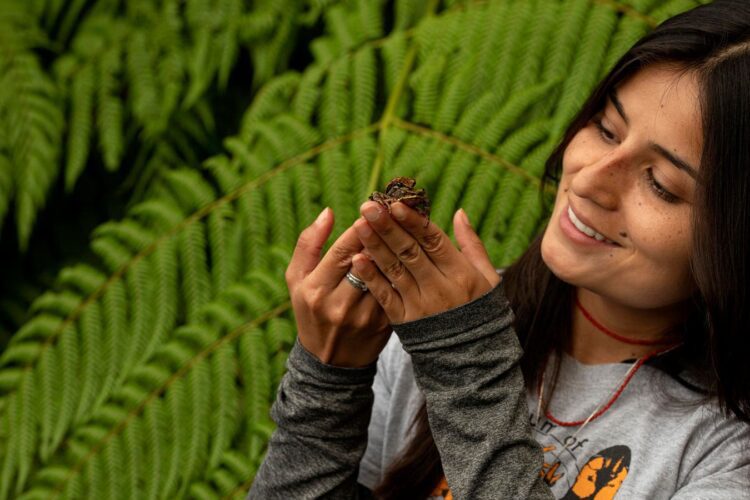
Ecuadorian Researcher MarÃa José Navarrete Méndez with a frog in Santa Marta, Colombia in July … [+] 2024.
Amanda Quezada
A scientist from Ecuador is studying frogs covered in a potent neurotoxin — first found in puffer-fish — that could hold the key to a range of new medical treatments.
Tetrodotoxin (TTX) is being studied as a treatment for cancer-related pain; heroin and cocaine withdrawal symptoms: neurological trauma, and some kinds of tumors.
Maria Jose Navarrete Mendez, PhD candidate in the Museum of Vertebrate Zoology at UC Berkeley explains that unlike many other frogs which make their own toxins or acquire them from their food, the TTX found on the highly-endangered Atelopus genus of frogs found in Ecuador and Colombia is likely produced by bacteria living on the frogs’ skin.
“Atelopus species weren’t just toxic; they had the same compound found in octopuses, pufferfish, flatworms, newts, and crabs,”she says, “That’s when I had a thought—what if bacteria were the original source of all TTX?”
Navarrete says that when she was starting her PhD, a group of researchers from Michigan State University isolated TTX-producing bacteria from a toxic newt from the west coast of the United States.
“It was gratifying to see my intuition align with the evidence: this suggests a mutualistic relationship, where the bacteria find a home to live in while the frogs gain a toxin that protects them from predators and potentially aids in disease resistance,” she says, adding that about 150 strains of bacteria have been reported to have the ability to produce TTX, on land and under the water.
Navarrete explains that recent studies have uncovered potential therapeutic applications of Tetrodotoxin in cancer treatment, anesthesia, and alleviating withdrawal symptoms during the treatment of heroin and cocaine addictions.
“Therefore, studying the origin, mechanisms of action, and evolutionary interactions of animals with these compounds can better inform their use, supply, and effectiveness in therapeutics,” she says.
Research into TTX could also help find solutions to the current mass die-off of amphibians thought to be caused by a fungal infection.
“Previous research has suggested that TTX might fight infections in newts, making it worth exploring its source, distribution, and ecological role in one of the most endangered groups of amphibians,” she says.
A from from the Atelopus genus in Limón Indanza in Ecuador, March 2024.
Amanda Quezada
Growing up in Ecuador
Navarrete grew up in Atuntaqui, a small town in the province of Imbabura in the Ecuadorian Andes, spending time on her grandparents on their farm while her parents were at work.
“Growing up on the farm, I often experienced what I would consider ‘Eureka’ moments that stimulated my understanding and interest in biology such as learning about predator-prey interactions when falcons hunted our chickens and understanding physiology and reproduction when the cows gave birth,” she says, “The insights of my grandparents, who witnessed the gradual disappearance and extinction of one of the frogs I study, helped me grasp the severity of amphibian population declines.”
Navarrete would go on to study biology at the Pontificia Universidad Católica del Ecuador in Quito and began doing research as an undergraduate, before being accepted into the Integrative Biology graduate program at UC Berkeley, becoming the first person in her family to go to graduate school.
Navarrete says that she sees science emerging from the Global South as an act of resistance and sovereignty which honors upbringing, cultures, and the knowledge cultivated through observing patterns and interacting with people who offer unique and diverse perspectives.
“Equally important has been the knowledge and support I’ve gained from working with the Indigenous community, who later rediscovered this species in their territory and whose contribution has been invaluable in efforts to conserve it,” she says, “These experiences, stories, observations, and contexts can only emerge from a science that is informed by the people it serves, seeking solutions that recognize their needs, values, and contributions.”
Researchers and children in Angamarca Ecuador-December 2022.
Maria del Carmen Vizcaino
Why Don’t Frogs Poison themselves?
Roberto Marquez, assistant professor and Michigan Fellow at the University of Michigan and a researcher from Colombia has been looking at another frog genus, Phyllobates, which are poison dart frogs native to Central and South America.
A 2010 analysis found that more than 63,000 poison arrow frogs of 32 species were traded internationally between 2004 and 2008; harvesting of these frogs from the wild is putting them at risk in their home ranges.
Marquez says his research program is focused on how these frogs (named after the use of their toxin for poison darts by the Embera indigenous people) have evolved to avoid the harmful effects associated with consuming and accumulating toxic alkaloids.
In a paper, Marquez explores why the Phyllobates frogs, which secrete the deadly neurotoxin batrachotoxin as a way to ward off predators, are not poisoned themselves: at first, it was though that a mutation provided a protection.
Another explanation might be molecules that act as “sponges” for the toxic, but the mechanisms underlying resistance in BTX-bearing species still remain unknown.
Marquez has even had a brush with the toxin himself.
“Once as an undergraduate I was taking measurements of some field-caught frogs that had been in a captive research colony for about six years, and since these frogs get their toxins from their diet, I assumed that they were no longer toxic,” he says, adding that he experienced numbing consistent with the toxin and later read that these frogs can remain toxic for many years in captivity.
Source link : http://www.bing.com/news/apiclick.aspx?ref=FexRss&aid=&tid=66da3aca21054e2d928d0db7cf38d73a&url=https%3A%2F%2Fwww.forbes.com%2Fsites%2Fandrewwight%2F2024%2F09%2F05%2Fhow-could-tetrodotoxins-from-frogs-in-ecuador-help-treat-pain%2F&c=8224975294555759483&mkt=en-us
Author :
Publish date : 2024-09-05 12:03:00
Copyright for syndicated content belongs to the linked Source.