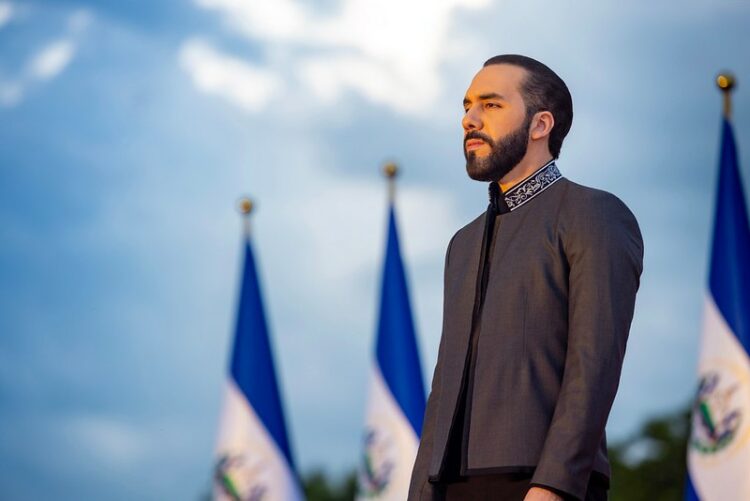
Bukele’s attendance at the conference also provided an opportunity to generate images that demonstrate his commitment to Judeo-Christian values. Approval by and affirmation from key Jewish and evangelical Christian leaders provides powerful legitimation in Salvadoran politics, reinforcing Bukele’s cult of personality among Salvadoran evangelicals who believe him to be chosen by God to “clean” their country of the scourge of gangs. His campaign and presidential press releases demonstrate how Christian Zionism generates not just support for Israel but symbolic and ideological power for his right-wing populist leadership.
Evangelical Christianity, as noted by scholars like Amy Erica Smith and Taylor C. Boas, constitutes an electoral force in El Salvador and elsewhere in Latin America that rewards conservative positions on social issues, such as abortion and LGBTQIA+ rights. Approximately 35 percent of Salvadorans identify as evangelical Christian and 45 percent as Catholic. Beyond the “culture war” politics that animate calls for religiously informed policies, however, Evangelicalism generates key frames for the justification and legitimation of security policies. For example, Christian Zionism is an ideology based on theological and biblical sources that justifies coordinated action in support of the territorial control and expansion of the state of Israel. These foundations include ideas that equate the strength of the state of Israel with divine providence, such as “God blesses those that bless Israel” and “Israel, God’s people.” Allied theological traditions link religion to action through what William Girard calls “spirit-filled geopolitics,” the worldview within Pentecostal movements that supernatural agents such as God and demons influence the actions of national governments and political authorities. According to this worldview, supernatural forces engage in a global spiritual battle that divides the world into two camps: one that supports Israel and is blessed by God, and another that is ungodly and condemns Israel. By visiting and supporting Israel and frequently alluding to his direct communication with God, Bukele frames his security actions and the war on gangs as maneuvers in this spiritual battle.
Bukele explicitly references this spiritual war. For example, he acknowledged in a June interview with Tucker Carlson that the “official” version of how he saved El Salvador points to increases in the military and police budget, which doubled the size of the military to combat gangs and bought military equipment such as guns, vehicles, and drones. The “real” explanation, however, according to Bukele, is that it is a “miracle”. “[T]here is a spiritual war and there is a physical war,” Bukele tells Carlson. “If you win the spiritual war it will reflect onto the physical war… our impressive victory was because we won the spiritual war.”
Regardless of Bukele’s faith, evangelical Christianity is essential for understanding both El Salvador’s support for Israel and Salvadoran security policies at home. Christian Zionist ideology and identity help explain Bukele’s rise to power. During his campaign, Bukele carefully courted the support of the Salvadoran leadership of evangelical Churches, who publicly prayed for his victory. A smear campaign that cast doubt on his Christian bonafides forced then-candidate Bukele—who was raised in a Muslim household—to explicitly defend his religious identity, declaring himself to be a disciple of Jesus Christ and sharing photos of himself at multiple religious sites as a sign of his tolerance and devotion. In his victory speech after being reelected in February, Bukele stated: “To the atheists, to the agnostics, we respect you and we are your friends, but let us believe in God, and let us give Him the glory.”
The Spiritual Danger of Gangs
Off the campaign trail, Bukele justifies his presidential decisions with religious rhetoric and a Manichean good/evil frame. As historian Amy Fallas explains, Bukele repeatedly calls attention to the “spiritual danger of the gangs;” in a May 3, 2022 Facebook post, he declared the war against gangs to be a contest “between good and evil.” Bukele has also claimed that “as [MS13] grew they became satanic, they started doing satanic rituals.” Religious language, ranging from Bible verses to invoking “divine purpose” to justify his actions, constitutes a key source of popularity for his government.
In 2020, Bukele invoked God when he sent heavily armed troops to storm the Salvadoran legislature after it refused to approve a $109 million loan to purchase military equipment for his “Territorial Control Plan.” Once soldiers surrounded the legislature, Bukele cupped his hands before his lowered face to pray and later told the crowd outside: “I asked God and God told me: patience, patience, patience.” More recently, Bukele addressed the Ibero-American Confederation of Christian Communicators and Mass Media (COICOM) and announced that “God’s goal was to say to all the nations of the world ‘ask, give me the glory, and I will heal your land.’ Nothing is impossible for God, we all know that, but [in El Salvador] He demonstrated it again.”
By repeatedly framing his actions as dictated by God and contrasting “the good people” with criminals and terrorists, Bukele echoes Manichaean colonial frameworks. He espouses a civilizational form of Christian Zionism that Paul Freston refers to as “cultural identification with Israel—seen as part of Western civilization” that is not dependent on “the individual’s personal religion.”
The Legacy of Evangelical Imperialism
Bukele is not the first to employ the rhetoric of sacralized politics. Central America is the historical site of many sacralized political projects, including Spanish colonization, U.S. expansionism under the mantle of “manifest destiny,” anti-communist crusades, and Christian Zionism itself. The latter can be traced through the War on Terror, the Cold War, and its Christian predecessors in previous eras of empire-building in the region. Since the 19th century, Central American governments and elites allied with the imperial interests of the United States have continuously supported Protestant missionaries’ efforts to convert Latin American populations from Catholicism and Indigenous and African spiritualities to Protestantism. Virginia Garrad-Burnett has shown how these efforts were motivated by the conviction that “missionaries would instill… the kinds of beliefs, ethics, and values that had propelled the United States to economic and political greatness.” As has been thoroughly documented, U.S.-based evangelical Christian policymakers and megachurches supported anti-communist and genocidal violence throughout Central America during the Cold War.
Ultimately, the belief in U.S. superiority within Latin American evangelical Christianity—and the idea that this superiority can be transferred by emulating the cultural practices of the United States—has paved the way for the equivalent and dangerous belief in Israeli superiority and its emulation. As Elliott Abrams, an influential U.S.-neoconservative policymaker during the Cold War, the War on Terror, and under the Trump administration, explained in 2022, “the role of Israel is to serve as a model…. an example in military might, in innovation, in encouraging childbirth.” This emulation and ideology form the backbone of Salvadoran foreign policy towards Israel, the promotion of Salvadoran security theology, and Bukele’s ability to bolster his popularity using Israeli and Judeo-Christian symbols.
The Israeli military-industrial complex contributes to political repression and militarization across the Americas. The role of security theology, however, helps explain both Bukele’s support for Israel and the rise of his populist authoritarian project in El Salvador. Christian Zionism—as it intersects with U.S. empire and colonial frameworks—legitimates both his domestic security and foreign policy. A deeper understanding of the ideological underpinnings of Bukele’s government and its symbolic relationship with Israel can further strengthen the basis for solidarity between Salvadorans and Palestinians. This security theology poses a threat to the life and autonomy of both Latin Americans and Palestinians; in turn, continuing to highlight the connections between Salvadoran and Palestinian struggles serves to strengthen both.
Isabel Rikkers has conducted research on criminalization of youth and community resistance to this phenomenon in San Salvador, and on Israeli militarism in Latin America as part of her activism for Palestine solidarity in Colombia.
Noelle Brigden, PhD, is an associate professor of politics at Marquette University and author of The Migrant Passage: Clandestine Journeys from Central America (Cornell University Press, 2018).
Source link : http://www.bing.com/news/apiclick.aspx?ref=FexRss&aid=&tid=6712d55e46484fd58368b4c592d5d53b&url=https%3A%2F%2Fnacla.org%2Fchristian-zionism-bukeles-el-salvador&c=1616591712209698488&mkt=en-us
Author :
Publish date : 2024-10-09 06:21:00
Copyright for syndicated content belongs to the linked Source.