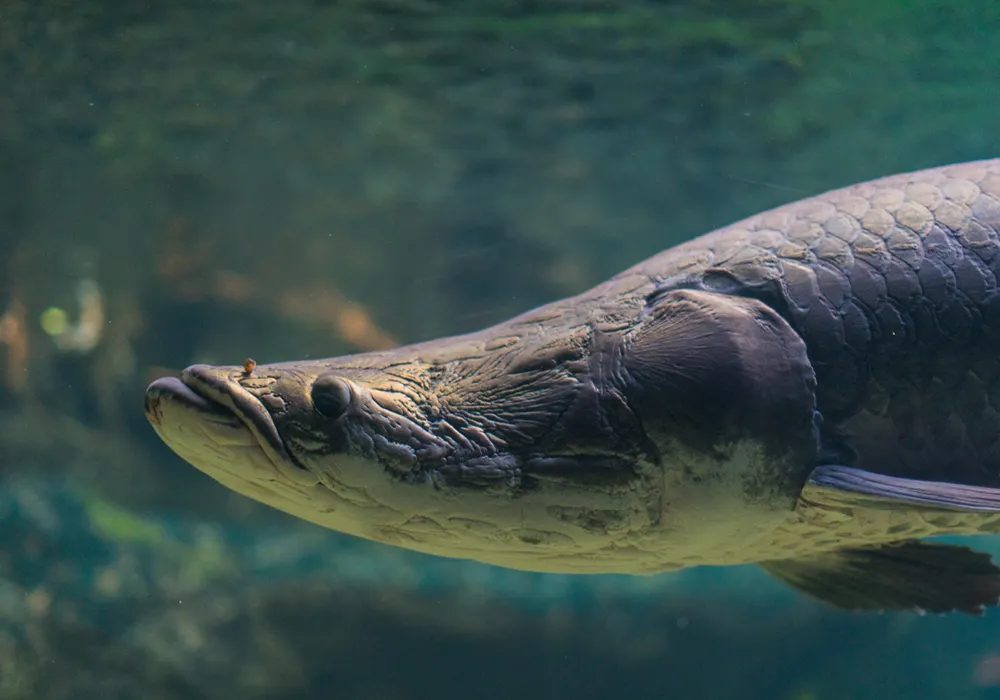
Thanks to their ability to breathe air, arapaima can survive up to 24 hours outside of the water.
Smithsonian/Meghan Murphy
3. Arapaima breathe air.
These fish have a modified swim bladder which enables them to breathe oxygen. This adaptation allows the arapaima to thrive in situations when the fish find themselves stranded in oxygen-deprived waters. In the rainy season, rushing river channels often carry the fish into flooded inland jungle areas. During the dry season, when water levels drop to leave arapaima stranded in landlocked ponds, oxygen levels can be extremely low—but the fish can still thrive.
4. They’re an ancient species.
Local indigenous communities have lived alongside the arapaima for thousands of years, but these colossal fish have been around far longer than humanity. Fossils discovered in Colombia that bear a striking resemblance to the arapaima have been dated to more than 13 million years ago.
5. They’re a fish with many names.
Pirarucu. Paiche. Bodeco. Amazon codfish. Dinosaur fish.
Scientifically, the name for it is Arapaima gigas. Their Brazilian name, “pirarucu,” is based on words from the Tupi language, which translates roughly as “red fish,” due to the pinkish hue of the scales near its tail.
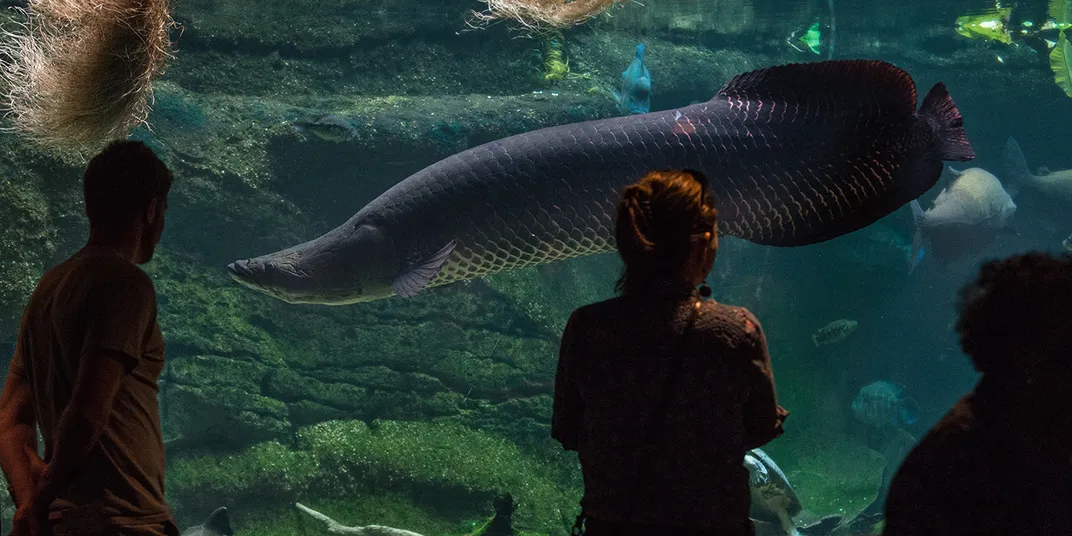
Arapaima can use short bursts of speed to close in on unsuspecting prey.
Smithsonian/Meghan Murphy
6. They have some of the toughest scales in the animal kingdom.
One of the arapaima’s most striking adaptations is the sleek set of scales that runs up and down the fish’s body. These are some of the toughest scales are the animal kingdom, capable of protecting the fish from sharp-toothed predators like piranhas and caiman.
Scientists who examined the arapaima recently discovered the animal’s scales owe their durability to a flexible inner collagen layer that binds the firm outer layers of scales together, almost like a natural bulletproof vest.
7. Arapaima populations have dropped significantly over the last several decades.
Recently hatched arapaima are preyed upon by many Amazonian predators, including piranhas, jaguars, giant otters and caimans. However, the most significant threat to their population is humans.
Wild populations have declined significantly throughout their natural range in the twentieth century. Overfishing, habitat loss, logging and agricultural expansion are all major contributors to the decline of arapaima in their wild river habitats.
8. The fish may be making a comeback.
While it may be a while before the evidence is clear, new research suggests arapaima populations are increasing in numbers.
For the last few decades, dedicated ecologists have worked alongside local communities and governments to help protect the arapaima for future generations. Conservation initiatives focus on protecting sensitive breeding areas and practicing sustainable management techniques: one major effort involved training local fisherman to avoid catching arapaima during the breeding season.
9. You can get up close to arapaima at the Smithsonian’s National Zoo.
At the award-winning Amazonia exhibit, visitors start their journey by weaving through a flooded forest in the Amazon River basin. Visitors can peek through submerged tree roots for an up-close look at arapaima, along with the black pacu, red-bellied piranhas, red-tailed catfish, and other aquatic species. Next, a researcher’s fieldwork site lets guests come face-to-face with electric eels. Finally, visitors can witness roseate spoonbills and hawk-headed parrots soaring overhead in the indoor rainforest before exiting through the amphibian research lab.
10. The Smithsonian is working to protect South American habitats.
Scientists with the Smithsonian’s National Zoo and Conservation Biology Institute work to address critical conservation challenges while protecting wildlife in the Amazon River basin and ecosystems across the planet.
Part of the Smithsonian’s conservation efforts include connecting amazing animals like the arapaima with millions of guests each year. Discover how you can help save species. Plan your visit today.
Rainforest
Source link : http://www.bing.com/news/apiclick.aspx?ref=FexRss&aid=&tid=67227e65bc5245d3a550240180e1b9ba&url=https%3A%2F%2Fwww.smithsonianmag.com%2Fblogs%2Fnational-zoo-conservation-biology-institute%2F2024%2F10%2F30%2Fcreature-feature-meet-the-freshwater-giant-arapaima%2F&c=16932647819012805575&mkt=en-us
Author :
Publish date : 2024-10-30 04:12:00
Copyright for syndicated content belongs to the linked Source.