(Image credit: Halley Mastro/University of Vermont)
One key piece of evidence was a specimen of rock spike moss (Selaginella rupestris), which today survives only on sandy and rocky places. “They need the things all plants need to grow, and they can’t get those on top of an ice sheet,” Halley Mastro, a graduate student at the University of Vermont and co-author of the study told Live Science. “They just wouldn’t grow.”
A 2016 study of the core suggested that the current Greenland ice sheet was a maximum 1.1 million years old. They also estimated that the loss of the ice at a site — called GISP2 —would mean that 90% of Greenland would have been ice-free at that time.
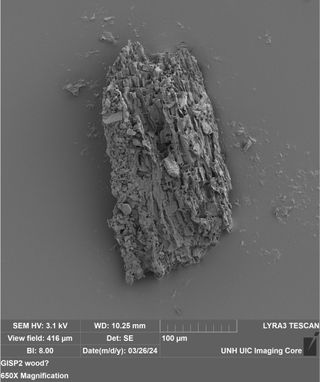
A willow wood fragment found in the GISP2 soil sample viewed under a scanning electron microscope. (Image credit: Barry Rock)
Another core, extracted from Greenland’s northwest coast in 1966, was analyzed by Bierman and an international team in 2019. They found several fossils — including seeds, twigs and insect body parts — hinting that this part of Greenland was ice-free within the past 500,000 years.
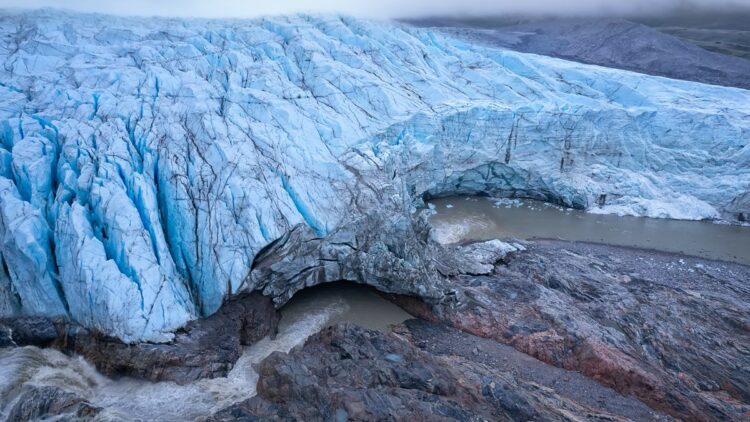
The latest study reveals the center of Greenland was also free of ice at some point in the last 1 million years. The landscape that is now covered by a layer of ice 2 miles (3.2 kilometers) thick hosted an entire tundra ecosystem, with flowers and potentially even small trees, according to the statement.
The 1993 core reexamined by Bierman and Mastro had been kept at the National Science Foundation Ice Core Facility in Colorado for over 30 years and was almost ignored.
“The ice part of the core has been extensively analyzed,” Bierman said. “The people who were taking the ice cores weren’t thinking much about what was beneath. After one set of analysis on the sediment, it was put in a bag on a shelf. We would not have known to check if we didn’t already have a project working on sediments below the ice.”
The finding that Greenland was once ice-free has implications for the present day.
An ice-free Greenland happened at lower levels of atmospheric carbon dioxide than present-day levels, so there’s potential for Greenland to be ice-free again, which would raise sea levels drastically.
“It will take decades, if not centuries, to lose its ice completely, but most of the sea level rise, more than other places, is coming from Greenland,” Bierman said.
There may be hope, however. “Nature has taken this ice sheet away in the past, and it has come back,” he said.
Source link : http://www.bing.com/news/apiclick.aspx?ref=FexRss&aid=&tid=66cc5b955aec4f6389e8f73d8a965d2b&url=https%3A%2F%2Fwww.livescience.com%2Fplanet-earth%2Fplants%2Ffossils-from-greenland-s-icy-heart-reveal-it-was-a-green-tundra-covered-in-flowers-less-than-1-million-years-ago&c=17841992982232478725&mkt=en-us
Author :
Publish date : 2024-08-10 13:00:00
Copyright for syndicated content belongs to the linked Source.