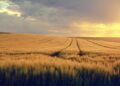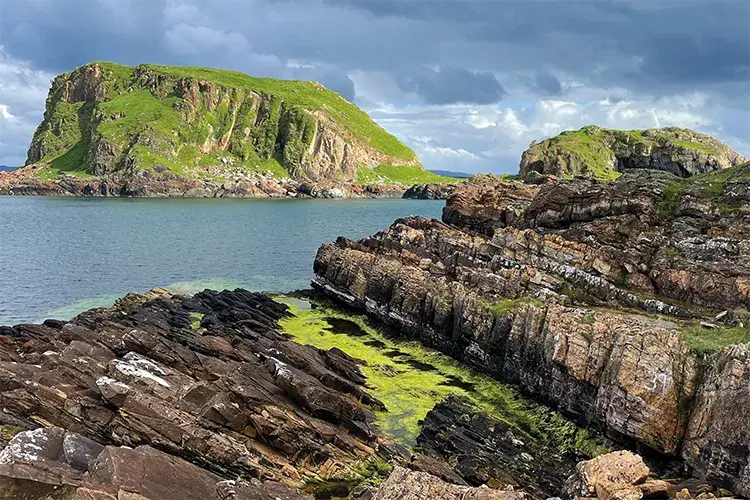
As you look out west from the rocky shores of Scotland’s Garvellachs archipelago towards Canada’s east coast, there’s nothing but 3,000 kilometres of Atlantic Ocean in between. But 700 million years ago, all this water was ice.
At least twice during Earth’s long history, scientists think that our planet froze over entirely. That shouldn’t have happened, explains Elias Rugen, a geologist at University College London (UCL). ‘If we have ice at the equator, Earth’s thermostat has basically broken. Earth has stabilising feedbacks, which means that it shouldn’t get too hot, it shouldn’t get too cold. But it did.’ We know it did because we’ve found evidence of that long-melted ice on every single continent, preserved in layers of rock laid down many millennia ago. What we’re not sure is why.
During the first of Earth’s deep freezes – an event lasting around 60 million years, today known as the Sturtian glaciation – we lost the rocks recording its transition from a warm, tropical planet to a ‘snowball Earth’. ‘You only have to look to Greenland or Antarctica, or even the Alps, to see the incredible erosive power of glaciation occurring right now,’ says Rugen. ‘Or you can go to the Lake District, with those massive U-shaped valleys, and you’ll see how glaciers just tear through absolutely everything.’ Sixty million years of glaciation – a simply unfathomable amount of time, adds Rugen – have eroded away any record of that time in Earth’s history. Everywhere, it seems, except a small, ragged chain of uninhabited islets off Scotland’s west coast. By some miracle, on the Garvellachs, those layers of rock have remained intact. Exposed to the air by the elements, these formations have long been studied and are known to contain rocks not found anywhere else in Scotland, but which scientists say were carried from North America by the flow of glaciers. It’s here that Rugen and his colleagues at UCL have now found the world’s only known, detailed record of how the Earth began to freeze.
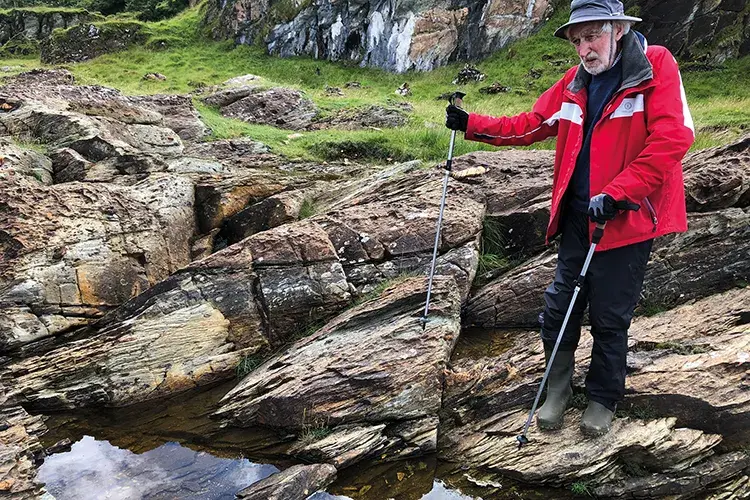 Co-author Tony Spencer, who was the first to recognise the significance of these rocks. Image:
Graham Shields
Around this time, our planet’s continents looked very different to how they do today. The land that now forms Scotland once sat just south of the equator. Rugen explains that, within a 70-metre band of rock, which lies beneath a section of younger rocks, you can see the gradual transition from limestones that formed in shallow, tropical seas and – within those – evidence of early, bacterial life. Then, he says, we start to see early signs of ice and things called dropstones (rocks and pebbles that have been deposited by flows of clay and silt) and unambiguous glacial sediments called diamictites. ‘These are just a mess of stuff that has been ploughed up by the glaciers and dumped there.’
Rugen says this record is ‘globally unique’, making it the primary candidate for a Global Boundary Stratotype Section and Point – better known as a ‘golden spike’. ‘Basically, it’s a rock-based division of geological time. A place that we decide, as geologists, best represents the change from one geological period to another.’ In this case, a new golden spike would mark the end of the Tonian and the beginning of the Cryogenian, a geologic period that lasted from 720 to 635 million years ago, and which began with the widespread glaciation of the Sturtian epoch.
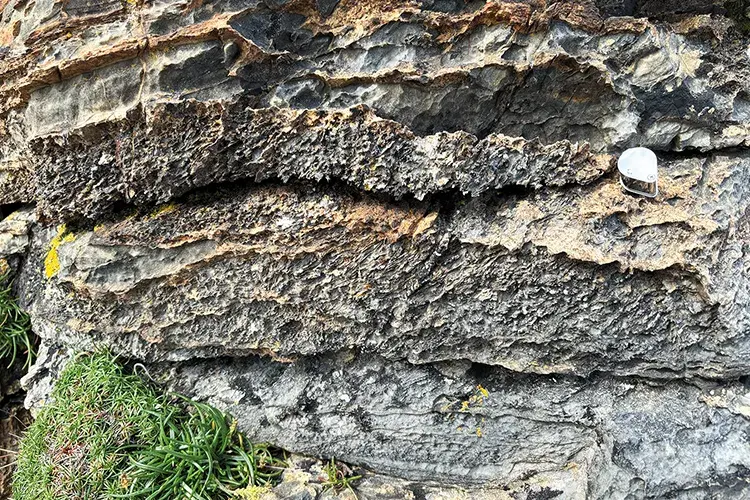 Layers of microbially-influenced limestone (stromatolite), typically formed in tropical climes. Image: Graham Shields
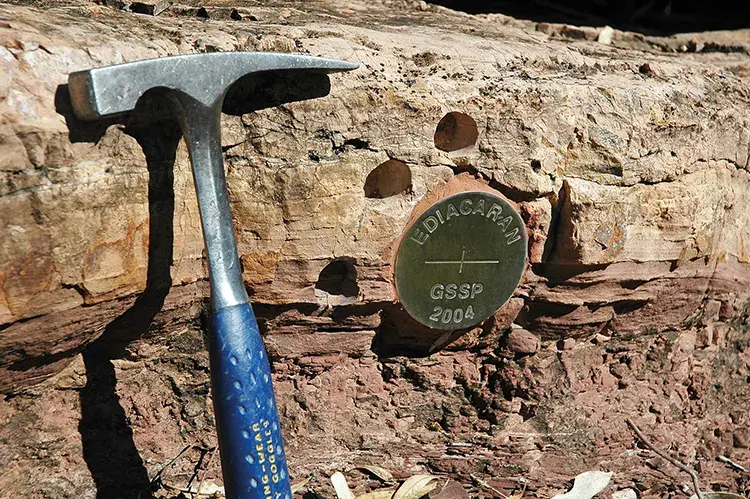 A golden spike (GSSP) marks the Cryogenian-Ediacaran boundary in South Australia. Image: James St. John
It can be quite a long process to select and vote on the best candidates for a potential new golden spike, as we saw during the attempt to formally define the start of the Anthropocene, a concept that was eventually rejected by the International Union of Geological Sciences earlier this year. This time, however, it should be a little simpler. ‘The concept of the Anthropocene hasn’t really been refined,’ says Rugen. ‘People are still debating about whether it may have started 50 years ago or more than 1,000 years ago. Whereas the Cryogenic is a strong concept, it’s the beginning of ‘snowball Earth.’’ While it’s possible that researchers could put forward another location for consideration (notable evidence of a once-frozen Earth are found in Canada, Namibia and China), Rugen says that no others have such a complete rock record. ‘In my, admittedly biased, opinion, no one else has a dog in the fight.’
Enjoying this article? We have thousands more for you.
Get immediate access to over 1,000 Geographical magazines in our archive back to 1935.
Sign up today and you will soon be travelling back through time reading all our amazing features of the last eight decades PLUS… you also get to enjoy every new issue of Geographical each month going forward in both print and digital formats.
Simply press the button below to choose the perfect package for you.
Whatever the results of the vote, the discovery will help scientists to confirm answers to some of Earth’s great questions, such as what caused the runaway albedo effect that led ice to spread as far as the equator, why Earth remained frozen for so long, and how this influenced the evolution of early life. ‘This missing time gap has been really frustrating for geologists,’ says Rugen, ‘It has meant that we haven’t had any way to probe that important part of Earth’s history.’
Source link : http://www.bing.com/news/apiclick.aspx?ref=FexRss&aid=&tid=66f30fd7c7264976958addb69cf99ff4&url=https%3A%2F%2Fgeographical.co.uk%2Fscience-environment%2Ffrozen-in-time-on-a-scottish-island&c=13514845611181981126&mkt=en-us
Author :
Publish date : 2024-09-24 07:05:00
Copyright for syndicated content belongs to the linked Source.