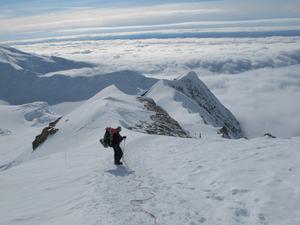
Credit: (Photo by Mike Waszkiewicz)
A Dartmouth-led study on ice cores from Alaska and Greenland found that air pollution from the burning of fossil fuels reaches the remote Arctic in amounts large enough to alter its fundamental atmospheric chemistry. The findings illustrate the long reach of fossil fuel emissions and provide support for the importance of clean-air rules, which the team found can reverse the effect.
The impact of pollution on the Arctic began as soon as widespread fossil fuel usage took hold during the industrial era, according to a report in Nature Geoscience. The researchers detected this footprint in an unexpected place—they measured declines in an airborne byproduct of marine phytoplankton activity known as methanesulfonic acid, or MSA, captured in the ice cores when air pollution began to rise.
Phytoplankton are key species in ocean food webs and carbon cycles considered a bellwether of the ocean’s response to climate change. MSA has been used by scientists as an indicator of reduced phytoplankton productivity and, thus, of an ocean ecosystem in distress.Â
But the Dartmouth-led team reports that MSA also plummets in environments high in emissions generated by burning fossil fuels, even if phytoplankton numbers are stable. Their models showed that these emissions cause the initial molecule that phytoplankton produce—dimethyl sulfide—to turn into sulfate instead of MSA, leading to a deceptive drop in MSA levels.
The researchers found precipitous drops in MSA that coincided with the start of industrialization. When Europe and North America began burning large amounts of fossil fuels in the mid-1800s, MSA began to plummet in Greenland ice cores. Then, nearly a century later, the same biomarker plummeted in ice cores from Alaska around the time when East Asia underwent large-scale industrialization.
“Our study is a stark example of how air pollution can substantially alter atmospheric chemistry thousands of miles away. The pollution emitted in Asia or Europe was not contained there,” says Jacob Chalif, first author of the study and a graduate student in the lab of senior author Erich Osterberg, an associate professor of earth sciences at Dartmouth.
“By releasing all this pollution into the world, we’re fundamentally altering atmospheric processes,” Chalif says. “The fact that these remote areas of the Arctic see these undeniable human imprints shows that there’s literally no corner of this planet we haven’t touched.”
The new study solves a yearslong marine mystery surrounding the significance of MSA, says Osterberg, who led the extraction of a 700-foot ice core from Denali National Park and Preserve that the researchers used in their analysis. Osterberg collected the core in 2013 with study coauthors and professors Cameron Wake at the University of New England, and Karl Kreutz and Dartmouth alumnus Dominic Winski ’09—who also received his PhD from Dartmouth in 2018—at the University of Maine.
The Denali core contains a millennium of climate data in the form of gas bubbles, particulates, and compounds trapped in the ice, including MSA, which is a common target in ice-core analysis. For centuries, MSA in the Denali core underwent minor fluctuations, “until the mid-20th century when it falls off a table,” Osterberg says.
Researchers in Osterberg’s ICE Lab, initially led by study coauthor and Dartmouth alumnus David Polashenski ’17, started investigating what the precipitous drop in MSA levels indicated about the North Pacific. Osterberg and study coauthor Bess Koffman, a professor at Colby College who was a postdoctoral fellow at Dartmouth, later tested numerous theories to explain why Denali MSA declined. Like the Greenland study, they first considered whether the MSA drop was evidence for a crash in marine productivity, “but nothing added up,” Osterberg says. “It was a mystery.”
Chalif picked up the project around the time when study coauthor and Dartmouth alumna Ursula Jongebloed ’18, now a graduate student at the University of Washington, was re-evaluating a 2019 study on ice cores in Greenland reporting that MSA there underwent a steady drop beginning in the 1800s. That study tied the decline to a crash in phytoplankton populations in the subarctic Atlantic due to a slowdown in ocean currents.
But Jongebloed’s work led to a study published last year reporting that declines in MSA found in the Greenland ice cores are not the result of the marine ecosystem crashing. Instead, they could be caused by pollution preventing the creation of MSA in the first place.
Chalif and Jongebloed connected at a conference in Switzerland in 2022 and discussed the Greenland and Denali MSA records. “We rethought all of our prior assumptions,” Chalif says. “We knew that the declining MSA at Denali wasn’t due to marine productivity, so we knew some kind of change in atmospheric chemistry must be involved.”
They discussed the possible effect of nitrate pollution, which is commonly emitted through burning fossil fuels. Chalif started digging into the impact of nitrate on MSA that same evening.
“Pretty much to the year, when MSA declines at Denali, nitrate skyrockets. A very similar thing happened in Greenland,” Chalif says. “At Denali, MSA is relatively flat for 500 years, no notable trend. Then in 1962 it plummets. Nitrate was similar, but in the opposite direction—it’s basically flat for centuries then it spikes upward. When I saw that I had a eureka moment.”
Their results showed that air pollution from the burning of fossil fuels disperses across the Atlantic and Pacific Oceans and inhibits the production of MSA in the Arctic. In addition to ruling out widespread marine ecosystem collapse, the findings open a new door to using MSA levels to measure pollution in the atmosphere, especially in regions with no obvious emissions sources, the researchers report.
“Marine ecosystem collapse just wasn’t working as an explanation for these MSA declines, and these young scientists figured out what was really going on,” Osterberg says.
“For me, it’s a new way of understanding how pollution affects our atmosphere,” he says. “The good news is that we are not seeing the collapse of marine ecosystems we thought we were. The bad news is that air pollution is causing this.”
But the data from the Greenland core shows that the local atmosphere began to stabilize when European and American air pollution became more regulated, Osterberg says. MSA rebounded in the 1990s as levels of nitrogen pollution dropped. That’s because nitrogen oxides, the type of pollution that affects MSA, dissipate within a few days, unlike carbon dioxide that lingers in the atmosphere for centuries.
“These data show the power of regulations to reduce air pollution, that they can have an immediate effect once you turn off the spigot,” Osterberg says. “I worry about younger people resigning to an environmental crisis because all we hear about is bad news. I think it’s important to acknowledge good news when we get it. Here, we see that regulations can work.”
###
Journal
Nature Geoscience
Method of Research
Observational study
Subject of Research
Not applicable
Article Title
Pollution drives multidecadal decline in subarctic methanesulfonic acid
Article Publication Date
23-Sep-2024
Source link : http://www.bing.com/news/apiclick.aspx?ref=FexRss&aid=&tid=66f44f7a61cf49db8aaa124c53814329&url=https%3A%2F%2Fwww.eurekalert.org%2Fnews-releases%2F1059273&c=11911761261239691034&mkt=en-us
Author :
Publish date : 2024-09-25 06:50:00
Copyright for syndicated content belongs to the linked Source.