Team USA in the Joint Science Education Project gather at U.S. Summit Station with a C-130 Hercules military plane in the background. (Aicah Barongo Adra, Abel Storch Siegstad)
In preparation for my trip, I knew that this experience would present difficulties for someone who follows halacha, or Jewish law. In Greenland, there is no Chabad, the Hasidic outreach group that seems to be everywhere else. In fact, the only article I found on modern Jewish life in Greenland was published by JTA last year talking about the one Jewish permanent inhabitant, living in Narsaq. Already a vegetarian, I would make due on the vegetable and dairy products (and pack my own food when the dishes were used for meat). For Shabbos, I consulted a rabbi at my high school for advice. Diving through the sources, the most radical (anonymous but quoted by Rabbi Joseph Mashash in his book “Teshuvot Mayim Hayyim”) said that since halachic time does not exist above the Arctic Circle (where there is 24 hours of daylight in the summer and 24 hours of night in darkest winter), the sunset-to-sunset observance of Shabbos does not occur!
I ended up following the opinion of Rabbi Yisrael Lifshitz, the 19th-century rabbi known as the Tiferes Yisroel, who says under such circumstances one keeps Shabbos and davens (prays) based on the location from which they came.
Just like I didn’t know that a danish pastry is not actually from Denmark (it’s from Vienna!), my culture eluded many of my peers and teachers. Many were confused over why I had never eaten at McDonald’s or had a Christmans tree (considered quintessential “American” activities).
And the revelations went both ways. Most of Europe’s Jews were killed, expelled or fled during the Holocaust; in Denmark, meanwhile, 90 percent of the Jews survived the war. I learned through conversations with the Danes that this was a direct result of an incredible underground resistance movement.
As I became adept at explaining my own cultural and religious beliefs, I began to see connections between things I did not even consider Jewish: for example, the popularity of pizza and sushi in kosher settings is probably due to the fact that both can be served under “dairy” supervision. Through a wide network of curious people, my perspective on my own identity allowed me to better understand others’ backgrounds.
Collecting rocks from moraines for hours, and driving in trucks to different field sites with no wifi or cell service, we passed the time asking each other questions. I was the only American in the research groups I participated in. The topics ricocheted from Denmark being entirely flat (and therefore a great place for agriculture) to Greenland’s reliance on individuals hunting caribou and muskox for their meat, to me listing which animals have split hooves and chew their cuds. It was very surprising to the student hunters that I knew this and why I knew this.
All the students on this program knew what the Statue of Liberty and the White House were. America’s presence is felt worldwide, so I was able to fill in inquisitive details while brushing up on my own U.S knowledge. As I got more comfortable with my travel companions, I explained American behaviors and customs with my own Jewish tilt — like how on Thanksgiving Jews will make sweet potato noodle kugel and challah turkey stuffing as a twist on the autumn theme.
The first reaction people had to the fact that I was traveling to Greenland this summer was, “Do people actually live there?” Even the rabbis, particularly Rabbi Moshe Sternbuch in his book “Moadim u’Zmanim,” when discussing time-sensitive mitzvot, ruled that Jews should not be residing (permanently) in such places because of the challenges of living a halachic life. And although Greenland only has a population of 50,000 — one-fiftieth the size of my home of Brooklyn — learning Greenlandic history and culture was important precisely because it went beyond the boundary of the world I knew before.
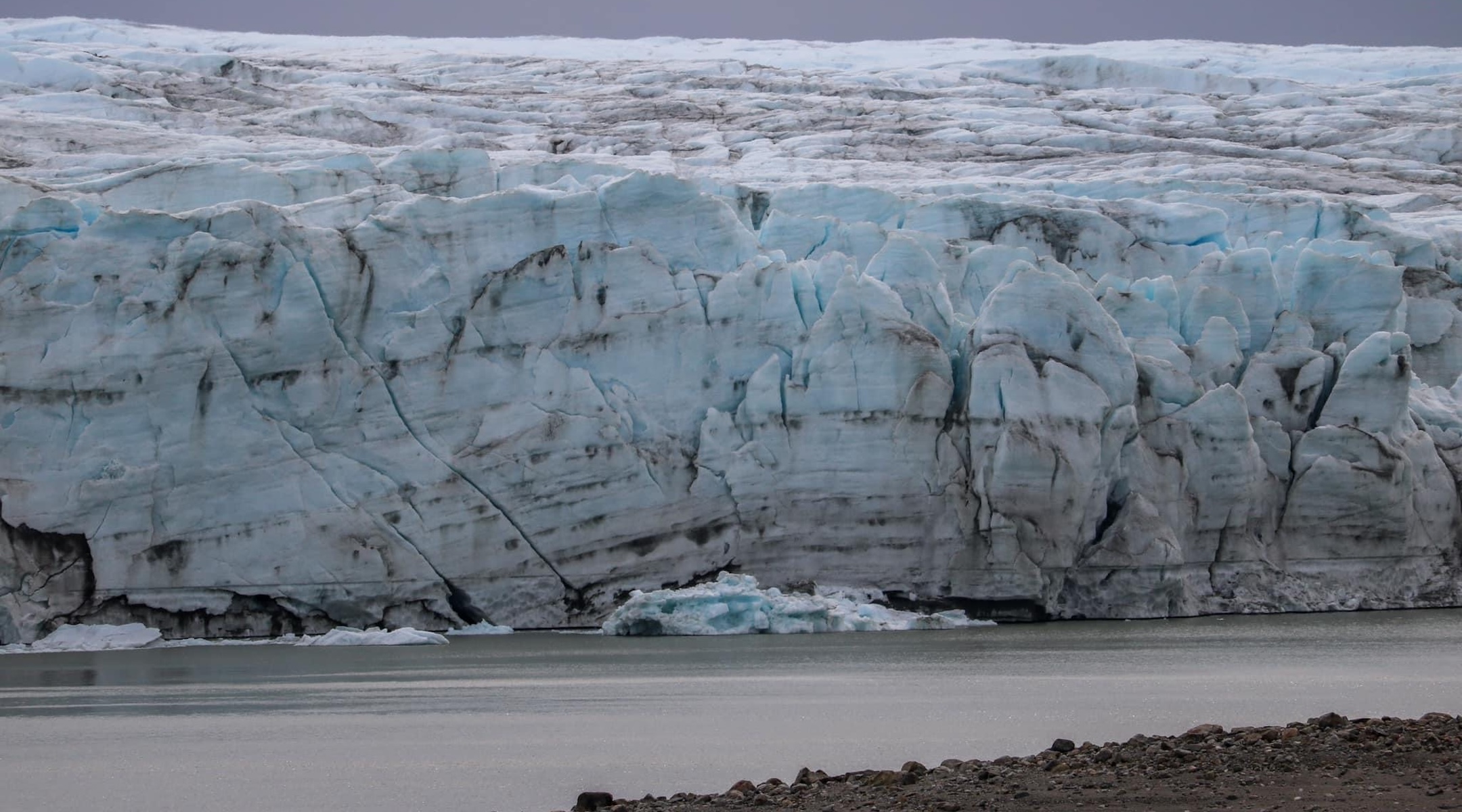
The Greenlandic ice sheet, photographed at Point 660 near Kangerlussuaq. (Aicah Barongo Adra, Abel Storch Siegstad)
One evening while sharing ghost stories, my friend from Nuuk, Greenland told me about the concept of the Qivittoq. Due to Greenland’s harsh terrain, a strong group is essential. If someone is found alone in the forest, outcast from their network, they are a Qivittoq, a half human, half god, and you should run quickly the other way since they have made an evil deal to stay alive. Hearing this tale, I thought back to my 11th-grade Talmud class when we discussed the concept of karet. In the Torah, karet, being cut off from the community, is viewed as a punishment worse than death. Like Greenlanders in the inhospitable north, Jewish people throughout history, from pogroms in Russia and Lithuania to today’s dramatic rise in anti-semitism in the United States, rely on each other to survive.
Through going outside of my comfort zone in an entirely new environment, I forged friendships with individuals interested in the niche scientific topics I have loved my whole life (like birds and cyanobacteria!). With these common academic pursuits, I peeked into a world alien in makeup but also surprisingly familiar. Because no matter where you go in life, common human ideals like family, community and friendship persist. And although theoretically I always knew that, through JSEP Earth is a tad bit smaller, and my cultural sensitivity grew a whole lot larger. Who could have imagined that happening on the Greenlandic ice sheet?
Source link : http://www.bing.com/news/apiclick.aspx?ref=FexRss&aid=&tid=66bbfbc69e364ccd8de8c7842bebeb5d&url=https%3A%2F%2Fwww.jta.org%2F2024%2F08%2F13%2Fglobal%2Fin-remote-greenland-a-nyc-yeshiva-kid-becomes-an-arctic-citizen&c=11636174927824570391&mkt=en-us
Author :
Publish date : 2024-08-13 03:14:00
Copyright for syndicated content belongs to the linked Source.