Discover the latest in science, tech, and space with over 100,000 subscribers who rely on Phys.org for daily insights.
Sign up for our free newsletter and get updates on breakthroughs,
innovations, and research that matter—daily or weekly.
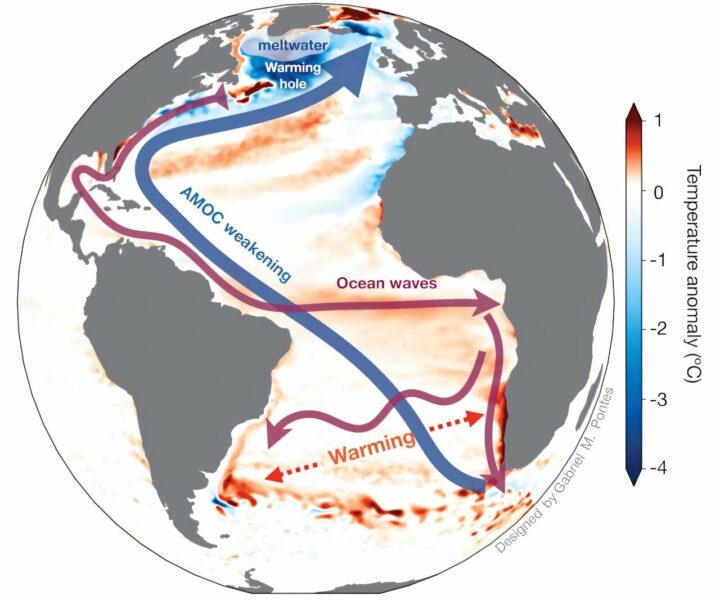
This fresh meltwater flowing into the subarctic ocean is lighter than salty seawater. So less water descends to the ocean depths. This reduces the southward flow of deep and cold waters from the Atlantic. It also weakens the Gulf Stream, which is the main pathway of the northward return flow of warm waters at the surface.
The Gulf Stream is what gives Britain mild winters compared to other places at the same distance from the north pole, such as Saint-Pierre and Miquelon in Canada.
Our new research shows meltwater from the Greenland ice sheet and Arctic glaciers in Canada is the missing piece in the climate puzzle.
When we factor this into simulations, using an Earth system model and a high-resolution ocean model, slowing of the oceanic circulation reflects reality.
Our research confirms the Atlantic overturning circulation has been slowing down since the middle of the 20th century. It also offers a glimpse of the future.
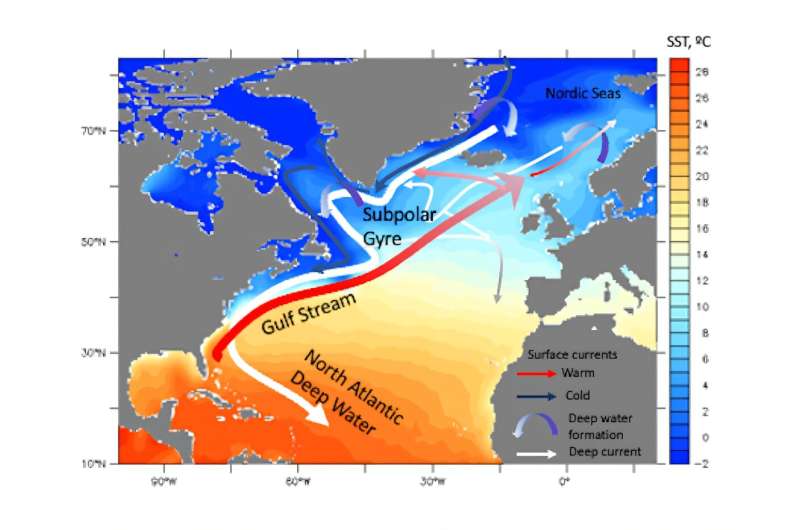
As they travel northwards, the Gulf Stream and North Atlantic Current cool as they lose heat to the atmosphere. The waters then become dense enough to sink to depth and form North Atlantic deep water, which travels southward at depth and feeds the other ocean basins. Credit: Modified from Nature Reviews Earth & Environment (2020)
Connectivity in the Atlantic Ocean
Our new research also shows the North and South Atlantic oceans are more connected than previously thought.
The weakening of the overturning circulation over the past few decades has obscured the warming effect in the North Atlantic, leading to what’s been termed a “warming hole.”
When oceanic circulation is strong, there is a large transfer of heat to the North Atlantic. But weakening of the oceanic circulation means the surface of the ocean south of Greenland has warmed much less than the rest.
Reduced heat and salt transfer to the North Atlantic has meant more heat and salt accumulated in the South Atlantic. As a result, the temperature and salinity in the South Atlantic increased faster.
Our simulations show changes in the far North Atlantic are felt in the South Atlantic Ocean in less than two decades. This provides new observational evidence of the past century slow-down of the Atlantic overturning circulation.
What does the future hold?
The latest climate projections suggest the Atlantic overturning circulation will weaken by about 30% by 2060. But these estimates do not take into account the meltwater that runs into the subarctic ocean.
The Greenland ice sheet will continue melting over the coming century, possibly raising global sea level by about 10 cm. If this additional meltwater is included in climate projections, the overturning circulation will weaken faster. It could be 30% weaker by 2040. That’s 20 years earlier than initially projected.
Such a rapid decrease in the overturning circulation over coming decades will disrupt climate and ecosystems. Expect harsher winters in Europe, and drier conditions in the northern tropics. The southern hemisphere, including Australia and southern South America, may face warmer and wetter summers.
Our climate has changed dramatically over the past 20 years. More rapid melting of the ice sheets will accelerate further disruption of the climate system.
This means we have even less time to stabilize the climate. So it is imperative that humanity acts to reduce emissions as fast as possible.
More information:
Gabriel M. Pontes et al, Weakening of the Atlantic Meridional Overturning Circulation driven by subarctic freshening since the mid-twentieth century, Nature Geoscience (2024). DOI: 10.1038/s41561-024-01568-1
Provided by
The Conversation
This article is republished from The Conversation under a Creative Commons license. Read the original article.
Citation:
Meltwater from Greenland and the Arctic is weakening ocean circulation to speed up warming down south, model suggests (2024, November 18)
retrieved 19 November 2024
from https://phys.org/news/2024-11-meltwater-greenland-arctic-weakening-ocean.html
This document is subject to copyright. Apart from any fair dealing for the purpose of private study or research, no
part may be reproduced without the written permission. The content is provided for information purposes only.
Source link : http://www.bing.com/news/apiclick.aspx?ref=FexRss&aid=&tid=673cc5bae5254439975e7b03362f57c0&url=https%3A%2F%2Fphys.org%2Fnews%2F2024-11-meltwater-greenland-arctic-weakening-ocean.html&c=1195501314127960575&mkt=en-us
Author :
Publish date : 2024-11-18 06:04:00
Copyright for syndicated content belongs to the linked Source.