Get the world’s most fascinating discoveries delivered straight to your inbox.
When the Vikings explored south of Newfoundland, in an area they named “VÃnland” (which translates as “Wine Land”), they were more interested in finding natural resources they could exploit. “Their real interest was in finding resources that might sustain the new Greenlandic colony,” Wallace said. “Vinland was explored because it had been discovered and offered potential resources.”
Kevin P. Smith, a research associate at the Smithsonian Institute who specializes in the Vikings, had a somewhat different opinion. He said that Norse texts indicate “there was interest in the first decades of the 11th century A.D. in establishing a colony in the area known as VÃnland.” The texts indicate that some Vikings believed it offered “opportunities for ‘second sons’ of the chieftain who had established the Greenland colony to carve out their own areas where they could be leaders/chiefs rather than ‘second sons,'” Smith told Live Science in an email.
Christopher Crocker, a research grant facilitation officer at Memorial University in Newfoundland who has researched the Vikings extensively, said that he doesn’t think there’s sufficient evidence to indicate whether the Vikings wanted to establish permanent settlements in North America.
“Whether they sought to establish long-term/permanent settlements there and to exercise some kind of economic and political control over the area [is] not at all clear in light of the evidence we have,” Crocker told Live Science in an email.
Defeat in North America
Smith said that medieval Norse sagas “make it absolutely clear that the reason they gave up trying to establish a colony in VÃnland was that the land already had many more inhabitants than the Norse had brought with them.” When the Vikings made contact with the Indigenous peoples of North America, conflict broke out quickly.
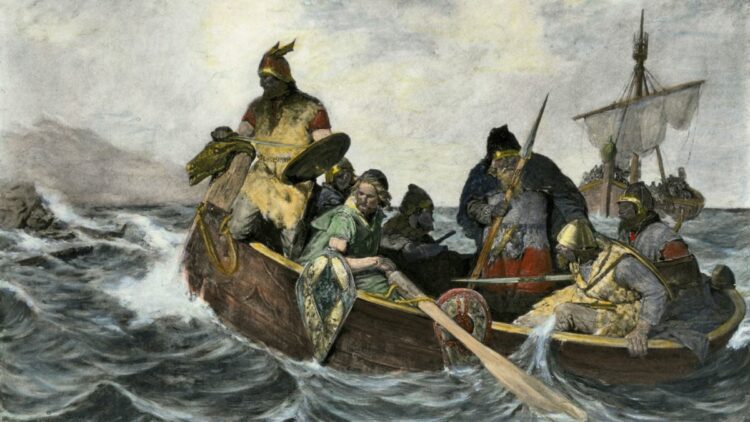
The “Saga of Erik the Red” mentions a clash between the Vikings and Indigenous people that ended with the Vikings retreating to their ships after suffering a defeat that left a few Vikings dead. The group of Vikings that fought the Indigenous people were “now of opinion that though the land might be choice and good, there would be always war and terror overhanging them, from those who dwelt there before them. They made ready, therefore, to move away, with intent to go to their own land [Greenland],” the text reads (translation by John Sephton).
The Vikings “who tried to establish a colony in North America were defeated, retreated, and saw no possibility of winning or establishing a stable colony in lands that [were otherwise] perfect for colonizing,” Smith said.
Related: Columbus ‘discovered’ the New World … so why isn’t America named after him?
Replicas of Norse dwellings at L’anse Aux Meadows in Newfoundland, Canada. (Image credit: Wolfgang Kaehler via Getty Images)Not enough Vikings
The number of Vikings who lived on Greenland was low, and even the total number of Vikings was relatively small, the scholars noted. “The total population of the Scandinavian countries in the late Viking Age was probably less than a million,” Jan Bill, curator of the Viking ship collection at the University of Oslo’s Museum of Cultural History, told Live Science in an email. Greenland, meanwhile, had “only an initial population of 400-500” Vikings, Wallace said. “At its peak around AD 1300, its maximum population was perhaps 2000-3000.”
What the total Indigenous population of VÃnland was at the time the Vikings visited is unclear, however it would have been vastly larger. A 2010 paper published in the journal American Antiquity estimated the Indigenous population of eastern North America around 1500 to be somewhere between 500,000 and 2.6 million people.
The North Atlantic route the Vikings used also posed a barrier. “Relatively seen, the cold and the storms of the North Atlantic made this sea a higher barrier than the more favourable conditions found further south,” Bill said.
The distance between ‘VÃnland’ and Greenland also posed a major problem for the Vikings. “Greenland was weeks away in terms of getting goods to market [in Europe], which made for a difficult trade network operation,” Kevin McAleese, a curator at Rooms Provincial Museum in St John’s in the province of Newfoundland and Labrador, told Live Science in an email.
Additionally, Scandinavia was less urbanized in the Viking age than Europe was in the time after Columbus sailed, and the states the Vikings ruled were less developed. “In the 15th century, state formation was much more advanced than in the 11th century, especially when comparing Scandinavia with the Iberian Peninsula,” said Bill, who noted that “more advanced states could invest more in colonization than the very young states of Denmark, Norway and Sweden.”
Other factors against colonization
After the voyages of Columbus, numerous epidemics swept across the Western Hemisphere and decimated Native American populations, which made it easier for European colonists to seize land and natural resources. In 2009, researchers Dr. William Agger and Herbert Maschner published a paper in the book “The Northern World: A.D. 900-1400” (University of Utah Press, 2009) proposing that illnesses from the Vikings may have caused an epidemic among a people in the Arctic that archaeologists now call the “Dorset,” but this epidemic didn’t spread widely across North America.
Additionally, historical records indicate that there was also internal dissent among the Vikings who traveled to North America, McAleese said. The saga of Erik the Red mentions arguments about religion, which directions to travel and which tactics to use when fighting the Indigenous peoples. With all the problems the Vikings faced, they may have abandoned L’Anse Aux Meadows after about two decades. Any hopes the Vikings had of colonizing North America turned out to be “a bridge too far,” McAleese said.
Source link : http://www.bing.com/news/apiclick.aspx?ref=FexRss&aid=&tid=6714c78f871b438fb6d8d636776c7617&url=https%3A%2F%2Fwww.livescience.com%2Farchaeology%2Fvikings%2Fwhy-didnt-the-vikings-colonize-north-america&c=8489507458018265975&mkt=en-us
Author :
Publish date : 2024-10-19 13:00:00
Copyright for syndicated content belongs to the linked Source.