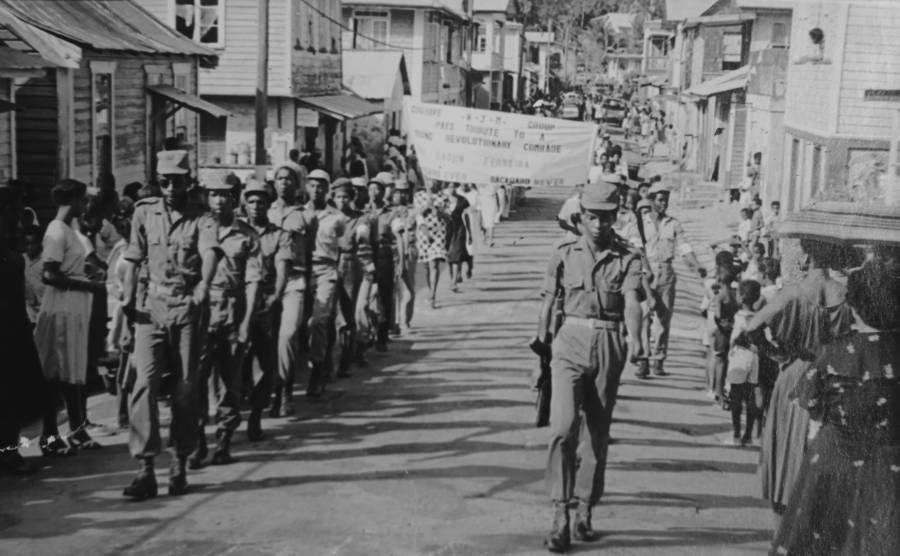
Remembering Grenada’s Revolution Beyond Cold War Narratives: A Fresh Perspective from NACLA
As the world reflects on the enduring legacies of revolutionary movements throughout the Caribbean, Grenada’s 1979 Revolution stands out not just for its profound impact on the island nation but also for the complexities that shaped its history. Often framed within a Cold War context, where communist ideologies clashed with Western interests, the narrative surrounding Grenada’s upheaval has frequently been simplified, overshadowing the rich tapestry of local politics, culture, and vision that contributed to this pivotal moment. In an enlightening discussion hosted by the North American Congress on Latin America (NACLA), scholars and activists have come together to challenge conventional perceptions of Grenada’s revolution, urging a reevaluation that goes beyond the binary of East versus West. This article delves into their insights and highlights the importance of remembering Grenada’s struggle not merely as a footnote in the geopolitical rivalry of the late 20th century, but as a significant chapter in the ongoing story of resistance and self-determination in the Caribbean.
Understanding the Historical Context of Grenada’s Revolution and Its Legacy
The revolution in Grenada that took place in 1979 was not just an isolated event; it was deeply intertwined with the geopolitical currents of its time. Emerging from a colonial past marked by both British rule and socio-economic struggles, Grenada’s path towards independence was fraught with challenges. Key figures, such as Maurice Bishop, emerged as vocal proponents for change, advocating for a more equitable society. This revolutionary fervor was set against the backdrop of the Cold War, during which the Caribbean became a hotbed for ideological conflicts. Factors like poverty, unemployment, and the aspirations of the Grenadian people directly contributed to the rise of the New Jewel Movement, which sought to instigate profound social and economic reforms, often viewing itself in opposition to both colonial interests and external capitalist forces.
As the revolution unfolded, its legacy morphed into a complex narrative shaped by nationalism, anti-imperialism, and resistance to intervention-notably illustrated by the U.S. invasion in 1983. The aftermath of the revolution continues to evoke discussions around sovereignty and external influence. To better understand its implications, consider the following aspects that remain pivotal in assessing Grenada’s legacy today:
- Political Agency: The push for self-determination continues to resonate across Caribbean nations.
- Social Justice: Efforts toward socioeconomic equity still echo in contemporary political discourse.
- Global Solidarity: The movement inspired various anti-colonial movements globally, emphasizing the interconnectedness of struggles.
Examining the Impact of Revolutionary Policies on Caribbean Society
The Grenadian Revolution, which unfolded between 1979 and 1983, represented a significant chapter in the Caribbean’s socio-political landscape. Spearheaded by the New Jewel Movement, this period saw an optimistic push for comprehensive reforms aimed at alleviating poverty and addressing social inequalities. Policies were introduced to ensure access to education and healthcare, drastically redefining the roles of women and youth within society. This transformative agenda not only sought to empower stifled demographics but also ignited a sense of national pride and identity. The impact of these revolutionary policies can be assessed through several lenses:
- Increased literacy rates: Educational initiatives fostered a culture of learning and growth.
- Women’s empowerment: The integration of women into national decision-making represented a significant social change.
- Health improvements: Access to healthcare contributed to better overall public health outcomes.
However, the narrative surrounding Grenada’s revolution often tends to be framed within Cold War dichotomies, overshadowing the grassroots movements that challenged these frameworks. The economic strategies adopted during this time aimed for self-sufficiency and sustainability, but external pressures, including economic sanctions and military interventions, hindered these aspirations. Despite the tumultuous end to this revolutionary era with U.S. intervention in 1983, analyzing its outcomes reveals enduring legacies in contemporary Caribbean society. To better understand these dynamics, the following table presents key statistics from this period:
| Aspect | Before Revolution | After Revolution |
|---|---|---|
| Literacy Rate | 67% | 97% |
| Women’s Employment | 30% | 60% |
| Healthcare Access | Limited | Universal |
Revisiting Cold War Narratives: A Call for Nuanced Discussions on Grenada’s Future
The narratives surrounding Grenada’s revolution and subsequent U.S. invasion in 1983 have often been viewed through the rigid lens of Cold War dichotomies. This polarized understanding oversimplifies the complexities of Grenadian society, its political aspirations, and the socio-economic factors that influenced the revolutionary movement. To move beyond the binary frames of ‘us versus them’ that dominated historical discourse, it is crucial to engage in nuanced discussions that recognize the multifaceted motives driving Grenadian leadership and the populace. Contextual factors such as local governance, social programs, and international solidarity must be examined in tandem with the Cold War backdrop, allowing for a richer interpretation of Grenada’s past and its implications for the future.
As Grenada navigates its present and plans for its future, revisiting these narratives presents an opportunity for collective healing and growth. Stakeholders can establish dialogues that foster a deeper understanding of the island’s social fabric and its global relationships. Engaging diverse voices-from historians to local activists-can challenge entrenched views and pave the way for a broader discourse that respects the agency of Grenadians in shaping their destiny. Here are some critical aspects that should be included in this discussion:
- Historical Context: The importance of understanding Grenada’s political evolution.
- Local Agency: Recognizing the role of Grenadians in their revolutionary journey.
- International Relations: Impact of global politics on local decisions.
To Wrap It Up
As we reflect on Grenada’s revolution and its place in Cold War narratives, it becomes clear that a deeper understanding of this pivotal moment is essential. The experiences of the Grenadian people, their struggles, and aspirations extend beyond the geopolitical rivalries that often dominate historical discourse. The North American Congress on Latin America (NACLA) encourages us to engage with these untold stories, challenging prevailing narratives and enriching our comprehension of statecraft, identity, and resistance in the Caribbean. By recalling Grenada’s revolutionary past, we not only honor those who fought for a better future but also gain insights that resonate in today’s global context. As we continue to navigate the complexities of modern political landscapes, remembering Grenada’s revolution serves as a vital reminder of the lessons history imparts.