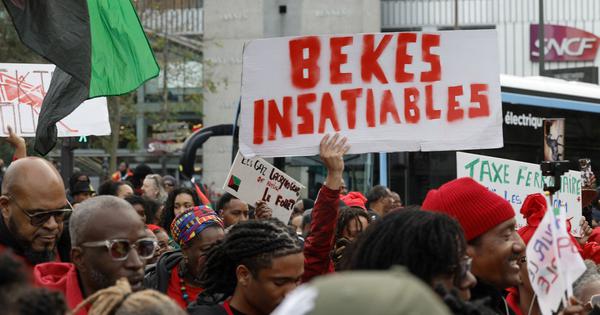
Violent protests erupted on the French Caribbean island of Martinique over the high cost of living, as food prices soared 40% higher than in mainland France. pic.twitter.com/YiviF0oKfl
— DW News (@dwnews) October 14, 2024
Decolonial perspective
Given the legacy of colonialism and its consequences on the quality – and equality – of life in French overseas territories, many protesters have embraced a decolonial approach.
Alongside an increase in discussions around independence, there has been a discernible shift in the French Caribbean toward regional collaboration, as seen by Martinique’s executive council president Serge Letchimy’s attempt to integrate with the Organization of Eastern Caribbean States. This move toward a more self-sufficient and regional economic model aims to provide greater autonomy from France and, in so doing, help lessen the wealth gap.
Echoing this perspective, Martinican sociologist Malcom Ferdinand observed in 2022 that the ongoing economic struggles in the French Caribbean “are not only linked to the colonial, slave-making, and patriarchal constitution of the modern world … [but] they are, above all else, its consequences.”
Better future
As Martinicans and Guadeloupeans continue to take to the streets, there are signs that the demonstrations, as they head into their third month, are having an effect.
The French government recently established an agreement with private sector entities involved in retail in Martinique, aiming to cut the price of common goods by 20%.
While many French Caribbean residents will likely view this as a move in the right direction, I believe it is unlikely to mollify local desire for a more equitable future. Channeling the views of many of his fellow overseas French citizens, Martinican writer Patrick Chamoiseau recently argued for greater social and environmental reforms to move beyond the cycle of dependency with Europe.
Without such reform, the French Caribbean, as Chamoiseau writes, will be forced to maintain the “artificial economy” established by colonialism, and Martinicans will thus continue to have “no control over food security … or over a future anything other than tragic”.
David A Vivian is Visiting Assistant Professor of French Language and Culture, Soka University of America.
This article was first published on The Conversation.
Source link : http://www.bing.com/news/apiclick.aspx?ref=FexRss&aid=&tid=672b9c529e2c472b8fedc62718bf35cb&url=https%3A%2F%2Fscroll.in%2Farticle%2F1075192%2Fcolonial-roots-of-deep-inequality-whats-driving-violent-protests-in-french-caribbean-islands&c=4553733273016530531&mkt=en-us
Author :
Publish date : 2024-11-06 03:38:00
Copyright for syndicated content belongs to the linked Source.