Rodrigo Tot has been at the forefront of the community’s fight for land rights for years. In 2017, he was awarded a Goldman Environmental Prize honoring “grassroots environmental heroes” for his leadership role in the land title quest.
“I have suffered first-hand,” Tot said Tuesday during a press conference, alluding to the fatal shooting of his son Edin Leonel Tot Sub 10 years ago in what appeared to be a targeted attack.
“There are other communities in the same situation,” said Tot. “We need to legalize our lands.”
The Guatemalan government was notified in September 2020 that the case was subject to the Inter-American Court of Human Rights, the Procuraduría de la Nación (PGN) told Mongabay in a written statement Wednesday. The PGN represents the State of Guatemala’s legal interests, including in domestic and international proceedings.
Guatemala has complied with its obligations under national law to ensure the human rights of Agua Caliente community members are respected, according to the PGN, which laid out its response to all three points of controversy in the case.
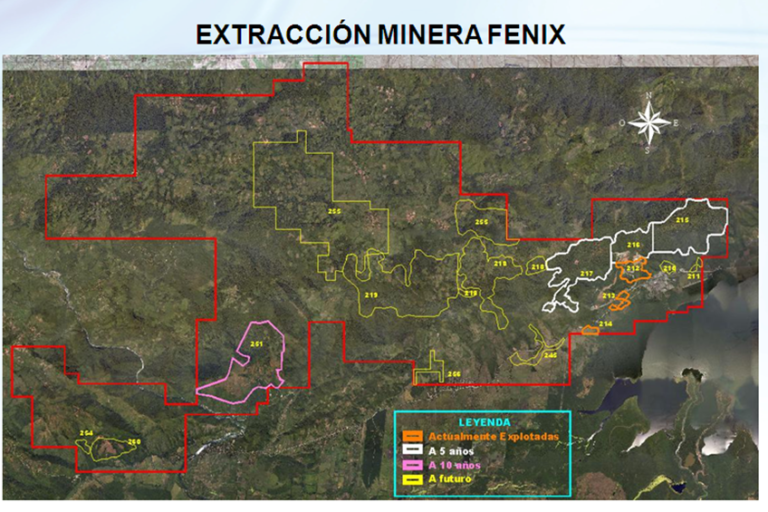 Map of Fenix mine extraction in El Estor, Guatemala. Image courtesy of Indian Law Resource Center.
Land was registered to community members in 2019, a consultation process concerning the Fenix mine concluded in agreements last December, and investigations into acts of violence continue, the PGN told Mongabay.
“The State emphasizes its commitment to ensure the human rights of all of its population, which will be demonstrated in the hearing [Wednesday],” according to the PGN statement.
A conflict over consultation
From the 1950s and 1960s under military rule, Guatemala has granted surface and subsoil rights to a string of transnational mining companies in the area. Successive owners of the Fenix mine, which operated for a few years in the late 1970s and was restarted in 2014, have engaged in exploration in Lote 9 lands.
“Fenix concession does not include the lands of Lote 9. This land is owned by representatives of the Aguas Caliente community. […] The company does not operate on the land of Lote 9,” the Solway Investment Group’s press office told Mongabay in a written statement.
In 2020, Guatemala’s Constitutional Court upheld a previous ruling ordering the government to suspend the Fenix mine exploitation license pending consultation with potentially affected Indigenous communities in the region, a legal requirement the government had failed to fulfil.
Q’eqchi’ community leaders and fishermen engaged in sustained protests in the town of El Estor last October over Q’eqchi’ representation issues in the consultation process, preventing the passage of trucks carrying coal to fuel the mining company’s processing plant.
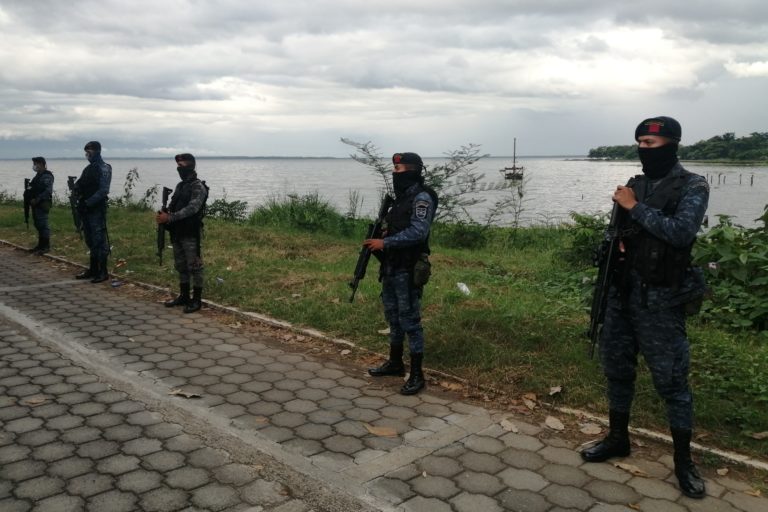 Guatemalan marines fan out along the access street to a pier during the state of siege in El Estor. Image courtesy of Sandra Cuffe.
The protests ended in a violent crackdown and a month-long state of siege akin to martial law, during which time security forces raided the homes of several outspoken Indigenous mine opponents as well as local journalists.
While constitutional rights were suspended locally, the government also held meetings elsewhere to advance its consultation process, which wrapped up December 9 with agreements. The Minister of Energy and Mines signed a resolution on January 6 to reinstate the Fenix mine exploitation license, and Solway’s press office told Mongabay its subsidiary “has restarted its extraction operations.”
Many Q’eqchi’ community residents, including Rodrigo Tot, do not consider the government’s consultation process to be valid. In Tot’s case, he noted international conventions ratified by Guatemala are clear that “prior” is a key characteristic of consultation.
“Talking about consultation is the first thing that is done,” said Tot. “At this point in time, talking about consultation is already too late.”
Banner image: Rodrigo Tot began visiting households in Agua Caliente and gathering evidence of Q’eqchi ownership of the land. Image courtesy of Goldman Environmental Prize.
Related listening from Mongabay’s podcast: A conversation with Cultural Survival’s Daisee Francour and The Oakland Institute’s Anuradha Mittal on the importance of securing Indigenous land rights within the context of a global push for land privatization. Listen here:
FEEDBACK: Use this form to send a message to the author of this post. If you want to post a public comment, you can do that at the bottom of the page.
Environmental Law, Human Rights, Indigenous Communities, Indigenous Groups, Indigenous Peoples, Indigenous Rights, Industry, Land Conflict, Land Rights, Law, Mining
Central America, Guatemala, Latin America
Source link : https://news.mongabay.com/2022/02/indigenous-community-takes-guatemalan-land-rights-fight-to-international-court/
Author :
Publish date : 2022-02-09 03:00:00
Copyright for syndicated content belongs to the linked Source.