More: President Trump’s executive orders on immigration, birthright citizenship, border security
An El Paso Times records search turned up no criminal records for several of the men interviewed in this story, but some have common names, and those searches were inconclusive given the lack of public data released on migrants being deported.
Many of those now arriving in Guatemala have lived in the U.S. for years, abruptly leaving behind family members.
Kakawax, for example, was 12 years old when he migrated from a remote Indigenous Maya Q’eqchi village to the United States. He was studying to be a chef, but after a traffic stop in South Texas, he was deported on Feb. 19.
Araceli Kakawax explained that he went to the U.S. to make money for his family back home, feeling the pull of the U.S. economy’s need for low-paid laborers.
“He just went to work,” she said.
‘Open season’ on migrants
Kakawax was turned over to ICE agents in early February after he was detained for not having a driver’s license after a traffic stop in Galveston, Texas. He was driving with a friend when he was pulled over for allegedly running a stop sign.
Migrants who returned to Guatemala were swept up in ICE operations in Texas, Florida, Louisiana and Virginia. These arrests started with minor infractions, including traffic stops and immigration check-in appointments.
A migrant deported on Feb. 19 said that it was almost like “open season” for migrants.
In interviews with the El Paso Times outside the reception center, migrants recounted being detained while pumping gas into their cars or leaving work — with some migrants still wearing their work uniforms upon arrival in Guatemala.
Kakawax heard all these stories while he was detained.
“There are people that I met in detention center who did nothing, who were just arrested on the street,” he said. “They are suffering a lot.”
Even those seeking to go through an immigration process to regularize their status legally are being deported, migrants said.
Three brothers, Denis Israel, Alex Alberto and Juan Jose IsaÃas Yac Calvo, were deported from the U.S. on Feb. 19. The three had migrated as minors to the United States with their mother in 2019, but after she passed away in 2023, they had continued the process to legalize their status.
But in early February, the rug was pulled from under them.
They had to arrive to check in as part of their process in Houston, Texas, on Feb. 11, as they had done many times over the years. But five minutes later, ICE agents had detained them and ordered their removal to Guatemala.
Their uncle, Ezequiel Yac Yac, arrived to welcome the three young men at the reception center.
“The strange thing is that they didn’t give him a chance to practically do anything,” Yac Yac said. “They complied with everything, but in the end, the truth is we don’t know what has happened.”
The brothers remained in a detention facility in Texas for over a week before they were deported.
Kakawax also was sent to a detention facility in southern Texas, where he eventually ended up in front of an immigration judge. A judge issued the order for his removal, and his family received a call last week that he was being deported to Guatemala.
“Being there was horrible,” Kakawax said. “The guards shout at you, and they don’t understand. Although you might want to say something, they don’t give you your right to speak.”
He was moved from the detention facility and put in a cold room overnight. Early the following morning, he was removed and placed on a deportation flight from Houston.
“I was chained on the feet, the belly, and hands,” he explained. “It feels awful.”
Migrants, many of whom have never been arrested before, complain the chains make them look like hardened criminals.
ICE officials use restraints to keep the peace on these emotional flights. The chain and handcuffs protect the flight crew and help them to quickly control the migrants who may act out in anger.
The handcuffs were not removed until the planes began descending into Guatemala City, migrants said.
“We were in chained the whole time,” Ã�ngel Pérez, a 24-year-old migrant from the department of Totonicapán, said. “We were chained since 2 a.m. My hands still hurt.”
Pérez and 125 other Guatemalans were deported on Feb. 18. He said he was relieved to be in Guatemala and free of the restraints.
‘Ladies and gentlemen, welcome to Guatemala’
The deportation flights do not arrive at Guatemala’s La Aurora International Airport. Instead, they arrive at the reception center across the runway next to the La Aurora Air Force Base.
The chartered flights pull up next to the center, which was built with money from the United States government through USAID and opened in 2020.
The migrants enter by foot from the tarmac, ushered into a large hall decorated with colorful murals depicting the Guatemalan countryside. Immigration officials then register them after a brief message welcoming them home.
“We hope that the return of each of you to your home is a blessing,” a Guatemalan immigration agency representative said. “We know that it has been a long process, it has been a difficult process, but remember that you are already in your home.
“Ladies and gentlemen, welcome to Guatemala.”
A small table sits on one side of the hall with local types of cookies, sweet bread rolls and coffee for migrants as they wait for their registration.
Once they pass through immigration, migrants receive a small welcoming paper bag containing toiletries and other items. They are provided limited services, including vouchers for new identification documents, which are required for many services in Guatemala. Some have never received the documents because they grew up in the United States.
There are spaces for migrants to charge their telephones and a place where they can exchange U.S. dollars or Mexican pesos for the local currency.
The deportees are permitted to leave the center once everyone has been registered.
Guatemalan officials warn migrants against using the taxis because of security concerns and price gouging that wait outside the building, providing a bus that carries migrants to the bus stations. Others leave through the congregated metal door to the chaotic streets of Guatemala City, where families anxiously await.
Local charities that provide services also offer a bed for the night to migrants whose families were not able to come to the city or are returning home to towns located a greater distance from Guatemala City.
“We provide lodging to people,” Lorena Pérez, who works at the Catholic Church’s Casa de Migrante in Guatemala City, said, “so that they can spend this night to escape a little from the impact that deportation has.”
‘Exhausting situation’
Deportations are traumatic, whether migrants have been in the U.S. for days or years.
Many migrants arrive in a state of shock. They were forced to leave the lives they built behind, while others were left with debts as high as $18,000. “People come very affected mentally, physically,” Karina López said, who works at the Guatemala City Casa de Migrante shelter. “It is a very exhausting situation. The impact that people experience is ultimately quite strong post-traumatic stress.”
The shelter also provides psychological services to migrants and support for obtaining legal documents.
Shelter employees have seen a shift in the profiles of those arriving at their doors on the deportation flights. Increasingly, they are seeing migrants who have been in the United States for decades and who primarily speak English.
“Last year, the ICE flights with people who had been in the United States for a long time only came on Wednesdays,” López said. “Now it is normal that people who come on these flights have had a lot of time in the United States.”
This has created new challenges, as many deportees no longer have family in Guatemala.
‘Take care of yourself’
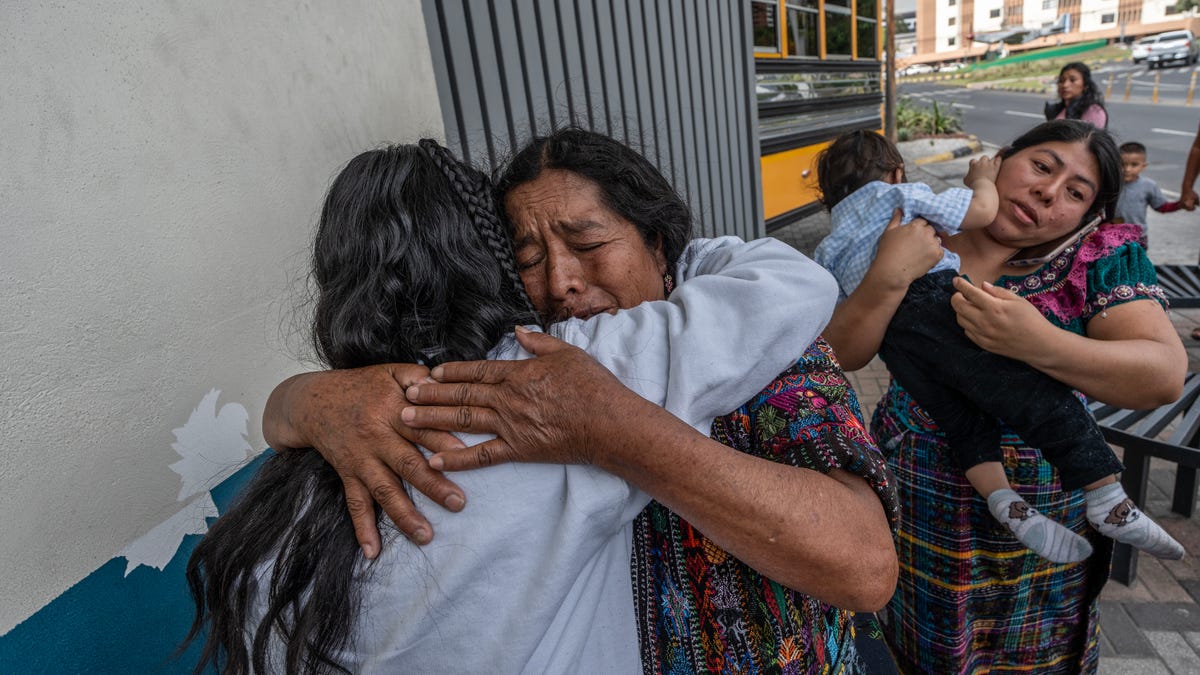
Guatemalan families arrived at the reception center early in the morning every day that there was a deportation flight to ensure they were present for their loved one’s arrival. They sat on the benches, curbs, or wherever they could find space, talking among themselves as they waited.
Anxiety grew as the hours passed. Family members quickly moved towards the door every time it opened to see if, by chance, their loved one was stepping out into their embrace.
Lorenzo GarcÃa waited to welcome his son home. When his son called him from inside the reception center, he broke down crying, holding his head in his hands. They embraced when he emerged from the center.
Before departing for home with his sister and mother, Kakawax shared some advice for migrants still in the United States.
“Take great care of yourselves,” he said. “May God bless all those who stayed. God will always be there for them.”
Jeff Abbott covers the border for the El Paso Times and can be reached at:[email protected];@palabrasdeabajo on Twitter or @palabrasdeabajo.bsky.social on Bluesky.
Source link : http://www.bing.com/news/apiclick.aspx?ref=FexRss&aid=&tid=67bc0bb099f14e0f93f6cbe28fd575a6&url=https%3A%2F%2Fwww.usatoday.com%2Fstory%2Fnews%2Fimmigration%2F2025%2F02%2F23%2Fmigrants-painful-deportations-during-trumps-first-30-days-in-office%2F79328647007%2F&c=5892180826036490428&mkt=en-us
Author :
Publish date : 2025-02-22 22:02:00
Copyright for syndicated content belongs to the linked Source.