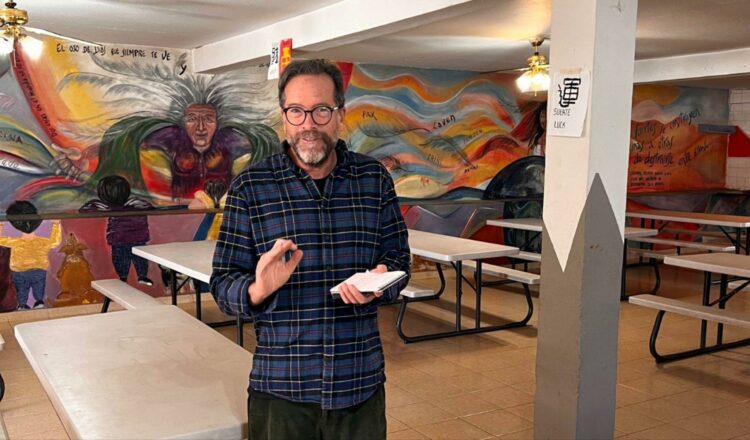
For nearly three decades, Arizona-based writer and journalist Todd Miller has immersed himself in the real-life people and policies defining the U.S.-Mexico border.
When the Department of Homeland Security took over immigration and enforcement after Sept. 11, 2001, he was crossing the border multiple times a week with BorderLinks, a community-based organization dedicated to education and social justice in the borderlands between Arizona and Chiapas. He later became a writer for the nonprofit organization North American Congress on Latin America, which analyzes and publishes trends in Latin America, and he wrote four books about the U.S. border. In 2021 Miller cofounded The Border Chronicles weekly journalism newsletter, where he writes stories and hosts a podcast with co-founder Melissa del Bosque, an investigative journalist and writer.
Much of this work provides a nuanced, stark contrast to the false and derogatory descriptions of Latin American migration that U.S. politicians have spread for many years.
During the current presidential campaign cycle, for example, former President Donald Trump has falsely insisted that “many, many terrorists” are entering the U.S. via the Mexico border – echoing violent depictions of immigrants that shaped his 2016 campaign. In reality, no known terrorists have ever entered the U.S. via the Mexico border, according to Miller and the U.S. Department of State.
Climate change has emerged as a growing theme from Miller’s time spent south of the border.
Over the course of his countless reporting trips and research into international surveys and reports, he has watched climate events displace residents of Latin America and the rest of the world in real time, which he wrote about in his 2017 book, “Storming the Wall: Climate Change, Migration, and Homeland Security.”
Alarmingly, a lot has already changed in the climate landscape since 2017. For the worse.
Yale Climate Connections spoke with Miller to better understand who is trying to cross the U.S. border, which climate factors are motivating their journeys, and how U.S. policies and presidential candidates influence the narrative.
Yale Climate Connections: How is climate change showing up most often in migrant stories at the U.S.-Mexico border today?
Todd Miller: The whole documenting of people being displaced by climate change is a difficult endeavor, to say the least. It’s so often multifaceted. For example, I’ve interviewed many farmers in Central America, and often the problem is the harvest doesn’t come because there’s no rain or the seasons are getting scrambled. The rain isn’t as reliable or it comes at the wrong time. Then there’s no money.
The fact that they have no money as a buffer sends people into crisis. Family members might go to San Pedro Sula in Honduras or Guatemala City first and get a crap job that doesn’t pay at all in these more dangerous cities where there’s more organized crime. We often hear part of that story, but below it is a climate story.
YCC: So in many of these stories, climate remains an invisible player.
Miller: I keep coming back to something that writer Christian Parenti [author of “Tropic of Chaos: Climate Change and the New Geography of Violence”] calls the “catastrophic convergence.” All these factors are converging, including economic, political, and justice issues. Then all of the sudden there’s this climate issue that’s a newer thing but becoming stronger and stronger. Because of this, it’s so hard to know how many people are on the move and when climate is the root cause. Sometimes it’s the last straw, like when a flood or drought hits.
YCC: You shared some of these difficult stories and the climate data back in 2017 in your book “Storming the Wall.” What part of that project made a lasting impression on you?
Miller: One of the places I focused on was Central America, but I also highlighted the Philippines. It’s one of the starkest examples, where climate change is in your face, obvious and constant. No one there is saying climate change doesn’t exist.
It was also a personal choice because my grandma is Filipino. She came from the island of Marinduque, which is a heart-shaped island right in the middle of the Philippines’ 7,000 islands. I went there and met with officials who were looking at future risks and climate change. That island of my grandmother was under complete threat, and a big factor was sea level rise. So I went to one of the beaches where it’s taking place and we came across an abandoned house. The waves were literally lapping in and out of this house, which had already been destroyed by the sea. It felt like looking at the carcass of a whale on a beach – this thing that was alive, that somebody was living in, is now dead.
YCC: Wow. And there is a local community witnessing this play out?
I interviewed a middle-aged fisherman near that house and he pointed to a buoy bobbing out in the waves where the water line used to be. He said they had already moved back the whole community once before. It just really hit me that here I am on my grandmother’s island that could possibly not exist in the future. At the time, I was also five months away from having my first child. So the thought of future generations was front of mind, spanning the early 20th century when my grandma lived on Marinduque to the life of my child who was still unborn but maybe would live until the end of the 21st century. That became the spirit of “Storming the Wall.”
YCC: Since that book in 2017, the climate story and the data have already evolved significantly – especially concerning droughts, hurricanes, and other life-threatening changes. What would you highlight if you wrote that book today?
I think immediately of Central America starting with the major droughts of 2018. The U.N. World Food Programme has done a couple big assessments within this Dry Corridor of Central America – encompassing Honduras and parts of Guatemala, El Salvador, Nicaragua, and southern Mexico. In 2018, they released a survey revealing 2.2 million people in that region were facing hunger. In early 2021, the World Food Programme did another survey and the number increased to nearly eight million. It was almost a fourfold increase of people facing hunger in about two years.
They attributed it largely to two devastating back-to-back Category four hurricanes that hit in late 2020, plus droughts and the COVID pandemic. Also those surveys, two years apart, revealed that the number of people with concrete plans to migrate jumped from 8% to nearly 15%.
YCC: When they head north, what kind of support are climate refugees finding in the U. S.?
There is no climate asylum in the U.S. When I talk to people who have been displaced by climate, like a hurricane, what they have to do is show persecution. It doesn’t matter if your house was destroyed or that you lost your job or livelihood. If someone’s house was destroyed by a hurricane, then [for example] a gang has to have taken over their neighborhood and they would have to feel threatened by that gang to do an asylum claim. This is something that needs to change. We’re looking at a world of mass displacement.
YCC: In the current U.S. presidential campaigns, we’re hearing a lot of violent rhetoric about criminal immigrants and the Mexico border. How do you contextualize all of this?
Miller: Trump deals with hyperbole all the time, especially in campaigns. And he’s actively campaigning on the border, thus he calls Kamala Harris “the border czar.” He wants to paint a picture based on a foundation of lies that his campaign put out on Biden originally. Central to those lies is that there’s an open border. Painting Harris as the border czar means she facilitated an open-border system. So he’s promising a staunch border enforcement platform: “I’m going to stop all these bad people from coming into the country.” It just seems like Trump is continuing from that rapist comment he made when he started campaigning in 2016.
There are countless studies, and every study I’ve seen about the so-called criminality of migrants shows there are very low crime rates in neighborhoods with undocumented people. It’s been shown over and over again. This idea that there is a higher percentage of criminals coming over the border is hyperbole. But it’s good for constituents who are looking for scapegoats. And the migrant scapegoat has been around for decades.
YCC: How has President Biden approached the border over the past four years?
Biden is operating budgets for border and immigration enforcement that are higher than Trump ever had. He’s not changed the border strategy at all. In fact, it’s even more fortified at this point. I like to look at the budgets more than the rhetoric to see what they’re really doing on the border. And Trump and Biden are both kind of the same in that regard.
YCC: What do you expect if Harris becomes president?
Recently, as vice president, she was infamously quoted telling migrants in Guatemala “Do not come” to the United States. It really seems like she will follow the lines of a Biden presidency. She already said she would continue asylum restrictions Biden announced in June and she would push for this border bill that is very enforcement-heavy. She has this background as a prosecutor and we have pictures of her posing with border enforcement agents. I anticipate it will be very deportation-heavy and increase the budgets for enforcement.
This interview was edited and revised for clarity and brevity.
We help millions of people understand climate change and what to do about it. Help us reach even more people like you.
Source link : http://www.bing.com/news/apiclick.aspx?ref=FexRss&aid=&tid=66eb94d46b9b432ab2b86adb5581eb06&url=https%3A%2F%2Fyaleclimateconnections.org%2F2024%2F09%2Fthe-reality-behind-false-claims-about-criminal-migrants%2F&c=16186148254953522038&mkt=en-us
Author :
Publish date : 2024-09-17 02:39:00
Copyright for syndicated content belongs to the linked Source.