Will newfound oil wealth change economic prospects for Guyana and Suriname?
Oil wealth has not always translated into economic wealth for nations with large oil and gas reserves.
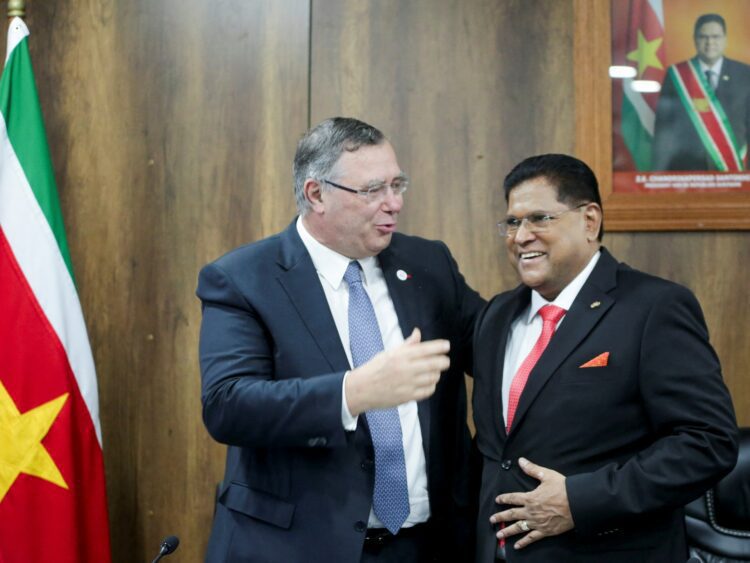
Santokhi told the AFP news agency that he was “quite aware of the oil curse”, also known as the “Dutch disease”, which had fallen on resource-rich countries such as Venezuela, Angola and Algeria – none of which has seen big uplifts for their economies despite a wealth of natural resources.
Only Norway has managed to escape the curse – mostly by building a sovereign wealth fund also known as the Government Pension Fund to act as a buffer against the highs and lows of oil prices after one of the world’s largest oilfields was discovered off the Norwegian coast in 1969.
Suriname
Learning from this, Santokhi said, Suriname has set up a similar fund in expectation of the oil cash influx.
According to the 2022 Suriname Poverty and Equity Assessment, conducted by the Inter-American Development Bank (IDB) and the World Bank, the national poverty rate in Suriname is 17.5 percent. This is nearly double the average 9.2 percent of the global population (about 700 million people) currently living in extreme poverty.
Guyana
According to 2019 estimates from the World Bank, the poverty rate in Guyana is even more dire – at 48.4 percent, down from 60.9 percent in 2006, making it one of the poorest countries in the Caribbean and Latin America despite the oil boom there.
Although Guyana possesses one of the world’s largest shares of oil per capita, almost half the population still lives on less than $5.50 a day, according to a 2021 USAID report, and has been hard hit by the global cost-of-living crisis in recent years.
According to the report, “Guyana’s political instability raises concerns that the country is unprepared for its newfound wealth without a plan to manage the new revenue and equitably disburse the financial benefits.”
Although poverty remains a challenge, the oil discoveries have lowered the poverty rate and opened the door for more state projects.
In September, the government outlined plans to build a $1.9bn gas-to-energy project aimed at doubling energy output.
“If you haven’t lived through what we lived through, you won’t understand what this mind-boggling growth means,” Guyanese media analyst and entrepreneur Alex Graham told The Guardian newspaper.
Which other countries use wealth from natural resources to benefit citizens?
Mongolia
In 2008, Mongolia established the Human Development Fund, which is responsible for distributing mining revenues to citizens via cash payouts. The programme was also designed to use revenues from state-owned coal and copper mining companies such as Erdenes Tavan Tolgoi and Erdenet Corp to fund social programmes, infrastructure projects and healthcare.
According to a 2012 article from the Brookings Institution, a nonpartisan policy think tank based in Washington, DC, the Mongolian parliament mandated in 2011 that 805 billion tugriks (about $567m) from the fund be allocated to all citizens. This allocation was intended to cover health insurance costs and student tuition fees. Additionally, a cash payout of 21,000 tugriks (about $15) was made to each citizen.
After the 2012 elections, however, the government implemented austerity measures to address Mongolia’s dire economic situation. It discontinued cash payouts and reverted to a more targeted approach, focusing solely on monthly payments for children.
Due to structural inefficiencies in the Human Development Fund, it was eventually replaced in 2016 with the Fiscal Stability Fund, which focuses on stabilising the economy rather than distributing direct cash benefits.
 Processing facilities at Oyu Tolgoi copper mine in the Gobi Desert of Mongolia [File: B Rentsendor/Reuters]
Botswana
Botswana’s Sovereign Wealth Fund, the Pula Fund, was founded in 1993 to manage revenues from diamond exports. The fund underwent a significant restructuring in 1997 under the Bank of Botswana Act of 1996.
The Pula Fund does not make direct payments to citizens. Its primary purpose is to cushion the economy against cyclical financial shocks.
According to a 2023 estimate from GlobalData, a data analytics and consulting company, Botswana is the world’s second largest producer of diamonds and accounts for about 20 percent of global diamond production. But in 2023, Botswana exported $3.2bn in diamonds – a 31 percent drop from 2022’s exports.
After independence in 1966, Botswana was the world’s second poorest country, but according to recent World Bank economic reports, it is now considered an upper middle income country with most of its growth driven by diamond exports.
United States
In the US, some states are heavily dependent on oil and gas revenues, and some have found ways to benefit citizens directly.
Alaska
Alaska’s Permanent Fund Dividend was established via a constitutional amendment shortly after oil production began in 1977 at the state’s petroleum reserve – the largest ever identified in North America. The oilfield is located in Prudhoe Bay in the North Slope region.
The fund was set up to use revenues from oil production to make dividend payments to “current and future generations of Alaskans”. According to state officials, roughly 600,000 Alaskans are eligible for the dividend, worth $1,702 this year.
Alabama
In Alabama, 28 percent of revenues generated from the sale of oil and gas are transferred to the Alabama Capital Improvement Trust Fund. This state fund primarily pays for technology and infrastructure projects that include construction and renovation of roads, bridges and government buildings, all providing an influx of jobs for the state.
Montana
In 1976, the Montana Coal Severance Tax Trust Fund was created through a voter-approved constitutional amendment. Half of it is funded by taxes on coal extraction revenues. The fund is responsible for job creation, school facility projects, new infrastructure and renewable energy projects.
Source link : http://www.bing.com/news/apiclick.aspx?ref=FexRss&aid=&tid=674b098493f549af9b6f8765c7cd6854&url=https%3A%2F%2Fwww.aljazeera.com%2Fnews%2F2024%2F11%2F30%2Fhow-suriname-and-guyana-plan-to-share-oil-and-gas-wealth-with-citizens&c=2604279586902758427&mkt=en-us
Author :
Publish date : 2024-11-29 11:00:00
Copyright for syndicated content belongs to the linked Source.