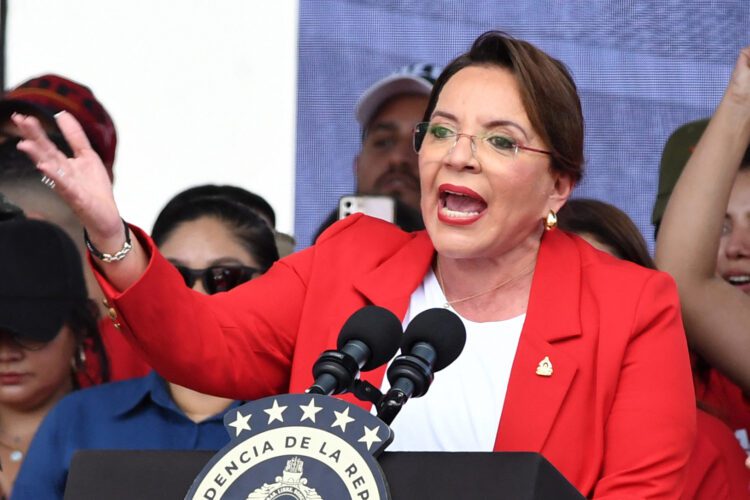
Castro also delivered on a campaign pledge to repeal a law, enacted in the post-coup years, that had allowed private interests to set up semi-autonomous enclaves empowered to enact their own civil laws and regulations, levy taxes and establish their own courts. Soon after the law was repealed, a U.S. company called Honduras Próspera Inc. lodged an ISDS claim seeking up to $10.775 billion. The company argued it had a 50-year right to continue operating a “startup city” it had launched under the repealed legal framework, citing trade and investment agreements Honduras had signed with the United States and Kuwait.
The repeal and claim have cast a shroud of uncertainty on the legal status of the startup city. Honduras Próspera has continued to operate under the now-repealed legal framework, and the government has not forced it to stop, with officials saying they are wary of jeopardizing their position in the ISDS case.
Last month, Honduras’ Supreme Court declared the now-repealed law unconstitutional and said in a press release that the decision will apply retroactively. It is unclear exactly what effect the decision will have on Honduras Próspera’s startup city or on its ISDS claim, however, because the court has yet to publish its decision.
Honduras Próspera has called the ruling “illegitimate,” warning that it “threatens to expropriate more than $120 million in U.S. investment.”
In an email to Inside Climate News, the company’s general counsel, Nicholas Dranias, called the report’s “mafia-style” characterization “obviously libelous, unjust, and absurd,” adding that the ISDS claim was attempting to hold Honduras to its own legal commitments.
Honduras Próspera’s critics in that country have not accused the company of engaging in corruption but fault it for taking advantage of a controversial law that was enacted under disputed circumstances in the post-coup years, and for seeking an award that is orders of magnitude more than it has invested.
The ISDS claim prompted dozens of Democrats in Congress to call on the Biden administration to step in to support Honduras and strip ISDS out of the Dominican Republic-Central America Free Trade Agreement, on which the claim is based. The Biden administration has declined to intervene in the case.
The U.S. ambassador to Honduras, Laura Dogu, has said that Castro administration policies “are sending a clear message to companies that they should invest elsewhere.” And Sens. Ben Cardin (D-Md.) and Bill Hagerty (R-Tenn.) and other U.S. lawmakers, have publicly supported Próspera.
Half of the other ISDS cases against Honduras focus on the energy sector, which was subject to a wave of privatization after the coup that the current government has attempted to reform. Foreign energy companies have brought seven claims, all of which have origins in contracts from this period of privatization.
This story is funded by readers like you.
Our nonprofit newsroom provides award-winning climate coverage free of charge and advertising. We rely on donations from readers like you to keep going. Please donate now to support our work.
Donate Now
The report details widespread irregularities associated with these contracts. Many were awarded without a bidding process. Some companies were awarded contracts even though they didn’t meet legal eligibility requirements. Solar companies with no solar experience won awards. Contract awards were sold to third parties within months. And some contracts required the government to pay above-average rates for electricity, the report said.
When Castro took office in 2022, she inherited a national energy company in deep financial distress, incurring losses at roughly $646 million per year. When her government sought to renegotiate contracts and passed legislation that rolled back some of her predecessors’ energy policies, companies began filing ISDS claims.
In five of the seven energy-related cases, investors are seeking a combined $1.3 billion, far more than the companies invested, according to the report. The amounts sought in the two other cases are not public. Companies filing ISDS claims can often seek and win compensation not just for real losses but also for unearned, expected future profits.
Moore, one of the report’s co-authors, said it is common for foreign investors to use ISDS claims as a negotiation tactic, especially when dealing with developing countries. Two Norwegian investors seeking $200 million each, for example, are using the claims “to pressure the State during the renegotiation of their contracts,” the report alleges.
One of the solar projects at the heart of those two claims, known as Los Prados, has been the subject of fierce community resistance, with locals saying they were never asked whether they wanted the solar farms. Some locals have supported the project while others feared the development would consume scarce farmland and freshwater in a drought-prone region. The division sparked violent conflict in one of the most dangerous regions in the world for environmental defenders.
Opponents of the project have faced threats and expensive legal charges. One local leader was murdered in 2018. A partner in the second solar project owned by the Norwegians was later convicted of helping to orchestrate the 2016 murder of Berta Cáceres, an Indigenous environmental activist who fought a prominent campaign against an unrelated dam project.
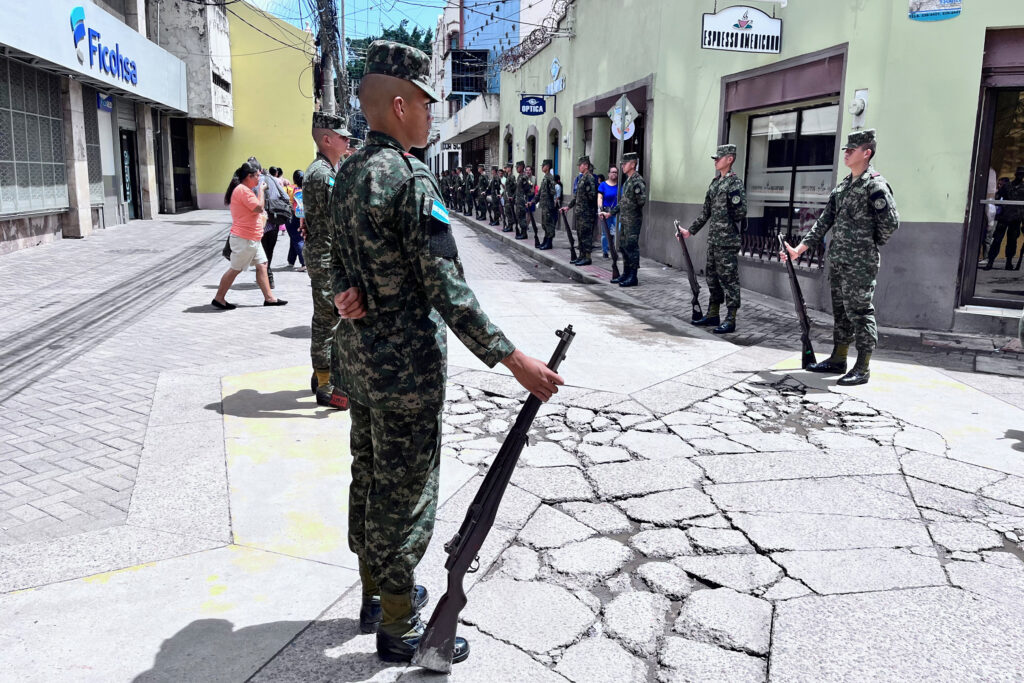 The military plays a central role in policing Honduras, one of the world’s most violent countries. Credit: Nicholas Kusnetz/Inside Climate News
A spokesperson for Scatec, a Norwegian company behind one of the claims, said in emails to Inside Climate News that it “takes allegations of corruption very seriously and confirms that we adhere to the highest standards of compliance and transparency.” The spokesperson said the company “closely scrutinized” the activities of the solar project partner and “did not find indications of corruption, nor indications that he could be involved in such appalling violations of criminal law.” The company added that the 2018 murder “had nothing to [do] with opposition to the Los Prados Project.”
Scatec said proceedings of its arbitration claim have been suspended and that the company maintains an “ongoing dialogue” with the Honduran government. Norfund, a Norwegian government-owned investment fund that is a party to the other claim, referred questions to Scatec.
Karen Spring, a Honduras-based human rights defender and researcher and a co-author of the report, said it is impossible to know the full circumstances surrounding the 2018 murder because it has never been properly investigated.
Community opposition also figured prominently in at least six other claims, including one related to the construction and operation of a toll road connecting Honduras’ Atlantic and Pacific coasts. Locals deemed the project, promoted by the post-coup government, a “Monument to Corruption.”
Opponents of the toll road, many poor and living near or below the poverty line, were incensed that they had to start paying to travel on an existing road that their tax dollars had already funded, according to the report. Protests lasted for more than 14 months, according to the report, culminating in opponents torching the toll booths in the wake of the 2017 presidential election, which was plagued with allegations of fraud.
When the contract between the government and operator, Autopistas del Atlántico, became public in 2018, it showed that it contained no cost-benefit analysis, empowered the investors to carry out studies that determined the minimum annual income they would receive and imposed steep penalties on the government for early cancellation of the contract, according to the report.
“The terms of it were just completely deleterious for the country,” Moore said.
In 2018, Honduras canceled the project and a probe into alleged irregularities was opened, according to the report, though the authors were unable to determine the outcome of the investigation. In 2023, the project’s investors, including JPMorgan Chase and two Goldman Sachs investment funds, filed an ISDS claim seeking just under $180 million, far more than the $42.8 million they invested, according to the report.
Antonio Pavel, general manager of Autopistas del Atlántico, disputed the claims in the report and told Inside Climate News there is no proof of any probe into allegations of corruption involving the project, or of any such allegations. The project, he said, has been “nothing but transparent from the beginning.”
Pavel added that the $42.8 million cited in the report only accounts for construction costs and that the company incurred legal fees, financing and other expenses that substantiate the $180 million claim.
JPMorgan Chase and Goldman Sachs did not respond to requests for comment.
The report’s authors said they wanted to convey the scale of criminality and corruption in Honduras and to show how the ISDS claims link back to these problems, even if indirectly, because of how the contracts and laws were enacted after the 2009 coup.
“Now you have these international arbitration panels that allow these companies, kind of encourage these companies, to sue states, when they themselves, these companies, should have known what they were investing in was extremely risky,” said Spring.
The ISDS system is based on commercial arbitration and primarily interested in holding governments to their commitments, regardless of whether those governments are autocratic or engaged in widespread corruption.
“All of that just disappears when you bring an ISDS claim,” Moore said. “I think that’s part of our argument, why I feel like these claims are unjust in the first place, and the fact that the system exists in the first place is also unjust. But they have it, and it’s very powerful.”
About This Story
Perhaps you noticed: This story, like all the news we publish, is free to read. That’s because Inside Climate News is a 501c3 nonprofit organization. We do not charge a subscription fee, lock our news behind a paywall, or clutter our website with ads. We make our news on climate and the environment freely available to you and anyone who wants it.
That’s not all. We also share our news for free with scores of other media organizations around the country. Many of them can’t afford to do environmental journalism of their own. We’ve built bureaus from coast to coast to report local stories, collaborate with local newsrooms and co-publish articles so that this vital work is shared as widely as possible.
Two of us launched ICN in 2007. Six years later we earned a Pulitzer Prize for National Reporting, and now we run the oldest and largest dedicated climate newsroom in the nation. We tell the story in all its complexity. We hold polluters accountable. We expose environmental injustice. We debunk misinformation. We scrutinize solutions and inspire action.
Donations from readers like you fund every aspect of what we do. If you don’t already, will you support our ongoing work, our reporting on the biggest crisis facing our planet, and help us reach even more readers in more places?
Please take a moment to make a tax-deductible donation. Every one of them makes a difference.
Thank you,
Nicholas Kusnetz
Reporter, New York City
Nicholas Kusnetz is a reporter for Inside Climate News. Before joining ICN, he worked at the Center for Public Integrity and ProPublica. His work has won numerous awards, including from the Society of Environmental Journalists, the American Association for the Advancement of Science and the Society of American Business Editors and Writers, and has appeared in more than a dozen publications, including The Washington Post, Businessweek, The Nation, Fast Company and The New York Times.
Katie Surma
Reporter, Pittsburgh
Katie Surma is a reporter at Inside Climate News focusing on international environmental law and justice. Before joining ICN, she practiced law, specializing in commercial litigation. She also wrote for a number of publications and her stories have appeared in the Washington Post, USA Today, Chicago Tribune, Seattle Times and The Associated Press, among others. Katie has a master’s degree in investigative journalism from Arizona State University’s Walter Cronkite School of Journalism, an LLM in international rule of law and security from ASU’s Sandra Day O’Connor College of Law, a J.D. from Duquesne University, and was a History of Art and Architecture major at the University of Pittsburgh. Katie lives in Pittsburgh, Pennsylvania, with her husband, Jim Crowell.
Source link : http://www.bing.com/news/apiclick.aspx?ref=FexRss&aid=&tid=66fe5e8a365b480ebd6fcae43f93f27a&url=https%3A%2F%2Finsideclimatenews.org%2Fnews%2F03102024%2Fhonduras-investor-state-dispute-settlement-report%2F&c=8859484377194145515&mkt=en-us
Author :
Publish date : 2024-10-02 22:06:00
Copyright for syndicated content belongs to the linked Source.