But historically speaking, Latinos are also a relatively new community (a federal law in the late ‘70s led US officials to start using the term “Hispanic” in census records) with a relatively fluid definition. About 21 different countries make up Latin America, and on top of that, much like other communities, we’re also further stratified by gender, geography, generational divisions, and more.
This all means that not only are Latinos not a monolith, we’re a complex kaleidoscope of people, constantly shifting the social and political landscape of the country, and, in turn, this country is changing us, too.
So, where do we start?
With Mexican Americans in the Southwest whose residence in some cases goes back generations, to before some states actually became states?
Or maybe the well known Cuban vote in Florida — where 54 percent voted for Donald Trump in 2016, compared with 28 percent of Latinos nationwide — a phenomenon that’s studied by political pundits and political scientists alike?
Or perhaps the new Venezuelan and Colombian families arriving in the Bay State, joining well-established communities from the Caribbean and elsewhere; together, they help make up a Latino community that’s more diverse than many other regions of the country. In Boston, Latino immigrants are redefining the region. Parts of Jamaica Plain are the streets of Santo Domingo, bumping with the sounds of dembow. Eastie, once called the Ellis Island of Massachusetts for brimming with European immigrants, is now more than 50 percent Latino. The Boston Foundation found that without Latinos, Boston would be at a far lower population, on par with that from the ‘80s.
Across the United States, Latinos are building cities and are part of the reason many regions, especially rural ones, are growing. The Federal Reserve Bank of St. Louis wrote about this trend in a 2021 report: “America’s burgeoning Latino population has become the demographic lifeblood of rural America.”
Those numbers can in turn be political currency — making us a force to be reckoned with at the polls. The Pew Research Center estimates 36.2 million Latinos will be eligible to vote in this presidential election, up nearly 4 million from 2020. In fact, as I wrote last cycle, every 30 seconds a Latino teenager turns 18, thus becoming a potential voter. And since that election, we account for 50 percent of the increase in eligible voters in the country.
And yet this growing power in Latino communities is too often ignored by politicians. Latinos and Asian Americans were the least likely to be contacted by campaigns in 2020, Pew found. While politicians will no doubt capitalize off the visuals of talking to an average Joe in a diner in middle America, the reality is they should start doing the same with the Latina next door.
So what’s been stopping them?
Luis Jiménez (no relation to me, though admittedly we’re both of Mexican heritage), a political science professor at the University of Massachusetts Boston, explains that part of the challenge in activating Latino voters is money. “Just right off the bat, it’s much more costly to reach Latinos,” he says.
That’s because when a political operative reaches out to a Black or white household, they expect to get at least two to three votes from that outreach. For Latino households, that outreach will likely only gain the party one vote. “Why should I spend $1 with Latinos when I can spend $1 with white people, and you’re going to get more votes with white people, right?” Jiménez says. “It’s a pretty simple calculation.”
A second challenge connects back to our diverse origins.
Take for example Latinos in the Northeast, where Latino populations in metro areas are more varied than other parts of the country. In a large part of the West Coast and at the Southern border, Mexicans dominate both in numbers and culture — the Latino community in Los Angeles is 75 percent Mexican, for example, according to Pew. But Latinos here tend to come from a wide variety of countries in the Caribbean and other parts of Latin America. Boston-area Latinos are 19 percent Puerto Rican — one of the top five concentrations in the country — but also 28 percent Dominican, 9 percent Salvadoran, 8 percent Mexican, 8 percent Guatemalan, 2 percent Ecuadorian, and 26 percent made up of other Hispanic groups.
That means when political operatives reach out to Latinos in our region, they likely need different power brokers. What one Latino may find charming (like the Harris campaign dubbing commercials in Spanish), another may find inauthentic or even pandering. Finding a consistent message that will work for all 65 million Latinos in the country is unlikely — but that would be true for any voting bloc at that scale.
In my family of Mexican heritage, voting is a complex topic because of our mixed immigration status. I have DACA, a federal program that lets me work legally for two years at a time, but it doesn’t grant me the right to vote. However, my sister and some of our other relatives are citizens born in the US, while other members of my family are undocumented.
When it comes to issues, immigration matters, but the economy and cost of living are top of mind. Recent polls show that Latinos — like most Americans — are especially concerned about high grocery costs, housing expenses, and other “pocketbook issues” as Richard Parr, a senior research director for the MassINC Polling Group, puts it.
Generational divides also show up. Odalys, my 27-year-old sister, is more liberal than our parents when it comes to reproductive rights, for example, an issue that is important to her. (“Freedom of choice is a big deal for our gente,” a Nevada activist told Politico last month. “The suspicion is brown folks are very Catholic and don’t want to talk about abortion, but that’s not the truth anymore. Roe v. Wade being overturned moved so many of our conservative folks over to the left on this issue.”)
A recent KFF Survey of Women Voters, for example, found that younger Latinas in Arizona overwhelmingly support the state’s Right to Abortion Initiative that would establish a right to abortion until fetal viability, typically between 23 and 25 weeks of pregnancy. Latinas 45 and older, however, were less supportive.
At the end of the day, my sister also holds the belief that it’s her duty to participate in elections, especially when others in our family don’t have that luxury. “It’s a responsibility to at least vote,” she tells me.
But not everyone feels the way my sister does — or believes that their vote will matter.
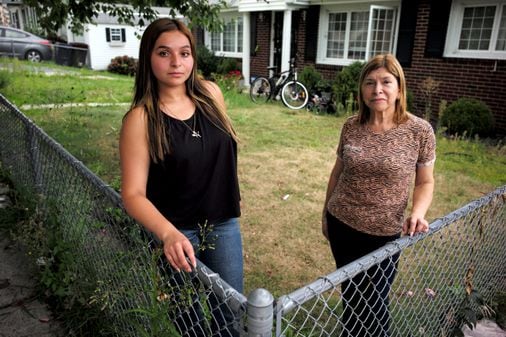
Looking ahead to November, Xiomara Perez, an 18-year-old Colombian American, isn’t yet sure she’ll even participate in the election. She’s not particularly passionate about politics, she says, and is undecided what candidate to cast her vote for, if she votes at all.
“I’m kind of disappointed,” says Perez, who lives in Everett. Perez feels like when it comes to politics, all politicians are the same. Her trust has eroded even though this would be her first election. “I feel for Hispanics and the economy, especially the working class…I just feel like whichever party I vote for, it’s gonna get worse anyway.”
Perez’s grandmother Elicenia Puerta is feeling more hopeful, though is still cautious. This would be her second election and she doesn’t want to see Trump back in office because she feels like he puts down Latinos and immigrants.
“No sabemos por qué a los Hispanos nos atacan mucho,” she says. We’re not sure why Hispanic people are attacked so often.
Puerta is a naturalized citizen and in the past has had trouble with voting due to issues with her legal name being mismatched with voter records. Out of their family of seven, only these two women are eligible to vote.
And that brings me to my third point: Despite being the second largest demographic, only about half of Latinos in the United States are eligible to vote, and then only half of those voters actually do so.
Latino citizens overall have a lower rate of registration compared with other groups in the United States, according to the census, with only 58 percent of voting-age Latinos registered in 2022 (compared with, for example, 71 percent of white, non-Latino Americans). The nonprofit group Voto Latino says 12 million Latinos eligible to vote in the United States are not registered.
Voter suppression efforts across the country have had an outsize impact on Latino communities. In March, Lydia Camarillo, president of the Southwest Voter Registration Education Project, testified before the US Senate Judiciary Committee about a long history of laws enacted to “dilute the political power of the Latino electorate and others,” she said. “This includes literacy tests, English requirements, long residence requirements, and proof of citizenship requirements, to name a few.”
Camarillo pointed out that, in the previous year alone, “Over 19 states enacted 34 laws to restrict access to voting,” including making it more difficult to vote by mail (necessary to people who need to work on Election Day) and limiting assistance to Spanish speakers and those with limited English.
In rural Washington state where I grew up, Latino votes were being diluted in local elections through redistricting — it was enough to spark a lawsuit and led to the creation of the Washington Voting Rights Act in 2018. That dynamic is still playing out to this day.
Jiménez (the professor not this reporter) points to the challenges voters face: from often having to register in advance, to Election Day being on a Tuesday in the middle of the workweek, to how confusing the electoral process can be for someone who’s new to following politics at the local, state, and national levels. That’s why higher voter registration and turnout is tied to higher levels of education and wealth across all demographics.
And these barriers affect all of us. Though the 2020 election between Joe Biden and Donald Trump led to historic turnout, the United States still sorely lags behind countries such as India and Mexico when it comes to participation of eligible voters of all backgrounds, according to the Pew Research Center.
For Latinos, all this creates a critical paradox: As we fail to vote, parties use it as an excuse to not reach out to us in the first place. It’s a vicious cycle. Politicians believe the myth that Latinos aren’t invested, and that reifies itself when voters tune out.
Jiménez likens this to something akin to static on the television. “That’s what it feels like for a lot of people. It’s just: Politics are this thing that happens in the background and you’re not quite sure what’s happening. So why should I bother engaging with it?”
“An old narrative has been, because these groups are predominantly first- and second-generation Americans, that they’re more interested in the politics of their home country than they are in the politics of the United States, or they’re groups that like to keep their head down and stay out of politics,” Taeku Lee, a professor of government at Harvard University, told NPR earlier this year. “I think they are every bit as invested in what politics can do to them or do for them.”
That “why bother” attitude, however, is one that political parties can’t afford to have now and in the future when it comes to Latino voters, especially younger ones. Voto Latino points out that 16.5 million Latinos voted in 2020, up from 12.6 million in 2016 — “a staggering surge,” as the group calls it, driven largely by young, first-time voters.
With growing influence like that, Democrats and Republicans should reach out and invest in activating Latino voters — because it’s the right thing to do, but also the smart thing — and likewise Latinos should demand more from their candidates.
After all, if the Latino vote is up for grabs as some have posited, then the party that figures out the right formula and is able to connect with us — in all our nuance, all our complexity — will be the one to secure not just the 2024 election, but many more elections to come.
This story was produced by the Globe’s Money, Power, Inequality team, which covers the racial wealth gap in Greater Boston. You can sign up for the newsletter here.
Esmy Jimenez can be reached at [email protected]. Follow her @esmyjimenez.
Source link : http://www.bing.com/news/apiclick.aspx?ref=FexRss&aid=&tid=66df0b5822f949728c3ebdf1c10f3498&url=https%3A%2F%2Fwww.bostonglobe.com%2F2024%2F09%2F09%2Fmetro%2Fmisunderstood-latino-voters%2F&c=559964607238240245&mkt=en-us
Author :
Publish date : 2024-09-09 01:29:00
Copyright for syndicated content belongs to the linked Source.