Sign up for CNN’s Wonder Theory science newsletter. Explore the universe with news on fascinating discoveries, scientific advancements and more
CNN
—
Matching sets of footprints discovered in Africa and South America reveal that dinosaurs once traveled along a type of highway 120 million years ago before the two continents split apart, according to new research.
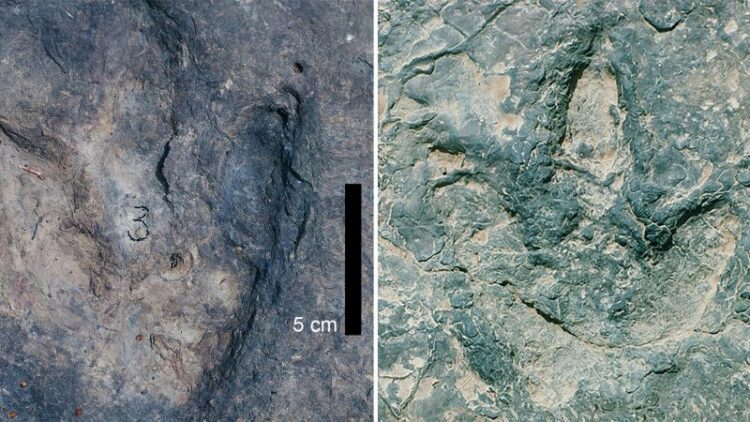
Paleontologists have found more than 260 dinosaur footprints from the Early Cretaceous Period in Brazil and Cameroon, now more than 3,700 miles (6,000 kilometers) apart on opposite sides of the Atlantic Ocean.
The footprints are similar in age, shape and geologic context, said Louis L. Jacobs, a paleontologist at the Southern Methodist University in Texas and lead author of a study describing the tracks published Monday by the New Mexico Museum of Natural History & Science.
Most of the fossilized prints were created by three-toed theropod dinosaurs, while a few likely belonged to lumbering four-legged sauropods with long necks and tails or ornithischians, which had pelvic structures similar to birds, said study coauthor Diana P.
Vineyard, research associate at SMU.
The trackways tell a story of how the movements of massive landmasses created ideal conditions for dinosaurs before supercontinents broke apart into the seven continents we know today.
The footprints were preserved in mud and silt along ancient rivers and lakes that once existed on the supercontinent Gondwana, which broke away from the larger landmass of Pangea, Jacobs said.
“One of the youngest and narrowest geological connections between Africa and South America was the elbow of northeastern Brazil nestled against what is now the coast of Cameroon along the Gulf of Guinea,” Jacobs said. “The two continents were continuous along that narrow stretch, so that animals on either side of that connection could potentially move across it.”
Africa and South America began to pull apart from each other about 140 million years ago. The separation created rifts in Earth’s crust, and as the tectonic plates beneath South America and Africa drifted away, magma in Earth’s mantle created new oceanic crust. Over time, the South Atlantic Ocean filled the space between the two continents.
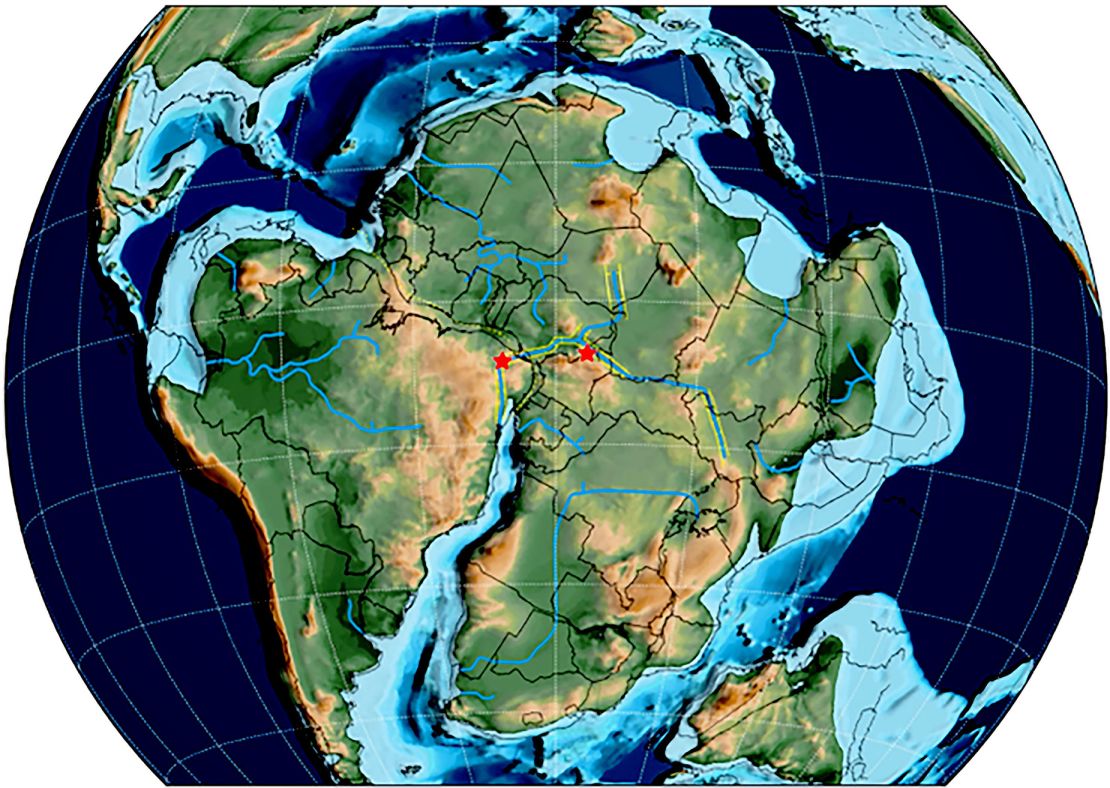
But before this gradual change took place, different types of basins formed as Earth’s surface pulled apart. Rivers fed into the basins, forming lakes, Jacobs said.
The study authors found evidence of what’s known as a half-graben basin in northeast Brazil’s Borborema region and a similar one in the Koum Basin in northern Cameroon.
“A half graben is an elongate basin formed by pulling apart of the Earth’s surface with a fault forming on one side such that the bottom of the valley tilts down toward the fault along which movement is occurring,” Jacobs said by email. “Hold your hand in front of you. Tilt your fingers down, representing movement along the fault. Rivers will flow down the valley and deposit sediments and sediments will be eroded from the high side of the valley.”
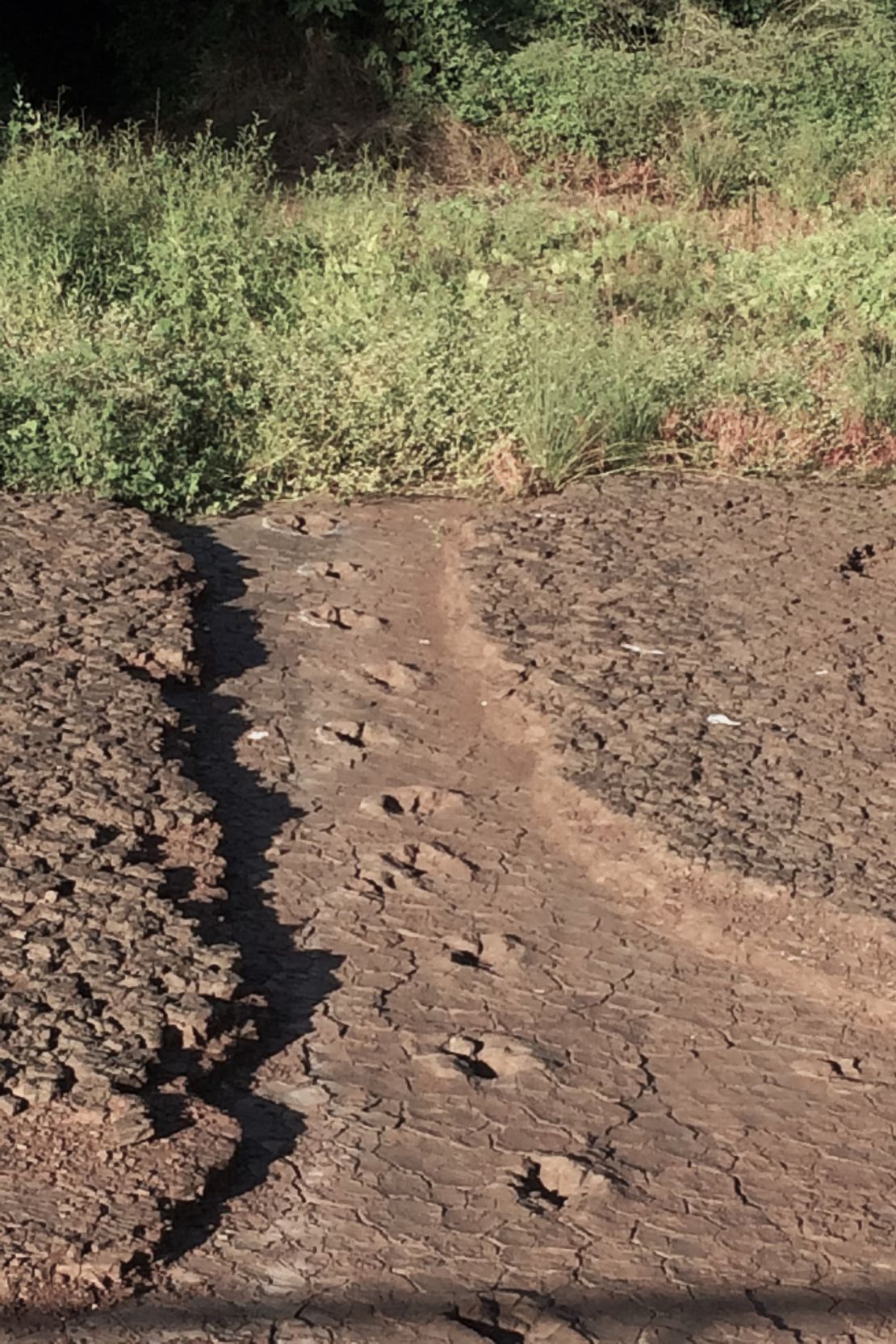
Within both basins, the researchers found dinosaur tracks, ancient river and lake sediments, and fossilized pollen.
“Plants fed the herbivores and supported a food chain,” he said. “Muddy sediments left by the rivers and lakes contain dinosaur footprints, including those of meat-eaters, documenting that these river valleys could provide specific avenues for life to travel across the continents 120 million years ago.”
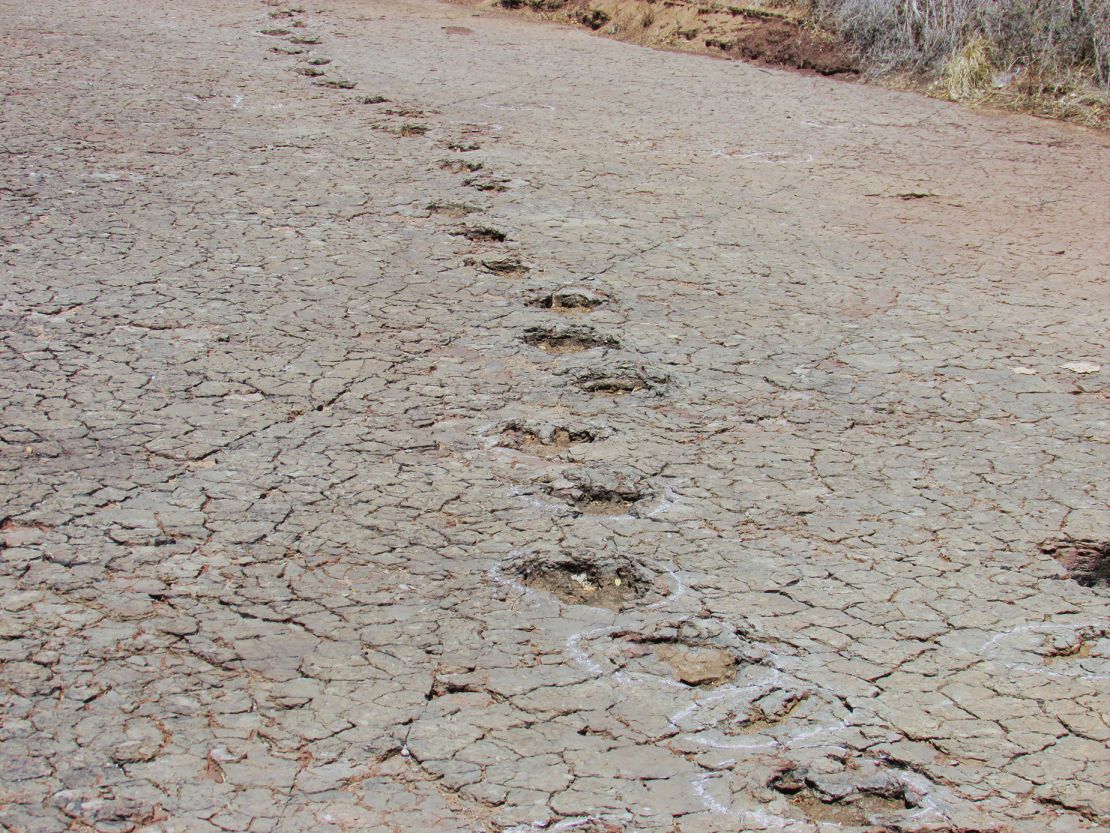 While dinosaur fossils can yield unique insights about the types of animals that roamed the planet millions of years ago, their footprints provide other windows into the past.
“Dinosaur tracks are not rare, but unlike the bones usually found, footprints are the proof of dinosaur behavior, how they walked, ran or otherwise, who they walked with, what environment they walked through, what direction they were going, and where they were when they were doing it,” Jacobs said.
It’s difficult to tell the specific species of dinosaurs that traveled along the basins, but they represent a larger portrait of the ancient climate and how different types of animals thrived in the environment that the continental rifting created.
“If your dog and a coyote walk across the same mudflat, you might know that two dog critters walked there, that they are very similar, but you may not be able to know if they are different species. Ditto the dinosaur track situation,” Jacobs said. “All animals have home ranges. All animals expand their ranges. All animals exploit resources as necessary depending on availability, often related to seasonality. Herbivores follow nutritious plants; carnivores follow their herbivorous food.”
At the time, rainfall levels helped create a tropical rainforest-type environment with abundant vegetation. Animals came to the basins from both present-day Africa and South America, causing their populations to mix.
“Imagine a lush, open basin with vegetation for the herbivores and carnivores following,” said study coauthor Lawrence Flynn, assistant director for the American School of Prehistoric Research and lab safety coordinator within the department of human evolutionary biology at Harvard University. “If nobody is there on the ‘new’ turf, then animals will disperse into it, given no competition.”
Later, once the continents drifted apart, this disruption likely caused a break in genetic continuity, a key driver of evolution, Jacobs said.
The dinosaur tracks in Cameroon were first discovered in the late 1980s, and Jacobs reported on them at the First International Symposium on Dinosaur Tracks and Traces, convened by paleontologist Martin Lockley, in 1986.
Jacobs then became friends with study author Ismar de Souza Carvalho, now a professor within the department of geology at the Federal University of Rio de Janeiro. Jacobs was studying dinosaur movements from the African side, while Carvalho was studying them from the Brazilian side.
As research into the basins in Africa and South America has continued in the following decades, Jacobs and Carvalho and their colleagues reviewed existing and new fieldwork and research to analyze the matching aspects. The new study is being published in tribute to Lockley, who devoted his career to studying dinosaur footprints.
“We wanted to put new and evolving geological and paleontological evidence together to tell a story more specifically of where and why and when dispersals between the continents happened,” Jacobs said.
“One beauty of this Earth is that any of us can see that Africa and South America used to fit together like puzzle pieces. It is easy to conceive that in a connected world, animals, including dinosaurs, could and would be likely to move from place to place.”
Source link : http://www.bing.com/news/apiclick.aspx?ref=FexRss&aid=&tid=66d29b2e859c4fe5bcb47ffaa12e2974&url=https%3A%2F%2Fwww.cnn.com%2F2024%2F08%2F26%2Fscience%2Fdinosaur-footprints-south-america-africa%2Findex.html&c=6419854262031860532&mkt=en-us
Author :
Publish date : 2024-08-26 07:43:00
Copyright for syndicated content belongs to the linked Source.