
Protesters block streets during a protest against the kidnapping and murder of an 8-year-old girl in Mexico.
Jose Luis de la Cruz/EFE/EPA
In this year’s election, the main candidates and parties appeared to be largely out of new ideas. Insecurity remains an urgent problem, but there were few real plans for better managing it.
Sheinbaum campaigned on the relative safety of Mexico City during her tenure as mayor, but the capital is a very different place to other parts of the country. Some wealthy cities are able to purchase a degree of safety through investments in police and private security (and perhaps tolerating extralegal security measures), but this doesn’t offer a paradigm for the whole country.
Organised crime and the war on narcotrafficking still dominate the headlines, but this masks other alarming patterns of violence.
Femicide, or the murder of women because they are women, remained at persistently high levels during López Obrador’s tenure, but received little attention from him. Investigations suggest that high levels of impunity for femicide can encourage other forms of violence.
Read more:
What Australia can learn from Latin America when it comes to tackling violence against women
The military becomes more public and private
On October 1, Sheinbaum becomes the supreme commander of the armed forces in Mexico. However, she assumes command of a military with more autonomy and power than at any other point in recent history.
For some time, activists and scholars have been sounding the alarm about the dangers of increased militarisation in Mexico – that is, the takeover of civilian roles by the military.
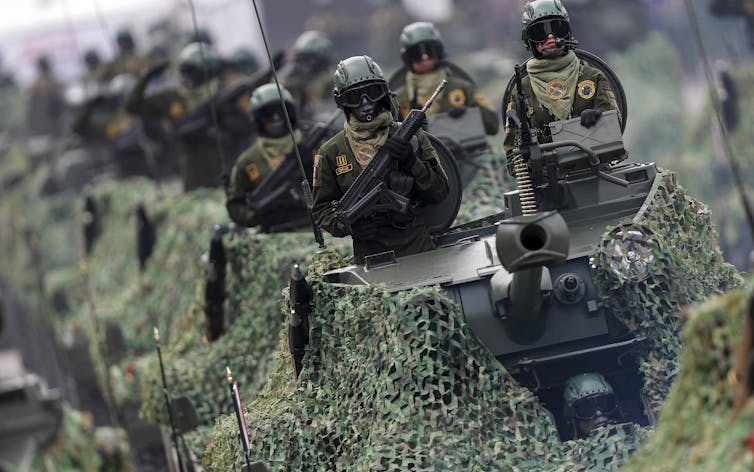
Mexican armed forces take part in an independence day parade this year.
Isaac Esquivel/EFE/EPA
With the war on narcotrafficking in 2006, the military took on civilian roles related to security, such as policing. López Obrador expanded this range of roles tremendously, using the military to build major infrastructure projects.
López Obrador also awarded substantial concessions to the military. Having constructed several train lines as part of the Mayan Train megaproject in southeastern Mexico, for example, military businesses will now take over the management of the transport system, as well as connected airports, hotels and other tourism facilities.
Other militaries in Latin America have extensive economic portfolios, but these are usually seen as a relic of the authoritarian past. Once a government affords such public roles and economic autonomy to the military, it is very hard to claim them back.
This increased participation of the military in various aspects of public life raises troubling questions about transparency and justice.
For example, the military has provided little access to information on the Mayan Train project, such as environmental impact statements. When I conducted interviews, locals reported being pressured and intimidated by the military over the expropriation of land for infrastructure projects.
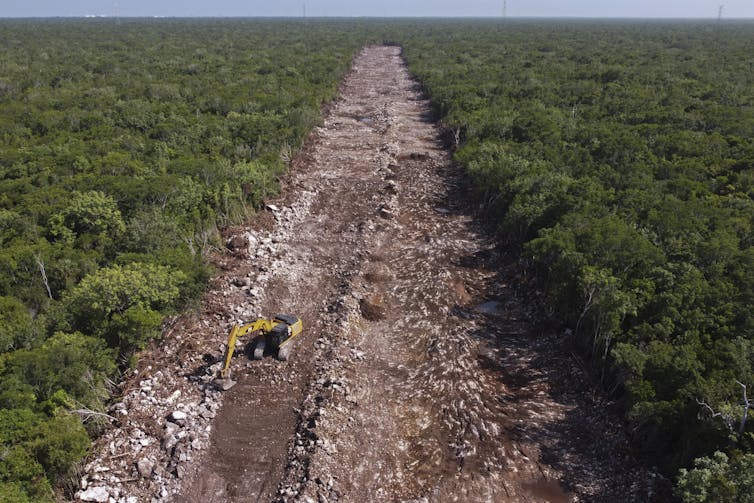
A cleared forest for the Mayan Train in Puerto Morelos, Quintana Roo state.
Eduardo Verdugo/AP
Sheinbaum’s biggest challenges
Observers note that Sheinbaum rarely deviates from supporting López Obrador and his policies. This is sometimes taken as a sign of weakness, with Sheinbaum cast as a kind of dutiful daughter to the patriarch of Morena.
However, this risks oversimplifying – in a heavily gendered way – the political context in which Sheinbaum has risen to power. She has little to gain by distancing herself from her powerful predecessor before she has even taken office. (Adopting his regional accent, though, is another story).
The question of how Sheinbaum steps out from the shadow of López Obrador is an important one. But this has less to do with whether he goes quietly into retirement and more to do with the difficulties he leaves behind.
Presidential terms in Mexico are long (six years). Historically, this has afforded new presidents time to distance themselves from their predecessors (who often play a role in lifting them up) to develop their own agendas.
Sheinbaum’s real challenge will be to develop policies that meaningfully tackle violence and insecurity, while managing a military with more autonomy and a shifting portfolio of interests.
Many other issues are also clamouring for attention. Sheinbaum would do well to start repairing some of the relationships that López Obrador damaged, such as between the president and the press, academia, Indigenous communities and the country’s irrepressible feminist movements.
Source link : http://www.bing.com/news/apiclick.aspx?ref=FexRss&aid=&tid=66fb33f816fe4907add5bb75707c522e&url=https%3A%2F%2Ftheconversation.com%2Fmexico-has-a-trailblazing-new-president-but-does-she-have-any-new-ideas-to-tackle-spiralling-crime-239818&c=6536498873874385973&mkt=en-us
Author :
Publish date : 2024-09-30 12:11:00
Copyright for syndicated content belongs to the linked Source.