MEXICO CITY — Many Mexicans will feel a deep sense of loss when folksy, charismatic, nationalistic President Andrés Manuel López Obrador leaves office on Sept. 30 — and that’s no surprise.
López Obrador himself has spent an inordinate amount of time talking about his own legacy — and his place in history — over his six-year term, something he brings up at almost every one of his marathonic daily 7 a.m. media briefings.
But what legacy will the rumpled, grinning López Obrador leave? It is perhaps the main question for a man who is obsessed with history, and one thing appears clear: He has changed the way politics is done in Mexico, perhaps forever.
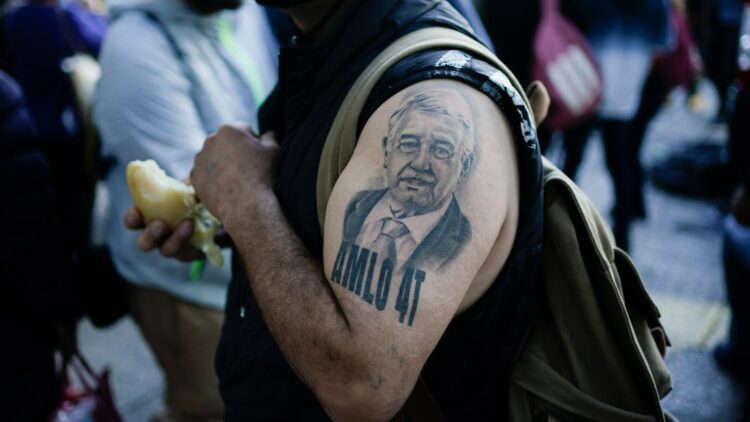
Unlike decades of reserved and distant presidents, López Obrador has built a deep personal connection with many Mexicans. He has stripped the office of the thousands of presidential guards, limousines and walled compounds that once characterized it, saying “you can’t have a rich government with poor people.”
“He is a politician who evokes familiarity, he reminds people of a father, an uncle, a grandfather,” said Carlos Pérez Ricart, a political analyst at Mexico’s Center for Economic Research and Teaching. That’s not a coincidence, either. López Obrador constantly praises the traditional family and says it has saved the country.
“He does feel nostalgia for some of the social structures of the 1970s in Mexico and nostalgia for the family,” said Pérez Ricart.
Will his legacy be like that of U.S. President Franklin D. Roosevelt, whose New Deal created lasting institutions like Social Security and home mortgage programs that resulted in an enormous, stable middle class?
The Mexican leader stakes his movement on cash social-benefit programs, he likes to compare himself to Roosevelt and many Mexicans think of him with the same fondness that the more patrician FDR inspired in his day.
“I think he’s going to be remembered as a president who started big changes, who thought about the people,” said Armando López, 60, who works as a street cleaner.
Marina Fiesco, an office worker taking a break at a Mexico City park with her 11-year-old son, voiced similar feelings.
“I feel he does think about the people,” said Fiesco. “It’s not about left or right, a president has to look out for the people.”
Part of that connection is that he talks more, and fields more questions, than probably any other leader in the world.
In his six years in office, he has held about 1,400 televised morning briefings that last an average of 2 1/2 hours each. He tells jokes, talks about his favorite foods, lashes out at critical journalists, makes fun of the opposition and sometimes plays his favorite music videos. Most briefings end with him saying, “Let’s go get breakfast.”
He frequently says things that are not true. He claims Mexico doesn’t produce fentanyl — the deadly synthetic opioid that kills about 70,000 Americans every year — even though his own officials have contradicted him. When homicides spiked this year — despite his claims to have achieved an 18% reduction — he simply ignored the figures.
Many Mexicans seem willing to tolerate the untruths, in part because López Obrador, 70, has mastered a key Mexican folk saying: “He who gets angry, loses.” He brushes real contradictions and problems off with a chuckle, a stony refusal to discuss them, or his stock phrase, “I have other data.”
He’s probably the most skillful politician ever to rule Mexico and seems to enjoy some unstoppable motivating force: In all of his thousands of hours of talking, never once has he sat down, taken one sip of water or gone off to use the bathroom.
Influenced by Mexican presidents of the 20th century, López Obrador would have liked to make his mark with big infrastructure projects — he is obsessed with railroads and oil refineries — and big state-owned companies like the ones that dominated Mexico’s economy in the 1970s, his formative years.
But his building projects have been often ill-planned and will be subject to the withering trends of economic and energy transition. Unlike his heroes from the past, he hasn’t been able to nationalize any industry, and has only been able to fight a rear-guard action to defend the indebted, struggling state-owned oil and electric power companies he inherited.
Nor has he been able to make much of a mark in foreign policy, apart from a few rather pointless, unresolved disputes with Spain, the Vatican, Ecuador and Peru. In the face of U.S. pressure, he has used the 120,000-member national guard he created not to confront drug cartels, but to prevent migrants from reaching the U.S. border.
And his social programs — like the $150-per month payment to people over 65 — can fade, be defunded or eviscerated by inflation.
So could López Obrador turn out to be a figure like Argentina’s president in the 1940s and 50s, Juan Perón, who left behind an ideologically amorphous legacy that was fought over by disparate wings of his movement for decades?
“I think that what we are going to see is the ‘balkanization’ of Obrador-ism,” said Pérez Ricart, “a dispute between the left and the right to own the term, a bit like what happened with Peronism in Argentina.”
Or he could go down in history as the person who, however briefly, revived the nearly century-old Mexican tradition of a “state party,” like the old PRI, where López Obrador began his political career. The PRI ruled Mexico for 70 years, before corruption, internal disputes and economic crises brought it down.
Some of López Obrador’s most devoted followers seem surprisingly willing to take the chance of another PRI.
“If after 70 years we’ve found we made a mistake, well, that’s life,” Fiesco said.
López Obrador may be part of a regionwide revival of old, populistic state-party models, both on the left and right.
For example, El Salvador’s President Nayib Bukele stresses that his administration — which won even greater margins of reelection than López Obrador’s Morena — is a “hegemonic party, not a state party.”
That’s almost exactly how Morena supporters describe their movement, but the instant any party starts to use the power of the government to keep itself in power, that distinction disappears.
Most people think it’s unlikely that Morena will last as long in power as the seven-decade run of the PRI.
“Times have changed, that’s not possible anymore,” said Armando López, the street cleaner. “People will support him as long as they see something (in return). They’re not going to follow him blindly.”
The Morena party was cobbled together by López Obrador out of old PRI members like himself and people from more leftist backgrounds. López Obrador is Morena’s star, its guide, its moral authority. Once he’s gone, the tensions within the party — already palpable — will likely grow stronger.
López Obrador is very aware of that, and from the start he has consciously built structures to guard his legacy, which he views as his own, not the party’s. He has handed more economic and law-enforcement power over to the armed forces than any other Mexican president, because the army obeys him unquestioningly and he trusts them.
His longest-lasting legacy may be those structural changes: the militarization of law enforcement and large swaths of the economy, the elimination of all independent regulatory and oversight agencies, the frequent attacks on the media and a judicial overhaul that critics say will weaken democratic checks and balances.
Mexico’s armed forces now run airports, trains, customs facilities — and even an airline.
“The truth is that there is one really important legacy, and that is the legacy of militarization,” said Guadalupe Correa-Cabrera, an associate professor at George Mason University.
___
Follow AP’s Latin America coverage at https://apnews.com/hub/latin-america
Source link : http://www.bing.com/news/apiclick.aspx?ref=FexRss&aid=&tid=66f51faff397480fb966214f472036ad&url=https%3A%2F%2Fabcnews.go.com%2FInternational%2FwireStory%2Fmexicos-popular-president-decades-retiring-leave-114065509&c=6290544585839269497&mkt=en-us
Author :
Publish date : 2024-09-25 14:26:00
Copyright for syndicated content belongs to the linked Source.