The Police
Sting then recorded a demo of the song when he returned to the UK. He posted the following about this first demo on Instagram in 2019.
“I brought Every Breath You Take into Utopia Studios in North London late one night in 1982. I’d already written the lyrics while staying at GoldenEye, Chris Blackwell’s house outside of Ocho Rios in Jamaica that formerly belonged to James Bond’s creator Ian Fleming.
“I was working alone at Utopia with the engineer Pete Smith. The music was based on the ninth chords that I’d already used successfully in Message In A Bottle and Da Do Do Do…, which had a become a sort of signature for me.
“As most rock music is based on fourths, fifths and sevenths, the ninth chord opened up a different world of possibilities and gave this rather simple and strange song a tonal sophistication that it wouldn’t have possessed otherwise, effectively complimenting its lyrical ambiguity.”
The Recording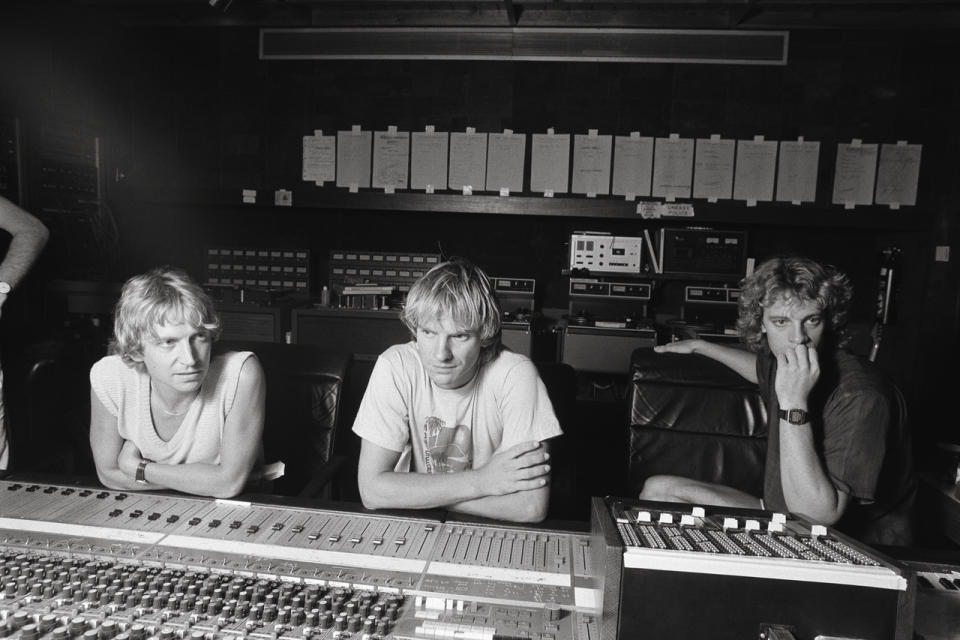
The Police
I remember working full-on for 10 days in Montserrat and having nothing on tape that was playable
Every Breath You Take went from that demo recorded at Utopia in London to the song you know today by way of a lengthy and traumatic recording session at Air Studios, on the island of Montserrat.
Hugh Padgham, who had also worked with the band on their previous album, Ghost in the Machine was the producer. In 2004, he told Sound on Sound about the recording process… or lack of it.
“By the time of Synchronicity, they were sick of each other – Sting and Stewart hated each other, and although Andy didn’t show as much venom, he could be quite grumpy – and there were both verbal and physical fights in the studio.
“Often, when these would take place, I’d try to be Mr Producer and get in the way, saying, ‘Come on, do you have to kick the shit out of one another?’ but they’d just turn around and shout ‘Get out of it! What do you know? You don’t know anything about us!’
“It was really difficult. I remember calling my manager, Dennis [Muirhead], and telling him ‘I can’t handle this,’ and I also remember quite clearly working full-on for 10 days in Montserrat and having nothing on tape that was playable.”
Hugh told Gary James in an interview at ClassicBands.com, “When I first heard [the demo of] Every Breath You Take by The Police. Police manager Miles Copeland said to me, and we all knew it was a hit, ‘Hey Hugh, don’t fuck this up!’ I’m thinking ‘Oh, my God! How much pressure is that?’ How do I take a demo that obviously sounds like a hit into a song that is going to be a hit? “
Stewart Copeland told Mixonline in 2003 about the first time he heard the demo to Every Breath.
“[It] was Sting singing over a Hammond organ, which was rare at that time, because by then, we all had home studios, so we’d show up with these fully mastered demos. In the case of Every Breath, what he brought to the band was much more simple, so we did a lot to it, as we did in the early days.”
The Guitar
Andy Summers
It was crap until I played on it
Stewart Copeland told Classic Pop in 2018 about how Andy Summers’ famous guitar part came about for Every Breath You Take.
“The demo was obviously a hit, but it was nothing like the current version, as Sting was singing the chords over a Hammond organ. Andy went, ‘Guys, hello? We’re a guitar band?’ Andy is truly clever with harmony and worked out the song’s arpeggiated guitar figure.”
He revealed more to Mixonline about what happened next…
“We threw out the Hammond Organ part completely, since we don’t have an organist in the group, but we do have a great guitarist [Andy Summers] who would be under-utilised in such an important song. Andy went away and worked out that guitar part, and suddenly it all made sense. We knew it was a big song, but it sounded too pedestrian, in spite of the great lyric, and it wasn’t until Andy came up with the guitar part that it clicked in.”
And he told MusicRadar…
“Andy went off and figured out those chords, fingering and that harmony. That’s all Andy.”
Andy Summers himself has given various accounts of what happened next – probably one of the most iconic moments in the recording of the song. This is what he told Guitar World in 2022.
“Well, I didn’t stand there and crow about it. It was more about keeping those other bastards happy. That song was going to be thrown out. Sting and Stewart could not agree on how the bass and drums were going to go. We were in the middle of Synchronicity and Sting says, ‘Well, go on then, go in there and make it your own.’
“And I did it in one take. They all stood up and clapped. And, of course, the f**king thing went right round the world, straight to No 1 in America. And the riff has become a kind of immortal guitar part that all guitar players have to learn.”
He was a little more blunt when interviewed by Eonmusic at the Progressive Music Awards in 2016:
“It was crap until I played on it, and then it emerged. I went in, and of course I had my Police guitar style down; it was very simple chord sequences, standard pop, and I laid that track down, virtually in one take. I just knew what to do with it; the licks. I had it right there, and they all stood up, and applauded”.
Things weren’t quite so straightforward when it came to recording the drums though.
The Drums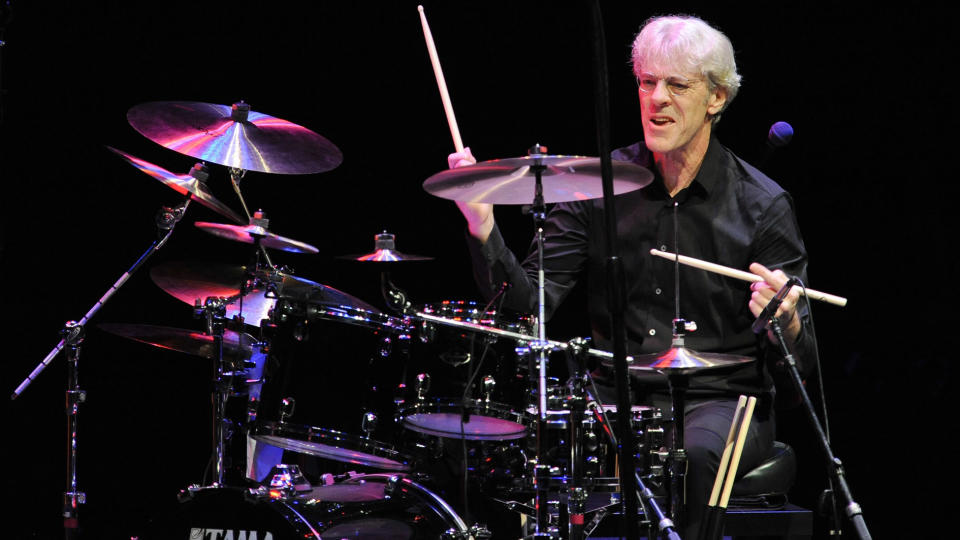
Stewart Copeland
We went back and forth finishing that song and we fought like cat and dog over the f**king hi-hat.
When it came to the drums, Stewart Copeland realised pretty early on that it would be a case of less is more. He revealed to Mixonline:
“We couldn’t do a lot of stuff because that would ruin it, so the stuff we did had to be the right stuff. We tried this, we tried that, such as a reggae version, which didn’t seem important enough. We tried a more rock track and I can’t even remember most of it because it was so unmemorable.”
However Hugh Padgham told Classic Pop in 2018 that initially Copeland tried to play more on the song than was strictly necessary.
“If Stewart couldn’t be The Police’s hit writer anymore, he wanted to show off his drumming skills. One morning, he came in and said, ‘I’ve got an idea. I want to overdub a hi-hat on Every Breath You Take.’ We got the hi-hat out, it’s played on the song, Stewart goes skiing at lunchtime and Sting comes in going, ‘OK, what fucking rubbish did you do this morning?’ I played him the new mix with the hi-hat and Sting went, ‘That’s fucking awful, get rid of it. It’s my song. I hate it’. And of course, Stewart comes in the next day going, ‘Where’s my fucking hi-hat?’”
Copeland told a similar story to MusicRadar.
“The drum part was composed rather than played. That was done with a click and we had a big battle about it. By that time, Sting had bonded with the Oberheim hi-hat sound, which did have a hypnotic quality. I insisted on playing the hi-hat myself.
“We went back and forth finishing that song and we fought like cat and dog over the fucking hi-hat. I doubt if anyone can tell from listening to the record. But the drum part was composed. It was all overdubs. The snare was a snare and a gong drum. The hi-hat was eighth notes. The kick was separate. All separate takes. It was an outlier. Certain tracks are outliers in that is not how we normally did things. The drums, I’m proud of how simple they are. They’re very Zen.”
The Finished Song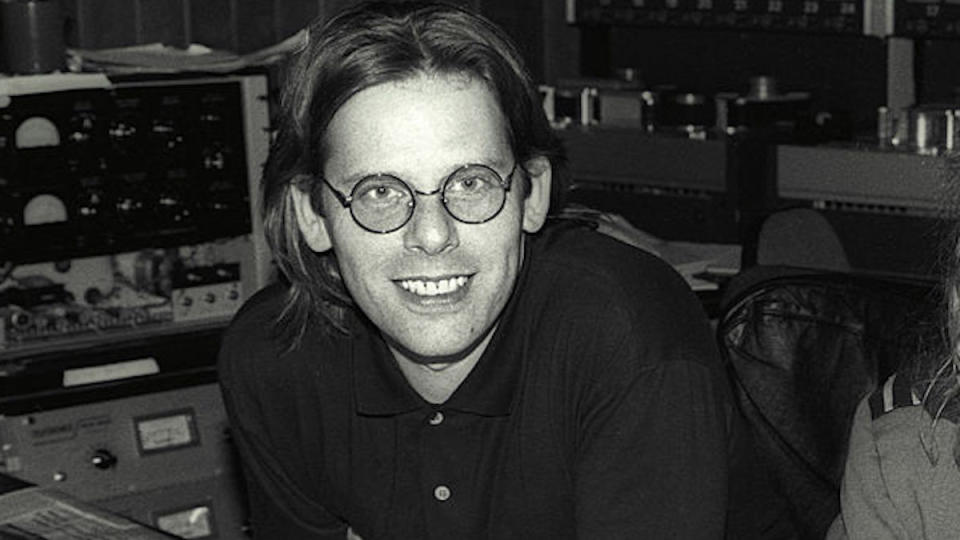
High Padgham
If my pet dog had produced Every Breath You Take, it would have been a hit.
Of the overall recording process, Hugh Padgham told Musictech in 2019.
“You’re trying to keep the peace and asserting your authority on the session, but when you’ve got three guys who have been together night and day for five to six years and have become the biggest band in the world.
“I can’t say it wasn’t stressful. But then making records in any circumstances can be challenging. You have to do what it takes to overcome them and get the record finished.”
But of his own role, Hugh hilariously played it down in Classic Pop.
“I really think if my pet dog had produced Every Breath You Take, it would have been a hit.”
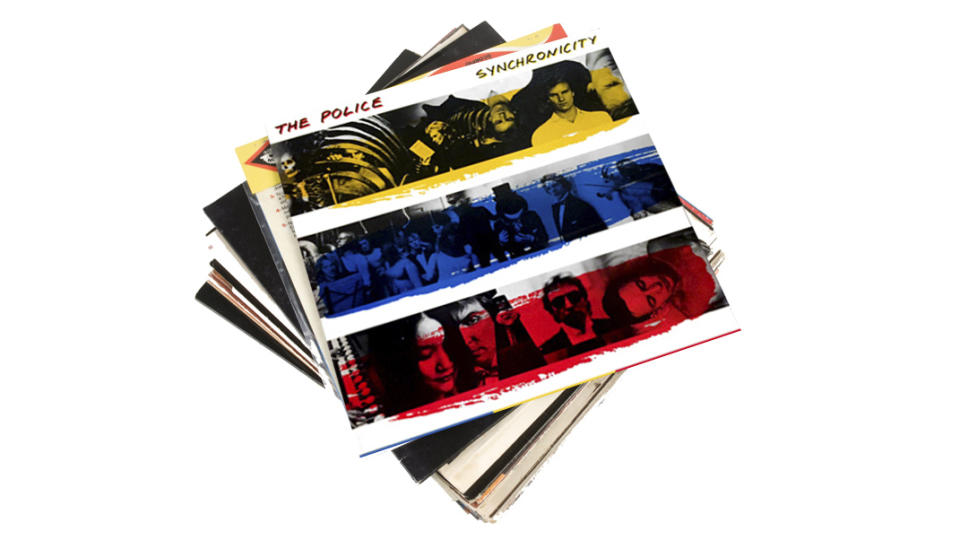
Synchronicity
Every Breath You Take The went in to be a huge hit in the UK and the States where it topped the charts for a record run in 1983 and won two Grammys. Sting also won an Ivor Novello award for it in the same year.
The song famously had a boost with 1997’s I’ll be Missing You by Puff Daddy and Faith Evans, which sampled the original and continued its legacy for a new generation of music lovers. And with this song, the arguments continue to this day over the royalties. In 2018 Copeland told Classic Pop about the Puff version:
“One of our favourite in-band riffs is that, when Puff Daddy sampled Every Breath You Take on I’ll Be Missing You, he sampled Andy’s guitar figure, not the melody or the lyrics. Me and Andy go, ‘Go on Sting, pay Andy his royalties,’ and Sting will say, ‘Okay Andy, here you are. . . ‘ Not reaching anywhere near his wallet.”
Meanwhile Sting said of the original song to the BBC in 2011:
“To me it has this double-edged thing and I think it is pretty powerful. Sometimes I’ll spend months on a song, making it very technical musically, and technical lyrically and I don’t get anywhere. Sometimes the simplest songs are the best. Being simple is not easy though.”
And after winning possibly the biggest accolade for the most radio plays in history in 2019, Sting said:
“All of us who write songs, we know in our hearts that when we write we are already standing on the shoulders of giants, those who came before us. They pass the ball to us, we just happen to be in the right place at the right time, so we run with the ball. Suddenly we find ourselves ahead of the field. It’s only temporary, I know this, but it feels damn good.”
Finally, Sting recently told Australia’s The Project TV show:
“There is something a little off about it [Every Breath], and I think that is its power. I never contradict people about how they interpret the song. It is what it is. I’m just happy that people like it.”
Source link : http://www.bing.com/news/apiclick.aspx?ref=FexRss&aid=&tid=66b0b6223df743bdb626d542d32484ec&url=https%3A%2F%2Fwww.yahoo.com%2Fentertainment%2Fcrap-until-played-fractious-story-090901535.html&c=2504935419918219032&mkt=en-us
Author :
Publish date : 2024-07-26 22:09:00
Copyright for syndicated content belongs to the linked Source.