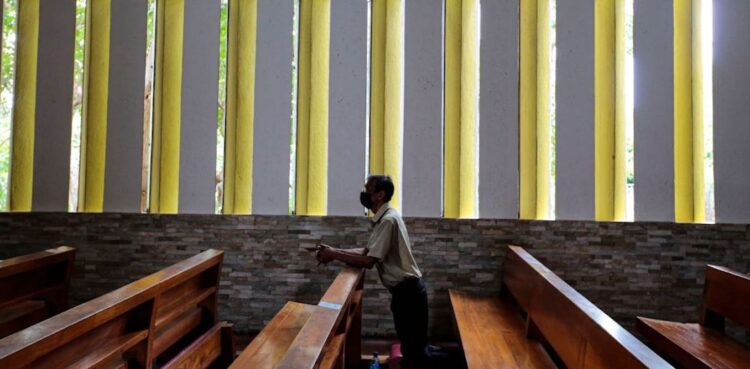
Police officers and riot police block the main entrance of a church building in Matagalpa, Nicaragua, in August 2022 to prevent Bishop Rolando Álvarez from leaving.
STR/AFP via Getty Images
With international pressure mounting, Alvarez and a group of fellow detained Catholic clergy were released in January 2024 and exiled to the Vatican – where the regime had previously expelled the apostolic nuncio, the pope’s top diplomat in Nicaragua. They are among 245 Catholic figures the country has expelled in recent years. An additional 135 people, including Catholics and evangelicals, were expelled and stripped of their citizenship in September 2024.
Today, 43% of Nicaraguan citizens identity as Catholics. But that percentage used to be much higher, and the country has deep cultural roots in Catholicism.
In Nicaragua, as in much of Latin America, the Catholic Church is the most powerful source of social authority and the largest independent institution for public debate. It represents a key channel through which democratic values may take root, grow and thrive – an obstacle, in the regime’s eyes.
For many years, the church was the only organization to escape Ortega’s grip – but no longer.
Dangerous path
I have witnessed firsthand Nicaragua’s shift from a country with promising seeds of democracy to violent autocracy. As civil war raged between the original Sandinista regime and U.S.-backed Contras in the 1980s, I led travel seminars to Nicaragua for faith groups, journalists, congressional aides and university students. I once personally encountered Ortega, serving as translator during a meeting with American journalists when his official translator failed to show up.
Today, as Ortega continues to consolidate power by crushing opposition, Nicaragua has deteriorated into an oppressive state ruled with an iron fist. This reality reflects broader dynamics globally, from autocratic movements in the U.S. and Western Europe to current regimes in Russia, India, Turkey, Hungary and China.
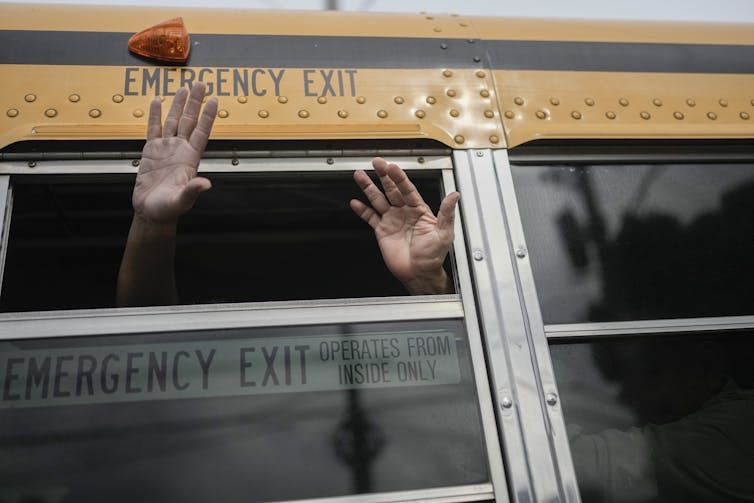
Nicaraguan citizens wave from a bus after being released from a Nicaraguan jail and landing in Guatemala City on Sept. 5, 2024.
AP Photo/Moises Castillo
Closer to home, Ortega poses a regional threat as a model for other potential autocrats. This is especially the case for neighbors like El Salvador, where President Nayib Bukele – the popular, self-described “coolest dictator” – is going down a similar path of turning the nation into an authoritarian state.
I have seen Nicaraguans’ generosity and courage in the long fight for liberty and justice. The closure of democratic spaces, civic institutions and humanitarian organizations, along with the suppression of religious freedom, is a glaring sign that the country is being marched toward more oppression and violence – and, as history shows, risks becoming ripe for revolution.
Only a gradual rebuilding of civil society, I believe, may save Nicaragua from that fate. The tragedy is what Nicaragua could have been: a thriving democratic society, with a commitment to empowering the poor.
Source link : http://www.bing.com/news/apiclick.aspx?ref=FexRss&aid=&tid=66f4044680f84674956e7431540c3134&url=https%3A%2F%2Ftheconversation.com%2Fcontinuing-crackdown-on-churches-and-ngos-moves-nicaragua-further-from-democracy-to-authoritarianism-238178&c=12409258219792304162&mkt=en-us
Author :
Publish date : 2024-09-25 01:27:00
Copyright for syndicated content belongs to the linked Source.