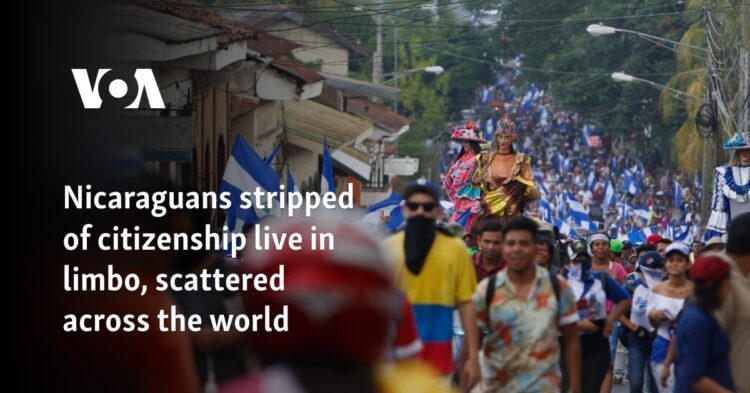
FILE – Exiled Nicaraguans released from a Nicaraguan jail wave from a bus after arriving at the airport in Guatemala City, Sept. 5, 2024.
In February 2023, he was among 222 prisoners loaded onto a flight to the United States with no idea where they were going. While the U.S. government provided Bermudez and others with temporary support, a few days at a hotel, a new phone, $400 and limited access to aid from a group of NGOs, help has since dried up.
Today, Bermudez, who has multiple advanced degrees, works at a Dunkin’ Donuts on the fringes of Salisbury, Maryland, struggling to pick up hours.
He rents a small room, suffers from chronic heart problems and post-traumatic stress disorder, and has no medical care.
“I haven’t bought my medicine, because if I do, I’ll have nothing to eat,” he said.
Back in Nicaragua, his mother had stroke this year. He’s struggled to send money home. With his daughter and wife also back home, he’s plagued with anxiety and depression.
He applied for asylum in February after living in the U.S. under humanitarian parole offered by the Biden administration but said he hasn’t heard back. He’s put all his hopes into building a life in the U.S. and doesn’t know what he’ll do if asylum doesn’t come through.
“I can’t leave, I have my hands tied,” he said. “All I can do is pray that God helps me.”
Lives upended
Like Bermudez, hundreds of thousands have fled Nicaragua. Thousands of civil society organizations have been shuttered, their assets seized as the government seeks to silence any dissent.
While many of the Nicaraguan exiles hope to one day return to their country, 82-year-old Moises Hassan has given up hope as he hides away in a town in the mountains of Costa Rica.
Hassan was once a guerrilla fighter against the Anastasio Somoza dictatorship and then, alongside Ortega, a member of the junta that succeeded it. He built a family and a home with thousands of books, and planned to live out the rest of his days there.
He was elected mayor of the capital, Managua, but saw his life and hopes sour when he began to criticize Ortega’s anti-democratic moves. He fled the country in 2021. While on a trip to visit his daughter he heard the government was detaining critics, and knew they would come for him.
It was no surprise when his name appeared on a list of people who were stripped of their citizenship and home and called traitors.
“The message is … ‘Don’t think that just because you’re out of the country that you’re out of our reach,'” he said.
But he said that with his pension seized along with his belongings, it has been a shock to depend on money from his children.
He and his wife remain in their corner of Costa Rica, too scared to even go to the capital, where they worry Ortega’s agents could track them down.
“I feel like I’m under house arrest,” he said, cradling his worn, now useless Nicaraguan passport. “I’m a prisoner in my own home.”
Source link : http://www.bing.com/news/apiclick.aspx?ref=FexRss&aid=&tid=674c30c2c6e5421cb4e2f026c04b8e96&url=https%3A%2F%2Fwww.voanews.com%2Fa%2Fnicaraguans-stripped-of-citizenship-live-in-limbo-scattered-across-the-world-%2F7881099.html&c=12500966915901221162&mkt=en-us
Author :
Publish date : 2024-11-30 19:30:00
Copyright for syndicated content belongs to the linked Source.