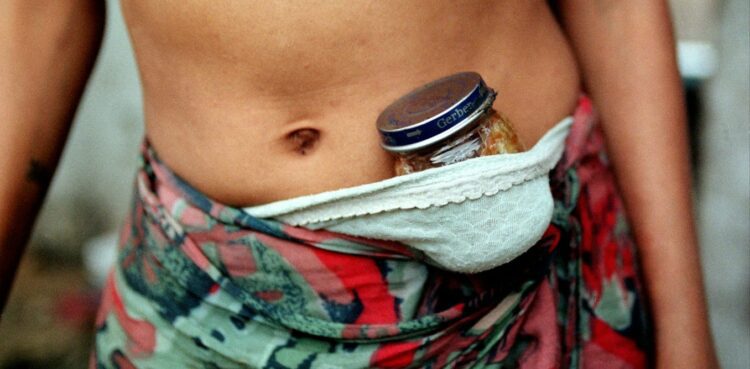
Crack doses ready for sale.
Dennis Rodgers, Fourni par l’auteur
Neither the way nor the reasons why Soraya became involved in trafficking can be described as particularly emancipatory. Rather, they highlight the way in which drug trafficking in fact responds to very gendered and “intimate” logics. On the one hand, Soraya’s status as a young woman made her useful to her cousin’s husband in carrying out certain drug trafficking operations without attracting suspicion in a wider macho Nicaraguan context, but on the other hand, her family ties to “Pac-Man” also made it difficult for her to refuse to help him.
Enduring gendered oppression
Soraya’s involvement in drug trafficking was also profoundly affected by her relationship with Elvis Gomez, with whom she became involved at the age of 15 (when Elvis was 23). Elvis was a failed drug dealer. He had tried unsuccessfully to become involved in drug trafficking several times in the past, and once he was in a relationship with Soraya, he forced her to let him work with her so that he could benefit from the financial windfall that this activity generated for those involved in barrio Luis Fanor Hernández.
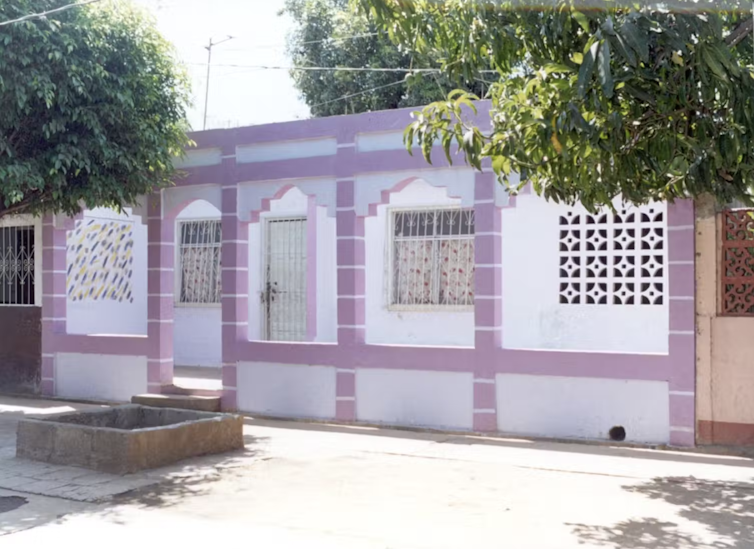
The kind of house a successful drug dealer such as Soraya might have lived in in barrio Luis Fanor Hernández in 2003 (not her real house).
Dennis Rodgers, Fourni par l’auteur
One of the reasons Elvis had failed to establish himself as a drug dealer was that he was a drug user, and Soraya often had to cover for him when he consumed the drugs that “Pac-Man” gave him instead of selling them, repaying his loss of earnings through the profits of her own drug dealing.
In 2010, Elvis used the savings that Soraya had accumulated from her drug dealing to finance his emigration to the United States. He told her he would bring her over later, but he left with another woman, Yulissa, with whom he had been involved simultaneously, along with their daughter. He also took Ramses, the son he had with Soraya in 2007, and cut off all contact with Soraya. She told me poignantly, “I was going crazy, texting him every day, telling him to let me talk to my son, and telling him to bring him back to Nicaragua, that I wanted him to live with me”. He only got back in touch in 2016, to insist that Soraya divorce him and formally transfer legal custody of Ramses to him, which she eventually did, in exchange for being able to be in regular contact with her son.
This episode clearly illustrates how Soraya’s trafficking activities inscribed themselves within wider structures and practices of gender inequality and male domination. Nicaragua remains a country marked by patriarchy and machismo, something that was strikingly reflected in the law banning abortion under all circumstances passed in 2008, or the adoption of law 779 on gender violence in 2012, which defines all such instances as “domestic violence” that must be resolved through mediation rather than the penal system.
In the end, although she was known as la Reina del Sur, this nickname had nothing to do with Soraya having a position of dominance in the drug trade in barrio Luis Fanor Hernández. Indeed, the vast majority of (few) women drug dealers in the neighbourhood were at the bottom of the business pyramid.
Beautician
Soraya says she stopped selling drugs in 2012, and that she is now a full-time beautician. Several current drug dealers in barrio Luis Fanor Hernández have, however, told me that she continues to deal and that her manicure business provides a convenient cover.
The fact that Soraya earns no more than 15 to 20 dollars a week from her manicure business could clearly be interpreted as suggesting that this might be the case. Soraya firmly denies it, however, and I believe her. Not only does she take on various odd jobs to make ends meet for herself and her ageing mother, she also lives in very humble conditions. Her current home, in particular, is much less flamboyant than any of those in which she lived in the past.
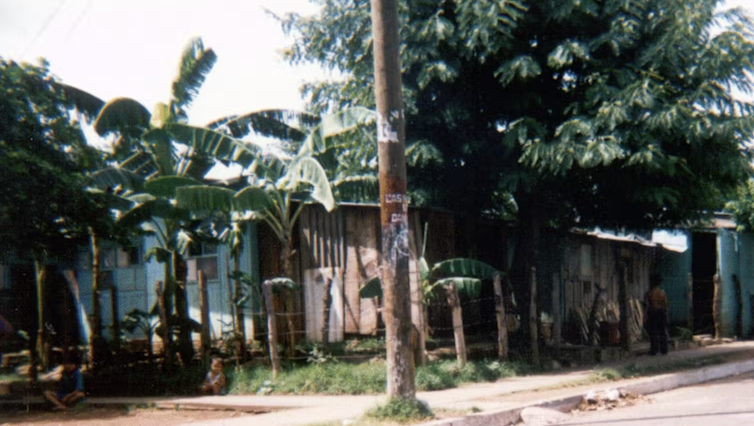
The type of house that Soraya lives in today (not her real house).
Dennis Rodgers, Fourni par l’auteur
When compared to the trajectories of male traffickers in the barrio – many of whom have greatly benefited, and continue to benefit, from their involvement in trafficking even after they have stopped dealing – it can be argued that Soraya’s involvement in drug trafficking has enhanced patriarchal and macho constraints, contributing to her current situation.
At the same time, while Soraya’s life has unquestionably been marked by a constant struggle in the face of different forms of domination and oppression, she also frequently and persistently seeks to confront and challenge her predicament. This is perhaps partly linked to her involvement in the drug trade, as the WhatsApp exchange I had with Soraya on 8 March 2021 clearly suggested. She had uploaded a picture of herself drinking at a nightclub, overlaying it with the following text:
“Today is International Women’s Day, and we celebrate the power of independent and autonomous women! We are beautiful, we are strong, and we can do whatever we want!”.
I wrote to Soraya to wish her a happy International Women’s Day, and also to tell her that I’d started to write her biography “about when she was la Reina del Sur”. A few minutes later she replied – “por siempre La Reina!” (“forever the Queen!”).
Source link : http://www.bing.com/news/apiclick.aspx?ref=FexRss&aid=&tid=670d2805994249d69db8d34486077891&url=https%3A%2F%2Ftheconversation.com%2Fgangsstories-soraya-the-real-queen-of-the-south-in-nicaragua-233837&c=2055893443332323945&mkt=en-us
Author :
Publish date : 2024-10-14 02:56:00
Copyright for syndicated content belongs to the linked Source.