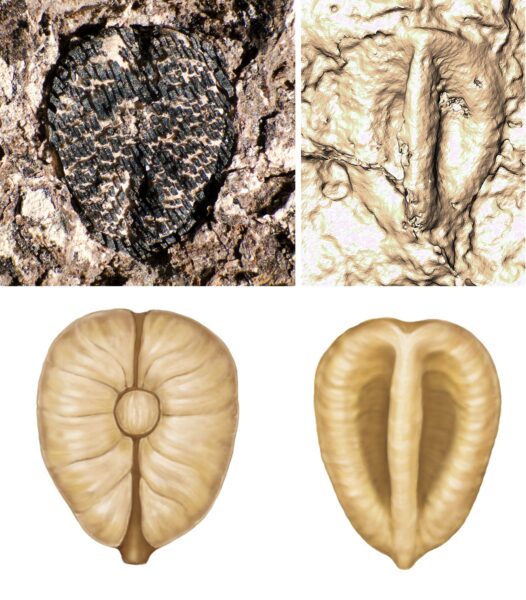
Lithouva — the earliest fossil grape from the Western Hemisphere, ~60 million years old from Colombia. Top figure shows fossil accompanied with CT scan reconstruction. Bottom shows artist reconstruction. Credit: Photos by Fabiany Herrera, art by Pollyanna von Knorring
Grape fossils in South America show evolution and resilience post-dinosaurs, aiding understanding of current biodiversity shifts.
Researchers have discovered fossil grape seeds that range from 60 to 19 million years old in Colombia, Panama, and Peru. One of these species represents the earliest known example of plants from the grape family in the Western Hemisphere. This discovery, recently described in the journal Nature Plants, shows how the grape family spread in the years following the death of the dinosaurs.
“These are the oldest grapes ever found in this part of the world, and they’re a few million years younger than the oldest ones ever found on the other side of the planet,” says lead author Fabiany Herrera, an assistant curator of paleobotany at the Field Museum in Chicago’s Negaunee Integrative Research Center. “This discovery is important because it shows that after the extinction of the dinosaurs, grapes really started to spread across the world.”
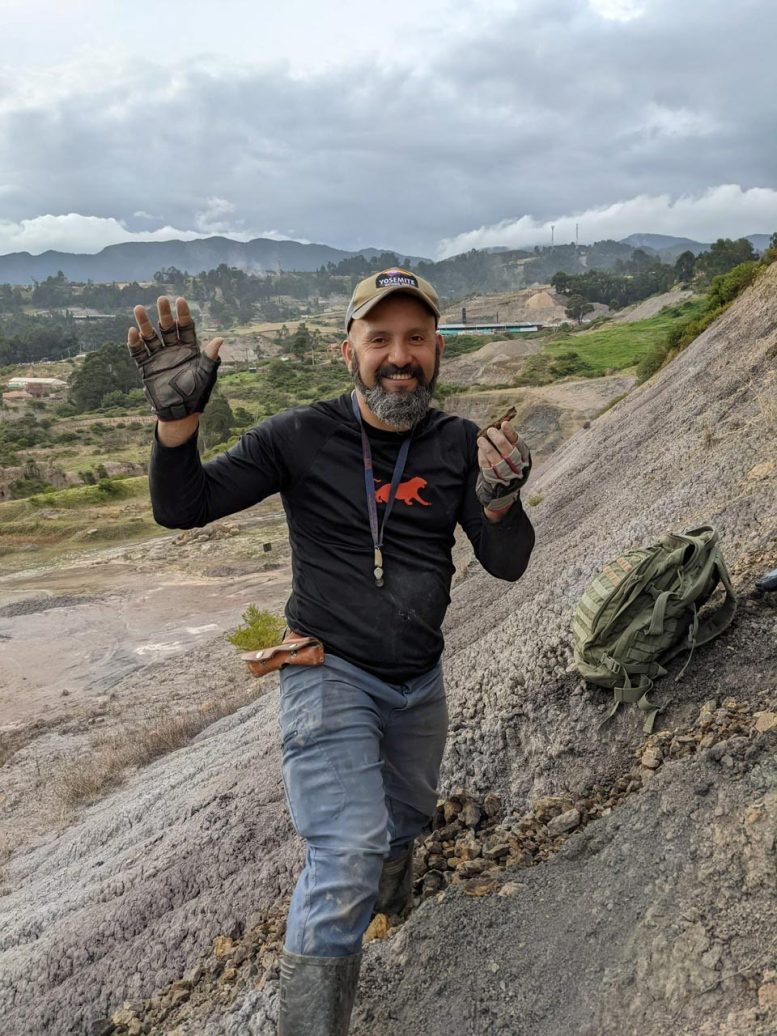
Lead author Fabiany Herrera holding a fossil of the oldest grape ever found in the Western Hemisphere. Credit: Fabiany Herrera
Impact of Dinosaur Extinction on Plant Life
Since it is rare for soft tissues like fruits to be preserved as fossils, scientists’ understanding of ancient fruits often comes from the seeds, which are more likely to fossilize. The earliest known grape seed fossils were found in India and are 66 million years old. It’s not a coincidence that grapes appeared in the fossil record 66 million years ago–that’s around when a huge asteroid hit the Earth, triggering a massive extinction that altered the course of life on the planet. “We always think about the animals, the dinosaurs, because they were the biggest things to be affected, but the extinction event had a huge impact on plants too,” says Herrera. “The forest reset itself, in a way that changed the composition of the plants.”
The researchers hypothesize that the disappearance of the dinosaurs might have helped alter the forests. “Large animals, such as dinosaurs, are known to alter their surrounding ecosystems. We think that if there were large dinosaurs roaming through the forest, they were likely knocking down trees, effectively maintaining forests more open than they are today,” says Mónica Carvalho, a co-author of the paper and assistant curator at the University of Michigan’s Museum of Paleontology. But without large dinosaurs to prune them, some tropical forests, including those in South America, became more crowded, with layers of trees forming an understory and a canopy.
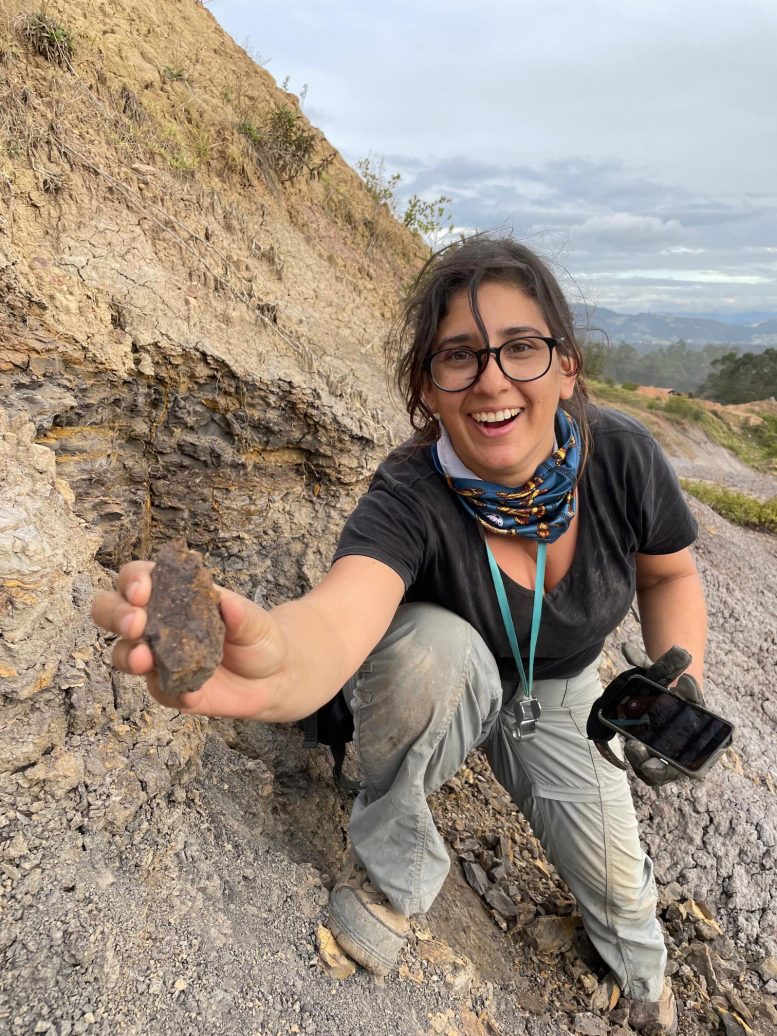
Mónica Carvalho, a co-author of the paper, holding the fossil of the oldest grape seed found in the Western Hemisphere. Credit: Fabiany Herrera
The Rise of Grapevines in Dense Forests
These new, dense forests provided an opportunity. “In the fossil record, we start to see more plants that use vines to climb up trees, like grapes, around this time,” says Herrera. The diversification of birds and mammals in the years following the mass extinction may have also aided grapes by spreading their seeds.
In 2013, Herrera’s PhD advisor and senior author of the new paper, Steven Manchester, published a paper describing the oldest known grape seed fossil, from India. While no fossil grapes had ever been found in South America, Herrera suspected that they might be there too.
Uncovering Grape Fossils in South America
“Grapes have an extensive fossil record that starts about 50 million years ago, so I wanted to discover one in South America, but it was like looking for a needle in a haystack,” says Herrera. “I’ve been looking for the oldest grape in the Western Hemisphere since I was an undergrad student.”
But in 2022, Herrera and his co-author Mónica Carvalho were conducting fieldwork in the Colombian Andes when a fossil caught Carvalho’s eye. “She looked at me and said, ‘Fabiany, a grape!’ And then I looked at it, I was like, ‘Oh my God.’ It was so exciting,” recalls Herrera. The fossil was in a 60-million-year-old rock, making it not only the first South American grape fossil, but among the world’s oldest grape fossils as well.
The fossil seed itself is tiny, but Herrera and Carvalho were able to identify it based on its particular shape, size, and other morphological features. Back in the lab, they conducted CT scans showing its internal structure that confirmed its identity. The team named the fossil Lithouva susmanii, “Susman’s stone grape,” in honor of Arthur T. Susman, a supporter of South American paleobotany at the Field Museum. “This new species is also important because it supports a South American origin of the group in which the common grape vine Vitis evolved,” says co-author Gregory Stull of the National Museum of Natural History.
The team conducted further fieldwork in South and Central America, and in the Nature Plants paper, Herrera and his co-authors ultimately described nine new species of fossil grapes from Colombia, Panama, and Perú, spanning from 60 to 19 million years old. These fossilized seeds not only tell the story of grapes’ spread across the Western Hemisphere, but also of the many extinctions and dispersals the grape family has undergone. The fossils are only distant relatives of the grapes native to the Western Hemisphere and a few, like the two species of Leea are only found in the Eastern Hemisphere today. Their places within the grape family tree indicate that their evolutionary journey has been a tumultuous one. “The fossil record tells us that grapes are a very resilient order. They’re a group that has suffered a lot of extinction in the Central and South American region, but they also managed to adapt and survive in other parts of the world,” says Herrera.
Given the mass extinction our planet is currently facing, Herrera says that studies like this one are valuable because they reveal patterns about how biodiversity crises play out. “But the other thing I like about these fossils is that these little tiny, humble seeds can tell us so much about the evolution of the forest,” says Herrera.
Reference: “Cenozoic seeds of Vitaceae reveal a deep history of extinction and dispersal in the Neotropics” by Fabiany Herrera, Mónica R. Carvalho, Gregory W. Stull, Carlos Jaramillo and Steven R. Manchester, 31 June 2024, Nature Plants.
DOI: 10.1038/s41477-024-01717-9
Source link : http://www.bing.com/news/apiclick.aspx?ref=FexRss&aid=&tid=66b80ce2830c4e738cef7c852c466c67&url=https%3A%2F%2Fscitechdaily.com%2Fthe-oldest-grapes-in-the-americas-discovery-of-60-million-year-old-seeds-unveils-ancient-plant-secrets%2F&c=8985924392407134487&mkt=en-us
Author :
Publish date : 2024-08-10 13:25:00
Copyright for syndicated content belongs to the linked Source.