The Panama Canal with the Centennial Bridge in the background. The pandemic has taken a toll on trade in Central America. (photo: Lokibaho by Getty Images)
When it Rains it Pours: Pandemic and Natural Disasters Challenge Central America’s Economies
By Patricia Alonso-Gamo, Manuela Goretti, and Inci Otker
IMF, Western Hemisphere Department
December 17, 2020
COVID-19 has not spared Central America. Confirmed cases have multiplied to
well over 600,000 in November, with the death toll exceeding 14,000.
Countries have taken prompt containment measures, with the strictest
enforced in the Northern Triangle of El Salvador, Guatemala, and Honduras,
amid inadequate testing and tracing capacities and limited access to basic
health services.
Insufficient hospital capacity and protective equipment,
elevated poverty, and, in some cases, densely populated cities have
worsened the human toll. Low levels of testing and weak reporting in some
countries suggest the situation might be even worse than official
statistics.
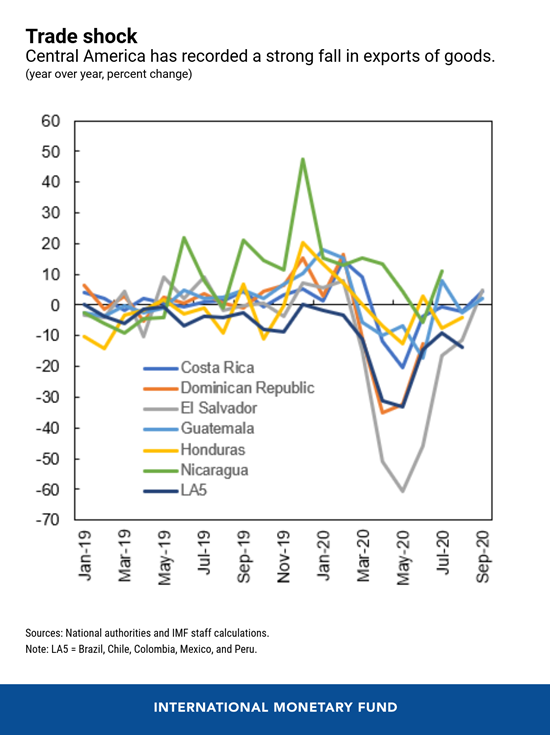
The economic toll has been heavy as well. The trade shock has been particularly strong in El Salvador, Nicaragua, and Panama (via a severe
drop in revenues from lower traffic in the Canal).
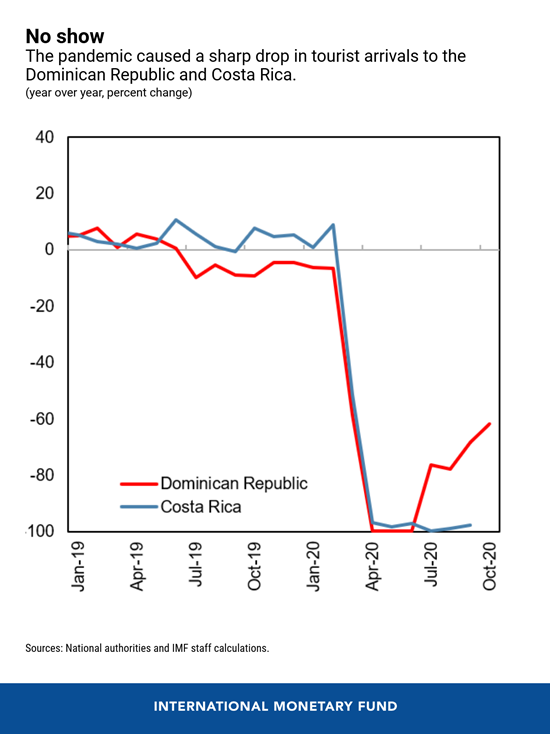
 Tourist arrivals dropped sharply in Costa Rica and the Dominican Republic,
where tourism receipts made up 6–10 percent of GDP before the pandemic.
On average, lockdowns have contributed about 70 percent to the slowdown,
especially in Panama, El Salvador, and the Dominican Republic, reflecting
the combination of stringent containment measures and a higher share of
contact-intensive sectors.
Hurricane season
Multiple natural disasters added to the economic destruction and increased
the risk of worsening the pandemic: two tropical storms in June in El
Salvador; a severe drought in Honduras; and two recent back-to-back
category 4 hurricanes that hit Nicaragua, Guatemala, and Honduras
particularly hard.
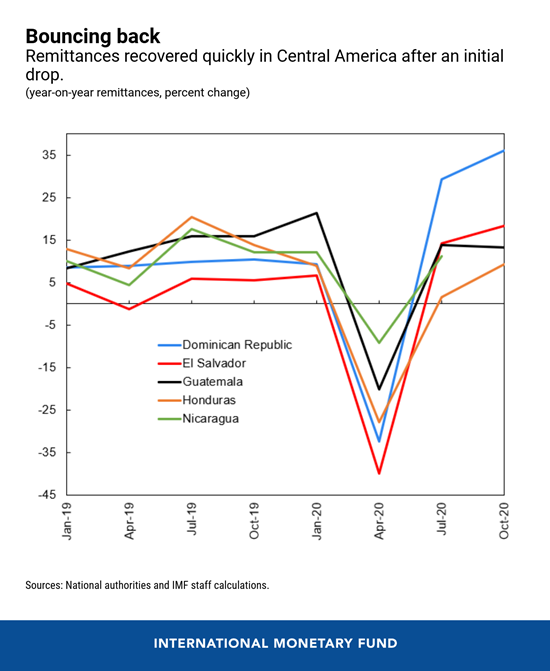
Several factors have helped mitigate the double health and climate shocks,
in particular a solid agricultural performance and, since May, a strong
rebound of remittances, on which most Central American countries depend
heavily. Lower oil prices benefitted the region, a net importer. Medical
equipment exports have partly offset the tourism downfall in Costa Rica.
Nonetheless, with tourism and trade unlikely to return to pre-pandemic
levels soon, real GDP is projected to contract sharply in 2020, by nearly 6
percent, ranging from -2 percent in Guatemala to -9 percent in El Salvador
and Panama. The speed of the recovery will depend on countries’ exposure to
the world economy; the stringency of containment measures as infections
continue to rise; the availability of vaccines; and their ability to
sustain supportive policies. The economic impact of the recent
natural disasters, still being assessed, might further lower these
estimates.
More with less
Extensive fiscal and monetary support have helped mitigate the economic and
social impact. Most countries increased spending, extending subsidies and
transfers to reach the informal sector that accounts for up to 60 percent
of employment in some countries (for instance, in Guatemala and Honduras).
Countries granted temporary tax relief to key economic sectors, and
provided liquidity support and credit relief through rate cuts, lending
facilities, credit guarantees, and regulatory forbearance.
The fiscal cost of these measures has been significant, squeezing
countries’ already strained finances and causing public debt to swell. But
targeted support will need to continue, to resolve the health emergency,
support the nascent recovery, and prevent that already elevated levels of
poverty, inequality, and unemployment rise even more.
Emergency financial assistance from the IMF and other multilateral
institutions has provided temporary relief, and most countries issued debt
in international markets. But financing needs remain large, averaging 9
percent of GDP over the next three years, amid tight financing conditions.
A few countries have already approached the IMF for additional support,
which could catalyze financing and anchor their adjustment programs
The road ahead
Looking ahead, fiscal consolidation will be necessary to rebuild countries’
financial health, and a broad political and social dialogue will be
critical to build support for gradual, transparent, and sustainable
medium-term plans. Spending should be reprioritized toward adequate,
well-targeted social safety nets to protect the vulnerable, and efficient
public investment in health, education, infrastructure, and technology to
narrow the existing skills and infrastructure gaps and enhance resilience
to future shocks.
Ambitious structural reforms will need to complement macro-policy actions
to boost competitiveness and increase growth potential, reduce inequality
and informality, support a strong and green recovery, and build resilience
to climate shocks. Regional authorities are already moving in this
direction, preparing a reconstruction plan that prioritizes financing to
projects that adapt and respond to climate change effects.
The financial system will require attention, as widespread job losses and
business closures will likely weigh on banks’ health. Supervisory
authorities will need to support flexible use of capital and liquidity
buffers consistent with international standards, while closely monitoring
financial stability risks and preparing to unwind the support measures when
warranted.
As it recovers from the health emergency, the region will face multiple
challenges on the way to an inclusive and sustainable economic recovery. It
will require careful phasing out of emergency policies to reduce debt
sustainability risks, while protecting the nascent recovery and the social
fabric. Access to additional multilateral loans and market financing will
be needed to meet sizable medium-term financing needs.
This article draws on joint work by the IMF’s country teams working on
Central America, Panama, and the Dominican Republic.
Source link : https://www.imf.org/en/News/Articles/2020/12/15/na121720when-it-rains-it-pours-pandemic-and-natural-disasters-challenge-central-americas-economies
Author :
Publish date : 2020-12-17 03:00:00
Copyright for syndicated content belongs to the linked Source.